Temperature20 – 26 °C
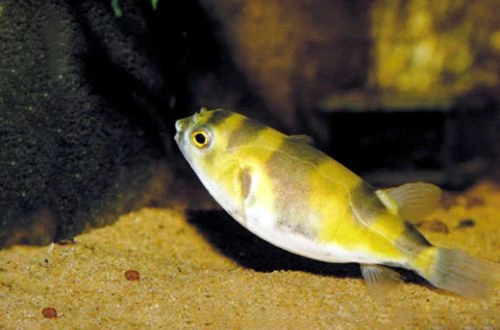
The Zebra Pufferfish, also known as the Parrot Pufferfish (scientific name Colomesus psittacus), belongs to the family Tetraodontidae. A distinctive feature of this fish is its ability to inflate itself when danger arises. It is important to note that this species does not exhibit friendliness towards other aquarium inhabitants, so it is recommended to keep it in isolation. Due to its specific behavior and potential difficulties with acclimatization, this fish is not suitable for beginner aquarists.
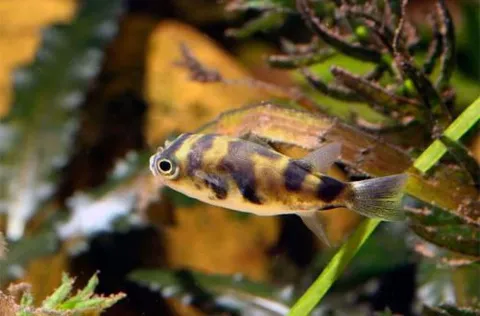
Adults can reach a length of up to 29 cm, although the size may vary to a lesser extent depending on the region of origin. Sexual dimorphism is weakly expressed in this species, and there are no obvious differences between males and females. The body shape of the Zebra Pufferfish is characteristic of the family: somewhat "ungainly," with small fins and large eyes. When threatened, the fish inflates into a spherical shape, with its small spines protruding. The coloration is usually yellowish, with rows of black stripes on the body and a white belly.
The natural range of the species is the western Atlantic along the northern coast of South America: from the Gulf of Paria (Venezuela and Trinidad) to the mouth of the Amazon in Brazil, including Guyana, Suriname and French Guiana. Previously, there was a misconception about its presence in the waters of the Indian Ocean, and this inaccuracy sometimes still persists. The zebra pufferfish is found in brackish waters: in river estuaries, mangrove swamps, estuaries, and shallow lagoons.
When young, these fish gather in schools for greater safety; however, over time, they transition to a solitary lifestyle. The zebra pufferfish exhibits pronounced aggression towards both its conspecifics and other fish species, necessitating its keeping in an isolated aquarium. Co-habitation with other brackish water species is only possible in very large aquariums, exceeding 1000 liters.
For comfortable keeping of a single zebra pufferfish, an aquarium of at least 648 liters is required. The decor can be relatively simple: it is recommended to use driftwood to simulate mangrove thickets, as well as a soft substrate, rounded stones, and rock formations. The presence of aquatic vegetation is not mandatory. The water should be brackish, with a salt concentration of about 10 grams per 1 liter. It is extremely important to prevent the accumulation of organic waste, which is very likely with a carnivorous diet. Therefore, the aquarium must be equipped with a powerful filtration system. Regular maintenance includes weekly water changes of 30–50% of the volume with fresh water, as well as cleaning the substrate and decorative elements.
As a carnivorous species, in its natural environment, the zebra pufferfish feeds on mollusks and crustaceans. In a home aquarium, it should be offered similar foods, both live and frozen. Hard components, such as those containing shells, must be present in its diet. A unique feature of pufferfish is the two plates forming the mouth apparatus, known as “teeth.” These “teeth” grow throughout the fish's life and are worn down during feeding. Neglecting this aspect and feeding only soft food can lead to serious health problems.
Aquarium breeding is not documented. The species is bound to brackish coastal waters — the estuaries of the Amazon and Orinoco — and reproduces there. It is not a popular aquarium subject, and no work on its propagation has been published.
In artificial aquarium conditions, this species does not breed, and most individuals are sourced from the wild. When placed in a new aquarium, acclimatization difficulties may arise, so it is highly recommended to provide water parameters identical to those in which the fish was kept before acquisition. Failure to comply with this condition significantly increases the risk of skin diseases. Another potential problem, as mentioned earlier, is the “teeth,” which can grow to such an extent that they interfere with feeding. Under favorable conditions, health problems usually do not occur.
When purchasing a zebra pufferfish, select active individuals with clean fins and no visible body damage. It is important to ensure that the fish shows interest in food and has no signs of emaciation, as pufferfish often suffer from insufficient nutrition in commercial aquariums. Due to the rarity of the species in retail and possible adaptation difficulties, it is recommended to purchase specimens from trusted suppliers or specialized aquarium clubs.
The essentials: size, tank volume, water parameters and care
An adult reaches 29 cm in length. Plan the tank around the maximum size: the fish quickly outgrows a cramped setup.
The recommended volume is 648 L. A smaller tank speeds up nitrate build-up and raises stress levels.
Temperature 20–26 °C, pH 7–9, hardness 10–26 dGH. Stability matters more than exact values: sudden swings are harder on the fish than a small deviation from the ideal.
Around 10 years when kept properly. Lifespan depends directly on tank volume, water quality and a varied diet.
Temperament: aggressive / incompatible / unfriendly. Keep this in mind when choosing tank mates.
Recommended setup: solitary. Ignoring this is a common cause of stress and disease.
Diet type: meat / protein (live, frozen, fresh). Feed small portions that are finished within a couple of minutes — overfeeding does more harm than underfeeding.
The scientific name of the species is Colomesus psittacus, family Pufferfish (Tetraodontidae). It also appears in the literature as: Tetrodon psittacus.
The water suits 114 of 208 plants in the catalogue — the easiest ones are shown first.
African Onion PlantAfzelius's AnubiasAmazon FrogbitAmazon SwordAnacharisAnubiasArrowhead CryptDwarf CloverDwarf CloverDwarf HygrophilaDwarf SagittariaDwarf ValGuppy GrassHornwortJava MossMoneywortMud SwordNair's LagenandraNarrow Leaf AnacharisNarrow-leaf CloverStringy MossTaiwan MossTape GrassUssuri Watermilfoil
Matched by family, categories and overlapping keeping conditions
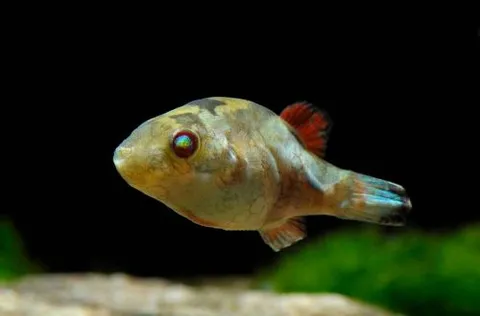
Carinotetraodon lorteti
Lortet's Puffer, scientifically known as Carinotetraodon lorteti, belongs to the family Tetraodontidae. It is believed to be named after the French zoologist Louis Charles Émile Lortet, who lived from 1836 to 1909.
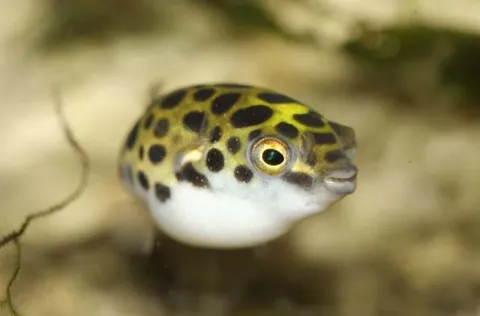
Dichotomyctere nigroviridis
Dichotomyctere nigroviridis, known as the spotted green pufferfish, belongs to the family Tetraodontidae. These fish are called "puffers" due to their unique ability to inflate themselves with water when feeling…
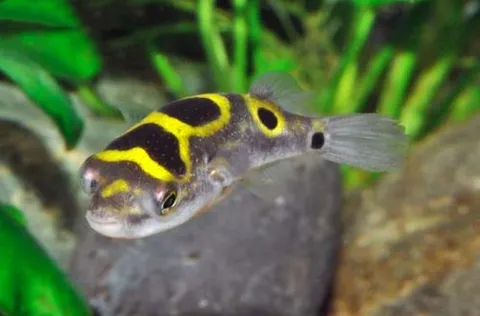
Dichotomyctere ocellatus
The Figure Eight Puffer, scientifically known as Dichotomyctere ocellatus, belongs to the family Tetraodontidae. These fish have earned a reputation as charming creatures due to their large, expressive eyes and…
Colomesus asellus
Colomesus asellus, known in the aquarium hobby as the Amazon puffer, Amazonian puffer, or donkey puffer, belongs to the family Tetraodontidae. A distinctive feature of this fish is its unique defense mechanism: when…