Temperature24 – 28 °C
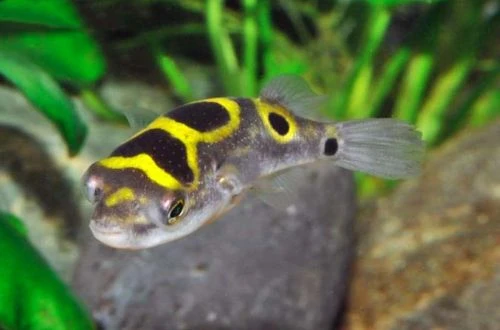
The Figure Eight Puffer, scientifically known as Dichotomyctere ocellatus, belongs to the family Tetraodontidae. These fish have earned a reputation as charming creatures due to their large, expressive eyes and generally friendly demeanor. Experienced aquarists find them easy to care for, but they are not recommended for beginners due to their specific diet and the need to maintain a brackish aquarium environment.
A distinctive feature of this group of fish is their ability to inflate themselves into a ball covered with many spines when they feel threatened. In their normal state, the fish's body is pear-shaped, and the fins are quite short. The coloration consists of a combination of white, brown, and yellow hues. The latter form a pattern on the back resembling the number eight, which gave this species its name.
The natural habitat of this fish is Southeast Asia. In the wild, Dichotomyctere ocellatus is found in the lower reaches of the Mekong River, which flows through Cambodia, as well as in the river systems of peninsular Malaysia and Borneo. In addition, it inhabits brackish coastal waters. It prefers areas abundant in shelters, such as mangrove thickets.
This fish species typically exhibits a peaceful and friendly disposition. It can successfully coexist with many other species of comparable size, provided they are able to live in brackish conditions. Examples of such tank mates include various livebearers, such as platies and mollies. However, it is advisable to avoid keeping this pufferfish with overly active, and especially aggressive or territorial, fish species.
It is important to note that this species is not freshwater. Although the pufferfish can temporarily adapt to fresh water, for its full and long-term maintenance, it is necessary to create a brackish environment with a salt concentration of about 5–8 grams per liter. The minimum aquarium volume for one figure-eight pufferfish starts from 50–60 liters. When setting up the aquarium, multiple shelters should be provided, for example, using driftwood, caves, or grottoes formed from piles of stones. These fish are very sensitive to nitrites and nitrates — products of the nitrogen cycle, which are especially dangerous in brackish water. Thus, the uninterrupted operation of the filtration system and regular scheduled aquarium maintenance become crucial. Care procedures must be performed very carefully so as not to startle the fish. If it gets scared and inflates, taking on a “ball” shape, there is a significant chance that other aquarium inhabitants may accidentally be harmed.
In the natural habitat of this fish, the diet consists mainly of benthic invertebrates: mussels, snails, oysters, as well as small crabs and other crustaceans. To successfully cope with such hard prey, pufferfish have a specific “beak” capable of crushing strong shells. This “beak” continuously grows throughout the fish's life, compensating for natural wear. Therefore, when kept in a home aquarium, it is important to provide appropriate nutrition. Fresh or frozen shrimp, as well as various types of snails, will be an excellent choice.
Breeding in captivity is considered extremely difficult and rare. Information about the process is limited, as successful cases are isolated. It is known that these fish are substrate spawners: eggs are laid on flat surfaces, such as stones or decorative elements. The male cares for the offspring, guarding the clutch and fanning it until the larvae hatch. Spawning stimulation in home aquariums is practically unstudied, and sexual dimorphism is weakly expressed, making pair selection difficult.
The species is highly sensitive to water quality and the accumulation of nitrogenous compounds such as ammonia, nitrites, and nitrates. Poor keeping conditions quickly lead to a weakened immune system and the development of secondary bacterial infections. Pufferfish are susceptible to parasitic infections, including skin and gill flukes, as well as nematodes, which can affect internal organs. Prevention involves maintaining cleanliness, regular water changes, providing a proper diet, and mandatory quarantine for new specimens.
When choosing a fish, pay attention to its activity and plumpness. A healthy specimen should show curiosity, have clear eyes without cloudiness, and a firm body without signs of emaciation or a sunken belly. Avoid fish that constantly lie on the bottom, appear lethargic, or have damaged fins or skin. Since the species is often sourced from the wild, it is important to ensure the absence of external parasites and signs of stress, and to ask the seller if the fish accepts offered foods.
The essentials: size, tank volume, water parameters and care
An adult reaches 8 cm in length. Plan the tank around the maximum size: the fish quickly outgrows a cramped setup.
The recommended volume is 60 L. A smaller tank speeds up nitrate build-up and raises stress levels.
Temperature 24–28 °C, pH 7–8.3, hardness 10–15 dGH. Stability matters more than exact values: sudden swings are harder on the fish than a small deviation from the ideal.
Around 10 years when kept properly. Lifespan depends directly on tank volume, water quality and a varied diet.
Temperament: peaceful (regular). Keep this in mind when choosing tank mates.
Recommended setup: both solitary and in group (flexible). Ignoring this is a common cause of stress and disease.
Diet type: meat / protein (live, frozen, fresh). Feed small portions that are finished within a couple of minutes — overfeeding does more harm than underfeeding.
The scientific name of the species is Dichotomyctere ocellatus, family Pufferfish (Tetraodontidae). It also appears in the literature as: Chelonodon biocellatus, Chelonodon ocellata, Crayracion fluviatilis.
The water suits 113 of 208 plants in the catalogue — the easiest ones are shown first.
African Onion PlantAfzelius's AnubiasAmazon FrogbitAmazon SwordAnacharisAnubiasArrowhead CryptDwarf CloverDwarf CloverDwarf HygrophilaDwarf SagittariaDwarf ValGuppy GrassHornwortJava MossMoneywortMud SwordNair's LagenandraNarrow Leaf AnacharisNarrow-leaf CloverStringy MossTaiwan MossTape GrassUssuri Watermilfoil
Matched by family, categories and overlapping keeping conditions
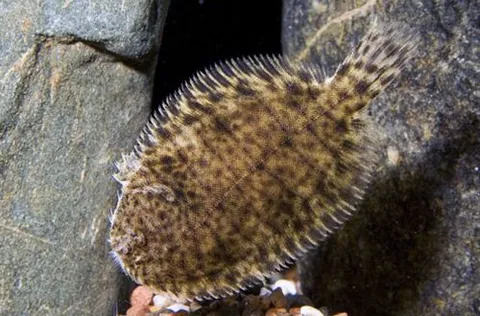
Brachirus panoides
Brachirus panoides, or the freshwater flounder, belongs to the family Soleidae. This species stands out with its unique appearance, which is hard to confuse with others. Although caring for this fish is considered…
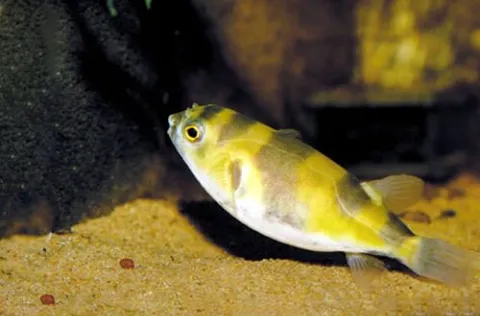
Colomesus psittacus
The Zebra Pufferfish, also known as the Parrot Pufferfish (scientific name Colomesus psittacus), belongs to the family Tetraodontidae. A distinctive feature of this fish is its ability to inflate itself when danger…
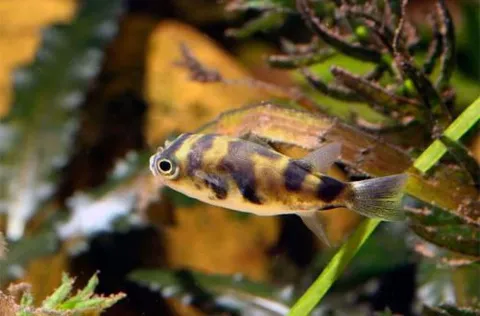
Colomesus asellus
Colomesus asellus, known in the aquarium hobby as the Amazon puffer, Amazonian puffer, or donkey puffer, belongs to the family Tetraodontidae. A distinctive feature of this fish is its unique defense mechanism: when…
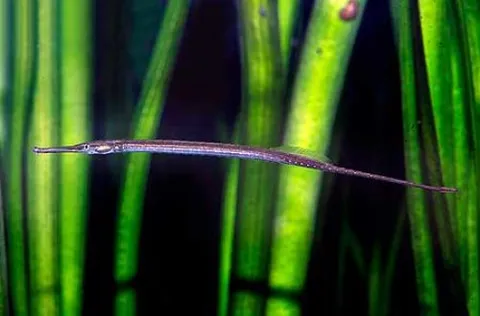
Microphis lineatus
Microphis lineatus, known as the Banded Pipefish, belongs to the family Syngnathidae. This species inhabits the coastal tropical waters of the American continent. It can be found in fresh, brackish, and marine waters…