Temperature20 – 28 °C
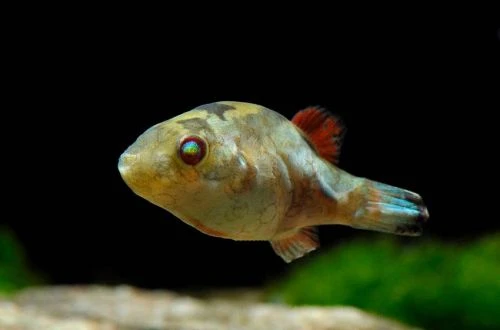
Lortet's Puffer, scientifically known as Carinotetraodon lorteti, belongs to the family Tetraodontidae. It is believed to be named after the French zoologist Louis Charles Émile Lortet, who lived from 1836 to 1909.
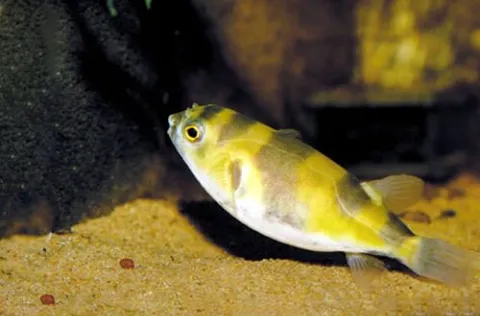
Adults of this fish reach a length of about 6 cm. Its body is dense, oval-shaped, and relatively large. Despite its slow swimming, the fish demonstrates excellent maneuverability thanks to its well-developed, albeit short, fins, which are shifted closer to the tail. Males are uniformly colored, predominantly in dark gray and olive hues, and their dorsal fin is bright red. Females are lighter, with a yellowish coloration and a distinct reticulated pattern. Their red eyes are a distinctive feature, due to which this species is classified into the “Red-Eyed Puffer” group along with the Red-Eyed and Bornean puffers.
This fish is native to Southeast Asia, where it is found in the lower Mekong River basin, covering the territories of Thailand, Vietnam, and Cambodia. It prefers slow-moving or stagnant waters, inhabiting shaded forest streams, small tributaries, and river floodplains. The bottom here is usually covered with fallen leaves, branches, and various snags, while dense thickets of aquatic vegetation are most often located along the banks.
This is a small but rather temperamental fish species. In the confined space of an aquarium, Lortet's Puffer can exhibit aggression and territorial behavior towards both its conspecifics and other inhabitants. It is particularly noteworthy that this fish tends to nip at the fins of its tankmates, making it potentially dangerous.
For the comfortable existence of a single fish, an aquarium of at least 50 liters is required. It is important to provide rich decor using snags and dense thickets of plants, including floating ones. A layer of fallen leaves from various trees can also be created on the bottom. For long-term keeping, maintaining stable water parameters and preventing excessive accumulation of organic matter becomes crucial. Water movement in the aquarium should be minimized, as Lortet's Puffer tolerates strong internal currents poorly. These fish lack typical teeth; instead, their jawbone is transformed into four fused, serrated structures that constantly grow. In their natural environment, they wear down due to consuming hard food such as crustacean shells and snail shells. Therefore, in aquarium conditions, an appropriate diet must be provided. The diet can consist of snails, unshelled shrimp, chopped mollusks, as well as live or frozen artemia, bloodworms, and daphnia. Dry foods are acceptable as a supplement but should not be the main food. When choosing dry products, preference should be given to granulated, tablet, or other hard forms.
Unlike many fish, Lortet's Puffer does not have full-fledged teeth. Their function is performed by four fused, paired, serrated structures formed from the jawbone. These formations constantly grow, and in natural conditions, they are naturally worn down when consuming hard food such as crustacean shells and snail shells. This is why it is extremely important to provide these fish with appropriate food. The diet can include snails, unshelled shrimp, chopped mollusks, as well as live or frozen artemia, bloodworms, and daphnia. Dry foods can only be used as a supplementary element to the main menu. When choosing commercial foods, it is recommended to give preference to those that come in the form of granules, tablets, or other hard forms.
Breeding in an aquarium is possible but is associated with difficulties due to high intraspecific aggression and demanding water quality. Spawning is paired, stimulated by imitating natural conditions and abundant feeding. The eggs are laid on fine-leaved plants or moss, after which the male takes on the protection of the clutch and care for the eggs, actively fanning them with his fins. Larvae that appear after 36–72 hours must be separated from the parents, as adult individuals may eat them. Rearing the fry is difficult: in the first days, they require the smallest live food, such as infusoria, as artemia nauplii may be too large for them.
The species is sensitive to water quality and tolerates the accumulation of nitrogenous compounds very poorly. Under stress, poor keeping conditions, or improper nutrition, fish are susceptible to parasitic infections, such as ich, as well as invasions by protozoa and helminths, often brought from nature. The main symptoms are refusal to eat, emaciation, lethargy, the appearance of white spots or patches on the body, and fin damage. Prevention includes maintaining stable water parameters, regular water changes, and strict quarantine for new individuals.
When purchasing, choose active fish with clear eyes and no visible damage to the skin or fins. It is important to avoid individuals with signs of emaciation, sunken bellies, or unnatural behavior, such as constantly lying on the bottom. Since the fish are prone to intraspecific aggression, it is recommended to carefully observe their behavior in the store's community tank: the presence of wounds or nipped fins indicates a high level of stress or incompatibility with tankmates. It is advisable to purchase fish only from reputable suppliers, as wild-caught specimens are often weakened.
The essentials: size, tank volume, water parameters and care
An adult reaches 6 cm in length. Plan the tank around the maximum size: the fish quickly outgrows a cramped setup.
The recommended volume is 50 L. A smaller tank speeds up nitrate build-up and raises stress levels.
Temperature 20–28 °C, pH 5–7.5, hardness 5–15 dGH. Stability matters more than exact values: sudden swings are harder on the fish than a small deviation from the ideal.
Around 6 years when kept properly. Lifespan depends directly on tank volume, water quality and a varied diet.
Temperament: aggressive / incompatible / unfriendly. Keep this in mind when choosing tank mates.
Recommended setup: solitary. Ignoring this is a common cause of stress and disease.
Diet type: meat / protein (live, frozen, fresh). Feed small portions that are finished within a couple of minutes — overfeeding does more harm than underfeeding.
The scientific name of the species is Carinotetraodon lorteti, family Pufferfish (Tetraodontidae). It also appears in the literature as: Carinotetraodon chlupatyi, Monotreta tiranti, Tetraodon lorteti.
The water suits 198 of 208 plants in the catalogue — the easiest ones are shown first.
Afzelius's AnubiasAnacharisAnubiasBrazilian PennywortDwarf CloverDwarf CloverDwarf HygrophilaDwarf SagittariaDwarf ValGuppy GrassHornwortJava FernJava MossMoneywortMud SwordNair's LagenandraNarrow Leaf AnacharisNarrow-leaf CloverStringy MossSüsswassertangTaiwan MossTape GrassTemple PlantUssuri Watermilfoil
Matched by family, categories and overlapping keeping conditions
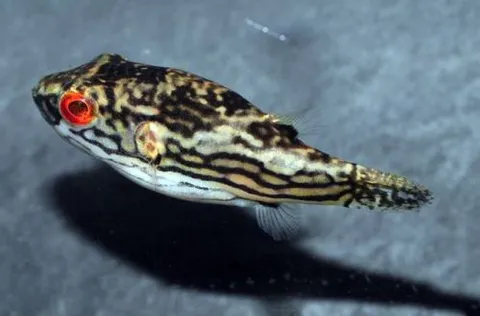
Carinotetraodon salivator
The Red-Eyed Pufferfish, scientifically known as Carinotetraodon salivator, belongs to the family Tetraodontidae, or pufferfish. In moments of potential threat, this fish, like other members of its family, can inflate…
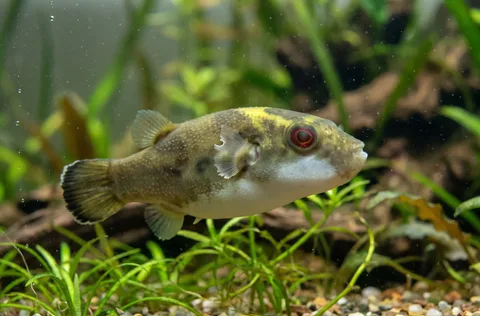
Carinotetraodon borneensis
The Bornean Pufferfish, known to specialists as Carinotetraodon borneensis, belongs to the family Tetraodontidae, or Pufferfish. It is less common in the aquarium fish market than, for example, its more widespread…
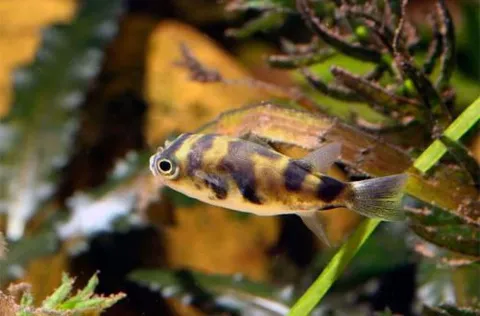
Colomesus asellus
Colomesus asellus, known in the aquarium hobby as the Amazon puffer, Amazonian puffer, or donkey puffer, belongs to the family Tetraodontidae. A distinctive feature of this fish is its unique defense mechanism: when…
Colomesus psittacus
The Zebra Pufferfish, also known as the Parrot Pufferfish (scientific name Colomesus psittacus), belongs to the family Tetraodontidae. A distinctive feature of this fish is its ability to inflate itself when danger…