Temperature24 – 28 °C
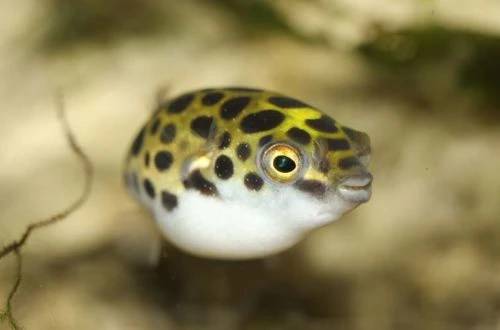
Dichotomyctere nigroviridis, known as the spotted green pufferfish, belongs to the family Tetraodontidae. These fish are called "puffers" due to their unique ability to inflate themselves with water when feeling threatened, adopting a characteristic rounded shape. It is important to note that the degree of this "inflation" varies significantly among different species. For example, marine inhabitants typically demonstrate this feature much more vividly than their freshwater relatives.
In nature, adult individuals reach a length of 17 cm, although in aquarium conditions they are usually slightly smaller, growing to an average of 14 cm. The pufferfish's body has a pear-like shape, typical for this group of fish. Small spines covering the outer integuments are pressed against the body in a calm state but rise when the fish "inflates." The body pattern consists of black rounded spots on a yellow background, which acquires a green tint under certain angles of light. The fish's belly is white, and the fins are translucent.
This fish originates from vast regions of Southeast Asia; its natural range extends from Indonesia to China. The species tolerates a wide range of salinity: juveniles live in fresh water — rivers, streams, lakes and flooded areas — and move to brackish estuaries and coastal mangroves as they mature. Adults need progressively saltier water, and keeping them in fresh water is a common cause of death in the aquarium.
This fish tends to be territorial and prefers a solitary existence. Adults exhibit aggression towards both conspecifics and other species, attacking those who infringe upon their boundaries. It should be remembered that the spotted green pufferfish possesses sharp, fused teeth capable of crushing crab shells. This means it can inflict serious injuries and even eat small aquarium inhabitants. Therefore, if the aquarium is small, it is recommended to keep only one individual. Young pufferfish are usually more peaceful and can be kept in groups, including with other species, until they reach maturity.
For one adult fish, an aquarium of at least 150 liters will be needed. The choice of decor is not critical and is determined by the pufferfish's morphological characteristics, as well as the hydrochemical composition of the water. If it is not possible to regularly feed the fish with shelled crustaceans and mollusks, it is worth including coral sand or limestone fragments in the decor that the fish could "chew on." For successful long-term keeping of the spotted green pufferfish, it is necessary to provide alkaline water of high hardness, or create brackish conditions, which corresponds to approximately 8–10 grams of salt per liter of water. In such an environment, only a limited number of aquatic plants can successfully grow, which is important to consider when decorating the aquarium. Given their diet, maintaining high water quality is particularly important. However, one should not rely solely on the filtration system. It is important to regularly remove all uneaten food residues and weekly replace a portion of the water with fresh water.
In their natural habitat, the diet of these fish includes almost everything they can find or catch. Various crustaceans and mollusks often become their prey. To successfully cope with hard shells, this group of fish has developed teeth that grow continuously, compensating for natural wear. In a home aquarium, it is recommended to offer appropriate food, such as shrimp, snails, as well as earthworms and large bloodworms. It is possible to accustom them to dry and frozen foods. It is important that the daily diet also contains a small amount of plant components.
Breeding in captivity is extremely difficult and practically not practiced by hobbyists. There are isolated documented cases of successful offspring production for scientific purposes, but there is no systematic basis for breeding. Sexual differences are weakly expressed, and reliable external signs for sex determination are absent. In nature, fish lay eggs on a hard substrate, and the male cares for the offspring, guarding the clutch until the larvae hatch.
These fish have no scales, which makes them extremely sensitive to water quality and parasitic diseases. The most common ailments are protozoan infections causing ichthyophthiriasis, as well as bacterial infections and helminth infestations, often brought in from the wild. Due to their specific diet and jaw structure, individuals often experience excessive tooth overgrowth, requiring mechanical correction. For prevention, it is necessary to maintain optimal water salinity, avoid the accumulation of nitrogenous compounds, and ensure high-quality filtration.
When selecting, avoid individuals with sunken bellies, lethargic behavior, or visible skin damage. A healthy fish should show curiosity, actively move around the aquarium, and have clear eyes without cloudiness. It is important to note that these fish are often kept in fresh water in stores, whereas for long-term health they require a brackish environment. When purchasing, it is recommended to clarify the keeping conditions with the seller and ensure gradual adaptation to the target salinity parameters to avoid osmotic stress.
The essentials: size, tank volume, water parameters and care
An adult reaches 17 cm in length. Plan the tank around the maximum size: the fish quickly outgrows a cramped setup.
The recommended volume is 150 L. A smaller tank speeds up nitrate build-up and raises stress levels.
Temperature 24–28 °C, pH 8–8.5, hardness 15–25 dGH. Stability matters more than exact values: sudden swings are harder on the fish than a small deviation from the ideal.
Around 10 years when kept properly. Lifespan depends directly on tank volume, water quality and a varied diet.
Temperament: aggressive / incompatible / unfriendly. Keep this in mind when choosing tank mates.
Recommended setup: solitary. Ignoring this is a common cause of stress and disease.
Diet type: high protein (predominantly meat). Feed small portions that are finished within a couple of minutes — overfeeding does more harm than underfeeding.
The scientific name of the species is Dichotomyctere nigroviridis, family Pufferfish (Tetraodontidae). It also appears in the literature as: Arothron simulans, Chelonodon nigroviridis, Tetraodon nigroviridis.
The water suits 70 of 208 plants in the catalogue — the easiest ones are shown first.
Amazon SwordAnacharisArrowhead CryptAsian WatermossBalansa Water TrumpetBarth's SwordBlue BuceBoivin's AponogetonCreeping JennyCrinkled AponogetonDitch StonecropDwarf CloverDwarf CloverDwarf HairgrassEelgrassFeathered LimnophilaGuppy GrassHornwortMoneywortMud SwordNair's LagenandraNarrow Leaf AnacharisNarrow-leaf CloverUssuri Watermilfoil
Matched by family, categories and overlapping keeping conditions
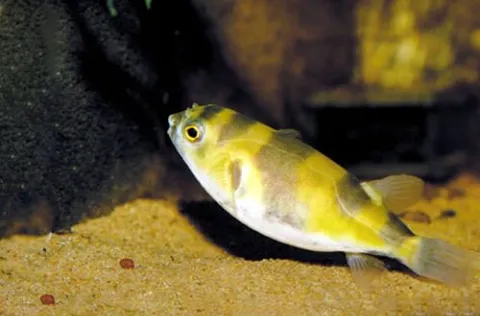
Colomesus psittacus
The Zebra Pufferfish, also known as the Parrot Pufferfish (scientific name Colomesus psittacus), belongs to the family Tetraodontidae. A distinctive feature of this fish is its ability to inflate itself when danger…
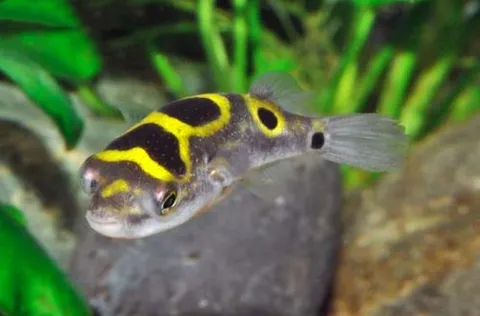
Dichotomyctere ocellatus
The Figure Eight Puffer, scientifically known as Dichotomyctere ocellatus, belongs to the family Tetraodontidae. These fish have earned a reputation as charming creatures due to their large, expressive eyes and…
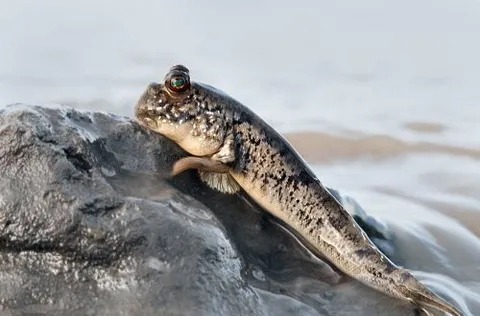
Periophthalmus barbarus
Periophthalmus barbarus, more commonly known as the mudskipper, belongs to the family Oxudercidae. It is an extraordinary fish that spends most of its life on land. Here it feeds, seeks out mates for reproduction, and…
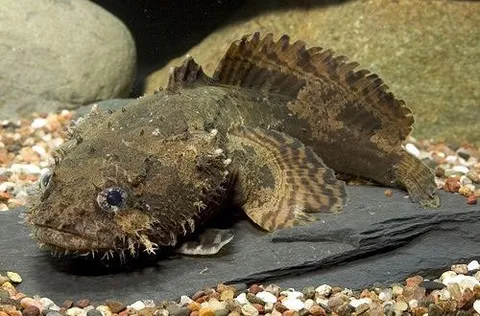
Batrachomoeus trispinosus
The Three-spined Toadfish (scientific name Batrachomoeus trispinosus), belonging to the family Batrachoididae, presents a rather unusual sight. Its appearance, characterized by a massive head and unconventional growths,…