Temperature25 – 30 °C
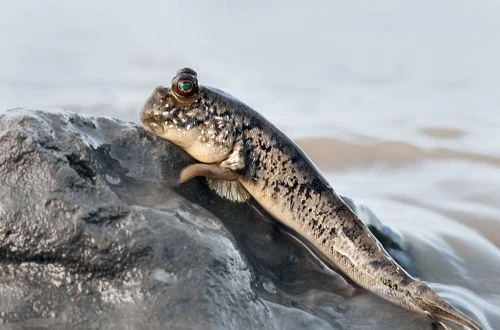
Periophthalmus barbarus, more commonly known as the mudskipper, belongs to the family Oxudercidae. It is an extraordinary fish that spends most of its life on land. Here it feeds, seeks out mates for reproduction, and fights for territory with its conspecifics. This unique characteristic has repeatedly attracted the attention of documentary filmmakers from BBC, Animal Planet, National Geographic, and others.
Adults of this fish typically reach about 15 cm in length. Distinguishing between male and female is quite difficult due to weakly expressed sexual dimorphism. The mudskipper has an elongated body and a large head. Above the head are large, protruding eyes that provide a 360-degree field of vision. The tail is short but very muscular. The pelvic fins have transformed, resembling amphibian limbs, and are used not for swimming but for pushing off surfaces. Thanks to these fins and tail, the fish can move on land. The dorsal fin is divided into two parts and, when raised, resembles a crest. The coloration is usually dark or gray, with irregularly spaced black speckles. The mudskipper exhibits an amphibious lifestyle, similar to frogs. It spends most of its time on land, where it feels completely comfortable. It rarely enters the water, only to moisten its skin or hide from danger, submerging its body and leaving only its eyes above the surface.
The natural habitat of this species is mangrove swamps along the coast of West Africa, stretching from Mauritania to Angola. In these areas, the mudskipper spends time at the water's edge, where regular tides occur. It is during low tides that extensive muddy areas are exposed, on which these fish often remain.
The behavior of the mudskipper is as amazing as its lifestyle. These fish are highly territorial. In confined spaces, it is recommended to keep only one male. In more spacious aquariums, the number of males can be increased. When two dominant males meet, a display of strength usually occurs, which sometimes escalates into a real skirmish. First comes a warning, and then an attack. Coexistence with other fish species is generally ruled out.
For keeping a single fish, an aquarium of at least 100 L is required. However, it is important to note that for the mudskipper, the land area is much more important than the water volume. The aquarium setup must include land areas rising above the water, simulating muddy or sandy beaches with driftwood and rocks. The aquarium should be equipped with a tight-fitting lid, and the heating system must maintain an air temperature corresponding to the water temperature. This is necessary to maintain high humidity and ensure the fish's comfort. Plants are not essential, but if desired, brackish water-acclimated species or artificial alternatives can be used. Brackish water conditions (salt concentration of 5–15 g per 1 L of water) imply the use of filters designed more for marine aquariums. Keeping them in freshwater is highly undesirable.
This species is carnivorous; in its natural environment, its diet consists of small crabs, insects, and other invertebrates. In aquarium conditions, mudskippers readily accept earthworms, crickets, flies, beetles, small fish, bloodworms, and various crustaceans. Dry foods are not suitable for them. It is recommended to offer live or frozen foods.
Reproduction of this species in captivity, even by experienced aquarists, has not yet been successful. This is due to the difficulty of recreating all the specific conditions of their natural environment. For example, in nature, the fish dig deep burrows (up to 1 meter) with characteristic "turrets" on top, where spawning and fry rearing occur. The female is selective and does not choose the first burrow she encounters, carefully selecting the best option.
Mudskippers are extremely sensitive to the quality of their habitat, and most health problems arise from improper keeping conditions. The main causes of diseases are stress from transportation, hypothermia, incorrect water salinity, or lack of access to land with high air humidity. Skin and fin damage sustained during fights or contact with sharp decorations often leads to the development of secondary bacterial and fungal infections. For prevention, it is necessary to maintain cleanliness in the aquaterrarium, ensure stable salinity, and use only smooth decorative elements to prevent injuries.
When choosing a mudskipper, attention should be paid to the fish's activity and the condition of its skin. Healthy individuals should be mobile, show curiosity, and react quickly to external stimuli. Avoid purchasing fish with signs of damage, ulcers, unnatural spots on the body, or signs of emaciation. It is important to ensure that the fish's eyes are clear and prominent, and its breathing is even. Since transportation is a significant stressor, it is best to observe the behavior of the individuals in the store for some time to ensure there are no obvious signs of illness or severe apathy.
The essentials: size, tank volume, water parameters and care
An adult reaches 15 cm in length. Plan the tank around the maximum size: the fish quickly outgrows a cramped setup.
The recommended volume is 100 L. A smaller tank speeds up nitrate build-up and raises stress levels.
Temperature 25–30 °C, pH 7–8.5, hardness 10–25 dGH. Stability matters more than exact values: sudden swings are harder on the fish than a small deviation from the ideal.
Around 5 years when kept properly. Lifespan depends directly on tank volume, water quality and a varied diet.
Temperament: aggressive / incompatible / unfriendly. Keep this in mind when choosing tank mates.
Recommended setup: solitary. Ignoring this is a common cause of stress and disease.
Diet type: meat / protein (live, frozen, fresh). Feed small portions that are finished within a couple of minutes — overfeeding does more harm than underfeeding.
The scientific name of the species is Periophthalmus barbarus, family Oxudercidae.
The water suits 108 of 208 plants in the catalogue — the easiest ones are shown first.
African Onion PlantAfzelius's AnubiasAmazon FrogbitAmazon SwordAnacharisAnubiasArrowhead CryptAsian WatermossDwarf CloverDwarf CloverDwarf HygrophilaDwarf SagittariaDwarf ValGuppy GrassHornwortJava MossMoneywortMud SwordNair's LagenandraNarrow Leaf AnacharisNarrow-leaf CloverTaiwan MossTape GrassUssuri Watermilfoil
Matched by family, categories and overlapping keeping conditions
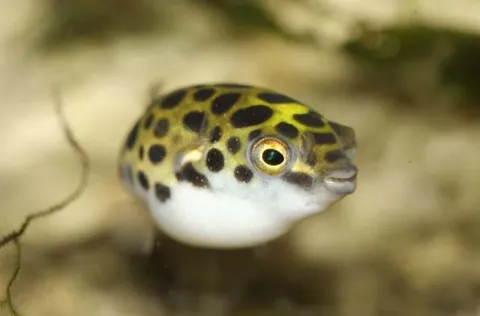
Dichotomyctere nigroviridis
Dichotomyctere nigroviridis, known as the spotted green pufferfish, belongs to the family Tetraodontidae. These fish are called "puffers" due to their unique ability to inflate themselves with water when feeling…
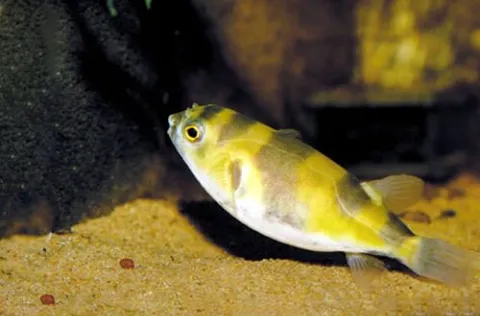
Colomesus psittacus
The Zebra Pufferfish, also known as the Parrot Pufferfish (scientific name Colomesus psittacus), belongs to the family Tetraodontidae. A distinctive feature of this fish is its ability to inflate itself when danger…
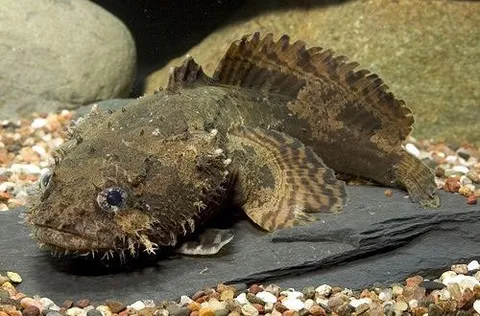
Batrachomoeus trispinosus
The Three-spined Toadfish (scientific name Batrachomoeus trispinosus), belonging to the family Batrachoididae, presents a rather unusual sight. Its appearance, characterized by a massive head and unconventional growths,…
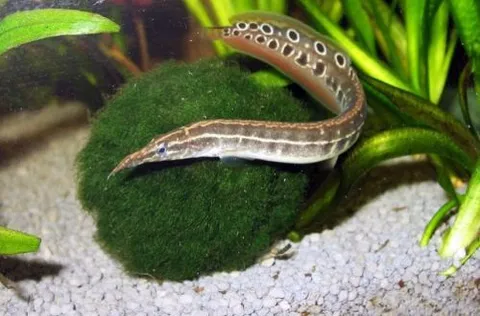
Macrognathus aculeatus
The Spiny Eel, also known as the Spotted Spiny Eel (scientific name Macrognathus aculeatus), belongs to the family Mastacembelidae. This species has a reclusive nature, making it one of the least conspicuous inhabitants…