Temperature20 – 30 °C
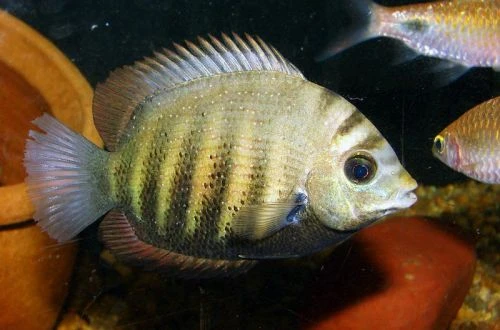
The scientific name for this cichlid species is Etroplus suratensis, but it is commonly known as the Banded Chromide or Green Chromide. Due to its significant size and rather subdued coloration, this species has not become one of the most popular among aquarists. Nevertheless, its unique ability to adapt to both fresh and brackish, almost marine, water makes it of particular interest.
Adult Green Chromides can reach a length of 25 to 35 cm. Their body is oval-shaped, noticeably compressed laterally, giving it the appearance of an elongated disc. The dorsal and anal fins, though not tall, extend almost from the head to the base of the tail. Their coloration is greenish, with characteristic dark diagonal stripes of the same hue and numerous small specks covering the entire body. Overall, compared to the related Orange Chromide and its selective breeding forms, the Green Chromide's coloration appears quite dull. Sexual dimorphism is weakly expressed, and an inexperienced aquarist may find it difficult to distinguish males from females.
This species originates from the island of Sri Lanka. Starting in the 1950s, it was actively imported to the continent for aquarium breeding. Since then, numerous wild populations of this species can be observed in the southern regions of India, as well as on the Malay Peninsula and in Singapore. Its natural habitats include lower river courses, brackish estuaries (Latin "aestuarium" means a tidal river mouth), and coastal lagoons. This species is euryhaline, allowing it to adapt to a wide range of water salinities, including completely freshwater environments.
The Green Chromide can be characterized as a relatively peaceful species, capable of coexisting successfully with other non-aggressive fish. However, during the spawning period, its behavior may change, becoming less predictable; if space is insufficient, it can display aggression towards smaller tank mates, actively defending its territory. Within the species, dominance is observed among larger and adult individuals. It is advisable to keep these fish in groups of 8 or more, as with smaller numbers, there is a high probability that the weakest individuals will be persecuted by their conspecifics. Thus, the more individuals of this species kept together, the more comfortable they feel.
For successful keeping of a group of such large fish, an aquarium of impressive volume, no less than 500 liters, will be required. The decor can be chosen at your discretion. Often, a sand substrate with many stones, as well as live or artificial plants and several snags, are used. Hydrochemical parameters can be either fresh or brackish, with a salt concentration of up to 15 grams per liter. The main difficulty in care is the need for constant maintenance of high water quality. In addition to a powerful filtration system, a weekly replacement of 25–50% of the water volume with fresh water is required. In a large aquarium, this is a challenging task if an automatic water top-off system, necessarily with preliminary purification, is not provided.
In natural conditions, the Green Chromide's diet consists of small crustaceans, insect larvae, worms, mollusks, as well as algae and various aquatic plants. When kept in an aquarium, it is desirable to offer a diet that mimics its natural one: live or frozen bloodworms, artemia, and flakes with spirulina. Dry foods in the form of flakes or pellets with a high content of protein and plant components can be an excellent alternative.
A gradual increase in water temperature and salinity serves as a stimulus for spawning, mimicking the onset of the dry season in their natural habitats. With the beginning of the breeding period, several individuals from the group form a temporary pair that remains together for quite a long time. The parents carefully guard the clutch, and then the fry, from the encroachments of other aquarium inhabitants. The eggs are attached to a stone or plant with thin threads to prevent displacement. The incubation period lasts 2 days at 27°C, and after another 3–4 days, the fry begin to swim freely, remaining, nevertheless, near the female. In a community tank, the survival rate of fry is extremely low. There are several reasons for this: in a large volume of water, it is difficult to provide the fry with adequate nutrition, young and inexperienced Orange Chromides sometimes eat their own eggs, and the fry often fall victim to other fish, despite parental protection. Offspring can be preserved by moving the decor element (stones, plants) with the eggs to a separate tank with identical water conditions. It is not necessary to move the parents in this case.
The main cause of most diseases is unsuitable living conditions and poor-quality food. If you notice the first symptoms, you should immediately check the water parameters and ensure there are no high concentrations of dangerous substances (ammonia, nitrites, nitrates, etc.). The parameters must be brought back to normal, and only then can treatment measures begin.
When choosing a Banded Chromide, attention should be paid to the fish's overall activity and the condition of its skin. Healthy individuals should have clean fins without signs of erosion, damage, or white film, as well as clear eyes without cloudiness. Avoid specimens with sunken bellies, signs of emaciation, or unnaturally sluggish behavior, as these fish are sensitive to water quality and stress during transport. In the store, fish may often appear timid, but when fed, they should show interest in food. It is recommended to ask the seller about the conditions (fresh or brackish water) in which the fish were kept to ensure smooth adaptation when moving to your aquarium.
The essentials: size, tank volume, water parameters and care
An adult reaches 25–35 cm in length. Plan the tank around the maximum size: the fish quickly outgrows a cramped setup.
The recommended volume is 500 L. A smaller tank speeds up nitrate build-up and raises stress levels.
Temperature 20–30 °C, pH 7–8.5, hardness 10–21 dGH. Stability matters more than exact values: sudden swings are harder on the fish than a small deviation from the ideal.
Around 8 years when kept properly. Lifespan depends directly on tank volume, water quality and a varied diet.
Temperament: semi-peaceful (dangerous to smaller ones). Not a predatory species, but small fish that fit in its mouth will eventually be eaten.
Recommended setup: group (8–10 individuals). Ignoring this is a common cause of stress and disease.
Diet type: mixed diet (meat + plant-based). Feed small portions that are finished within a couple of minutes — overfeeding does more harm than underfeeding.
The scientific name of the species is Etroplus suratensis, family Cichlids (Cichlidae). It also appears in the literature as: Chaetodon caris, Chaetodon suratensis, Etroplus meleagris.
The water suits 114 of 208 plants in the catalogue — the easiest ones are shown first.
African Onion PlantAfzelius's AnubiasAmazon FrogbitAmazon SwordAnacharisAnubiasArrowhead CryptDwarf CloverDwarf CloverDwarf HygrophilaDwarf SagittariaDwarf ValGuppy GrassHornwortJava MossMoneywortMud SwordNair's LagenandraNarrow Leaf AnacharisNarrow-leaf CloverStringy MossTaiwan MossTape GrassUssuri Watermilfoil
Matched by family, categories and overlapping keeping conditions
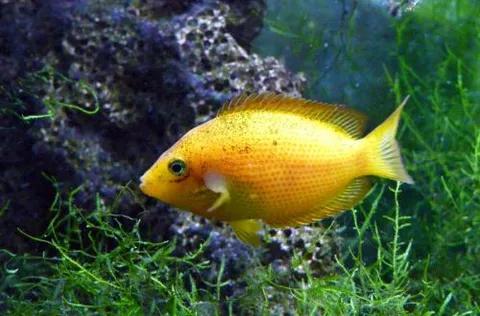
Pseudetroplus maculatus
The Spotted Chromide, also known as the Orange Chromide (scientific name Pseudetroplus maculatus), belongs to the family Cichlidae. It is a beautiful and very bright fish, particularly notable for its ornamental forms.…
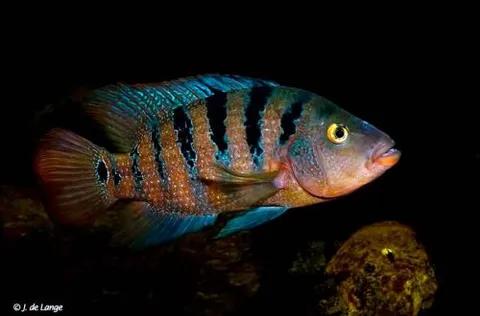
Mayaheros urophthalmus
The Mexican Cichlid, also known as Mojarra or Maya Cichlid (scientific name Mayaheros urophthalmus), belongs to the family Cichlidae. In its natural habitats in the USA and Mexico, this species is a target for…
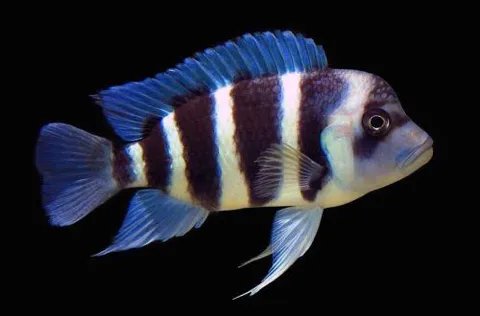
Cyphotilapia frontosa
Cyphotilapia frontosa, or the Humphead Cichlid Zebra, also known as the Queen of Tanganyika, belongs to the Cichlidae family. In common parlance, it is often called Frontosa Blue, which is a Russian pronunciation of the…
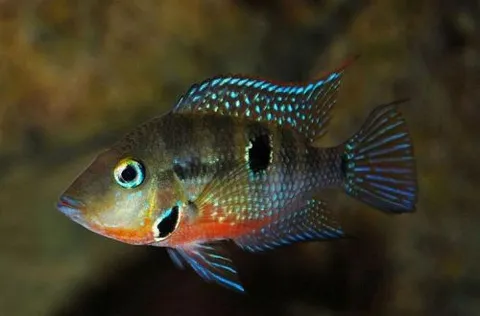
Thorichthys meeki
Thorichthys meeki, also known as the Firemouth Cichlid, bears the scientific name Thorichthys meeki and belongs to the family Cichlidae. This species attracts the attention of aquarists, especially American cichlid…