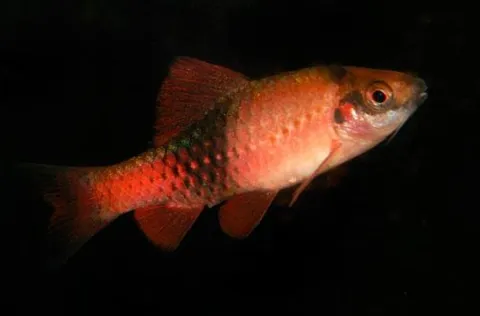
Melon Barb
Haludaria fasciata
Haludaria fasciata, known as the striped barb, is a member of the carp family (Cyprinidae). The fish received its scientific name in honor of the Bengali artist Haludar, who created illustrations in 1797 for Francis…
The flying barb, Esomus danrica, belongs to the family Cyprinidae. It first arrived in Europe in 1905 from British colonies in Asia. In its early years in the hobby, it gained wide popularity thanks to its ease of care. However, interest in this species has declined over time, as more colourful and exotic fish have appeared on the market.
Adults reach 6–7 cm in length. The flying barb has an elongated, streamlined body and large, pointed fins positioned toward the tail. The pectoral fins are notably wing-like in size and placement. This is fitting, as the fish earned its name from its ability to leap out of the water and briefly glide through the air—though it does not match the South American hatchetfish in this skill. The body is usually grey with a silvery belly, and two stripes run along the body: one black and one golden. Sexual dimorphism is weak; males are typically slimmer and slightly smaller than females.
This species is native to much of South Asia, including Pakistan, Nepal, Myanmar, Bangladesh, much of India, and Sri Lanka. In nature, flying barbs prefer shallow river and stream sections, swamps, and tropical forests flooded during the monsoon season. They are often found where aquatic plants are abundant.
The flying barb is peaceful and prefers to live in a group. Note that this is not a true schooling species; instead, a complex hierarchy develops within the group. Keep a minimum group of 8–10 individuals to prevent aggression from dominant fish, which can occur in smaller numbers. Such hostility may sometimes extend to other tank mates. Good companions are peaceful species of similar size, such as danios, barbs, and other cyprinids.
A group of 8–10 flying barbs needs a tank of at least 200–250 litres. Since these fish inhabit the upper water layers, pay attention to surface area as well as depth. Use a dark substrate and provide plenty of plants and driftwood as shelter. A secure lid is essential, as this fish can jump. The species adapts well to various conditions and is easy to keep, as shown by its survival in flooded rice fields in nature. However, do not neglect regular maintenance: perform partial water changes weekly and remove food waste and excrement. Being omnivorous, flying barbs readily accept most popular foods in dry, frozen, and live forms. Floating pellets are best, since food that sinks to the bottom is often ignored.
The flying barb is omnivorous and readily accepts most common foods, whether dry, frozen, or live. Floating foods are preferable, as sinking food is usually ignored.
Breeding flying barbs in the aquarium is moderately difficult. A separate tank is needed, as these fish eat their own eggs. Simulate the monsoon season by performing frequent water changes with softer water and gradually raising the temperature toward the upper end of the recommended range. Spawning is typically in pairs or groups, with females scattering small eggs among fine-leaved plants. Remove the parents immediately after spawning. Incubation and fry development follow the standard pattern for cyprinids. The first food for fry is infusoria and microworms; as they grow, transition them to brine shrimp nauplii.
This species is prone to a specific condition called 'wasting syndrome', marked by rapid loss of muscle mass. No effective treatment is currently known. Otherwise, the fish have a strong immune system when water quality is maintained and stress is minimized.
When selecting individuals, watch for activity: healthy flying barbs should be active and occupy the upper water layers. Avoid fish with damaged fins, as they are prone to infighting when hierarchies are disrupted or group size is too small. It is best to buy a school of 8–10 individuals at once to reduce stress during acclimation.
There are no pair reviews for this species yet — check tankmates in the matcher.
All tankmatesThe water suits 197 of 208 plants in the catalogue — the easiest ones are shown first.
Afzelius's AnubiasAnacharisAnubiasBrazilian PennywortDwarf CloverDwarf CloverDwarf HygrophilaDwarf SagittariaDwarf ValGuppy GrassHornwortJava FernJava MossMoneywortMud SwordNair's LagenandraNarrow Leaf AnacharisNarrow-leaf CloverStringy MossSüsswassertangTaiwan MossTape GrassTemple PlantUssuri Watermilfoil
Matching water does not mean the plant will stay intact.
The essentials: size, tank volume, water parameters and care
An adult reaches 6–7 cm in length. Plan the tank around the maximum size: the fish quickly outgrows a cramped setup.
The recommended volume is 200 L. A smaller tank speeds up nitrate build-up and raises stress levels.
Temperature 20–26 °C, pH 6–8, hardness 1–15 dGH. Stability matters more than exact values: sudden swings are harder on the fish than a small deviation from the ideal.
Around 4 years when kept properly. Lifespan depends directly on tank volume, water quality and a varied diet.
Temperament: semi-peaceful (including aggression during spawning / intraspecific conflicts). Keep this in mind when choosing tank mates.
Recommended setup: group (8–10 individuals). Ignoring this is a common cause of stress and disease.
Diet type: floating (any). Feed small portions that are finished within a couple of minutes — overfeeding does more harm than underfeeding.
The scientific name of the species is Esomus danrica, family Cyprinids (Cyprinidae). It also appears in the literature as: Cyprinus danrica, Cyprinus jogia, Cyprinus sutiha.
Matched by family, categories and overlapping keeping conditions
Haludaria fasciata
Haludaria fasciata, known as the striped barb, is a member of the carp family (Cyprinidae). The fish received its scientific name in honor of the Bengali artist Haludar, who created illustrations in 1797 for Francis…
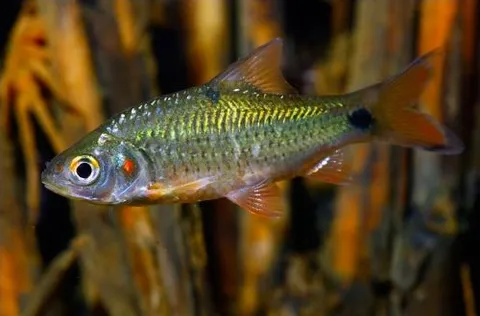
Systomus rubripinnis
The Java Barb, scientifically known as Systomus rubripinnis, is a member of the Cyprinidae family. This rather large fish exhibits remarkable hardiness and relatively low maintenance requirements. It is rarely…
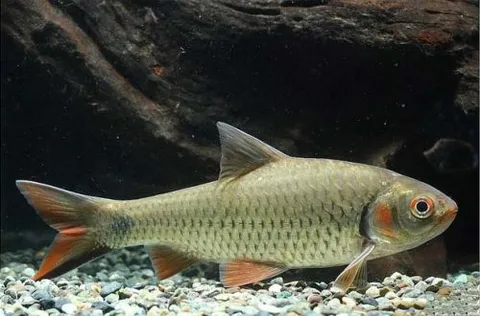
Systomus orphoides
Systomus orphoides, known as the "Red-cheeked Barb," belongs to the family Cyprinidae, or carps. This species is almost indistinguishable in appearance from its closest relative, the Olive Barb (Systomus sarana). This…
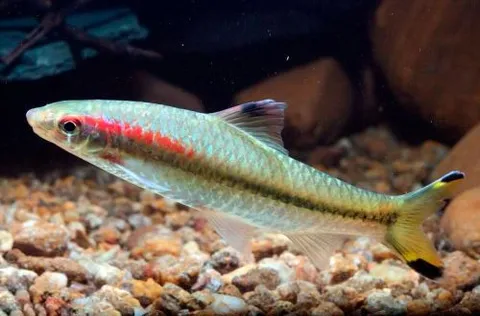
Dawkinsia chalakkudiensis
A representative of the carp family (Cyprinidae), the Chalakkudi Barb, known scientifically as Dawkinsia chalakkudiensis, only appeared in aquaristics in 2001, making it a relatively new species for hobbyists. It…