Temperature23 – 27 °C
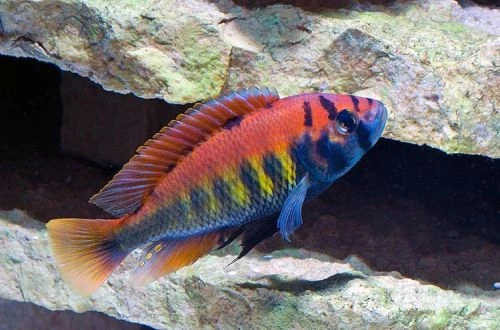
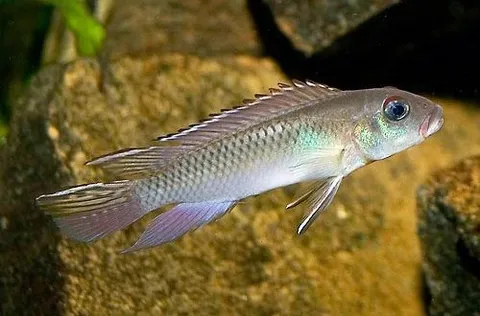
Haplochromis nyererei, also known as Nyerere's Haplochromis, belongs to the family Cichlidae. The fish is named after Julius Kambarage Nyerere, the first president of Tanzania (1961-1985). This fish is not difficult to keep, but its aggressiveness towards other males can be a problem; therefore, the optimal solution is to keep only one male in the aquarium.
Adults typically reach 7–8 cm in length. Males are larger and more brightly colored than females: their back has a bright orange hue, their belly is a rich blue, and yellow vertical stripes run along their body. Females are gray, with only their fins and tail sometimes having red or blue pigmentation. There are at least 11 different variations of this species, which differ slightly in body pattern. To identify a specific variety, its name often includes the island where it was discovered.
The natural habitat of this species is Lake Victoria, the largest body of water on the African continent, located on the borders of Tanzania, Uganda, and partially Kenya. The fish is found predominantly in the southern part of the lake, among numerous islands. The local landscape is characterized by an abundance of rocky outcrops along the rugged coastline, full of crevices and grottoes, while aquatic plants are extremely rare in these areas.
Males display aggression towards each other, and in confined spaces, their skirmishes can lead to death. Therefore, it is recommended to keep a group consisting of one male and several females in a single aquarium. Towards other species, this fish exhibits relatively neutral behavior. It is well compatible with other fish from Lake Victoria, as well as with Mbuna cichlids.
For a group of 3–4 individuals, an aquarium of at least 250 liters is recommended. Gravel-sand substrate is used for decoration, as well as large stones and rock fragments from which gorges and caves are created. The long-term health of Haplochromis nyererei directly depends on maintaining stable water conditions within the permissible range of temperatures and hydrochemical parameters. In addition to installing the necessary equipment, this requires regular aquarium maintenance: weekly partial water changes with fresh water, timely removal of organic waste, and constant monitoring of nitrogen compound levels in the water.
This species is omnivorous and readily consumes most standard aquarium fish foods. Specifically, the daily diet may consist of dry flakes or pellets, supplemented with live or frozen daphnia, brine shrimp, and bloodworms.
Breeding this species is quite simple. The fish use a strategy characteristic of many African cichlids, especially those inhabiting Lake Malawi. The female lays several dozen eggs, which she immediately takes into her mouth after fertilization. The incubation period lasts approximately 3 weeks in the female's mouth. The hatched fry remain under her protection for some time until they reach a sufficient size.
The main cause of diseases in fish is most often unfavorable keeping conditions. If environmental parameters go beyond acceptable limits, the fish's immune system is suppressed, making it vulnerable to various infections constantly present in the environment. At the first suspicion of illness, it is necessary to immediately check the water parameters and ensure there are no dangerous concentrations of nitrogen cycle products. Restoring optimal conditions often contributes to self-healing. However, in some cases, medication may be required.
When choosing individuals, preference should be given to active fish with clean fins and no visible skin damage. Avoid specimens with signs of emaciation, sunken bellies, or unnatural behavior, such as apathy or constant presence at the water surface. Given the pronounced intraspecific aggression, it is recommended to acquire a group with a predominance of females, as males can exhibit strong territoriality even in a store environment.
The essentials: size, tank volume, water parameters and care
An adult reaches 7–8 cm in length. Plan the tank around the maximum size: the fish quickly outgrows a cramped setup.
The recommended volume is 250 L. A smaller tank speeds up nitrate build-up and raises stress levels.
Temperature 23–27 °C, pH 7–8.5, hardness 4–15 dGH. Stability matters more than exact values: sudden swings are harder on the fish than a small deviation from the ideal.
Around 6 years when kept properly. Lifespan depends directly on tank volume, water quality and a varied diet.
Temperament: semi-peaceful (including aggression during spawning / intraspecific conflicts). Keep this in mind when choosing tank mates.
Recommended setup: harem (1 male and several females). Ignoring this is a common cause of stress and disease.
Diet type: any (universal). Feed small portions that are finished within a couple of minutes — overfeeding does more harm than underfeeding.
The scientific name of the species is Haplochromis nyererei, family Cichlids (Cichlidae). It also appears in the literature as: Pundamilia nyerere, Pundamilia nyererei.
The water suits 114 of 208 plants in the catalogue — the easiest ones are shown first.
African Onion PlantAfzelius's AnubiasAmazon FrogbitAmazon SwordAnacharisAnubiasArrowhead CryptDwarf CloverDwarf CloverDwarf HygrophilaDwarf SagittariaDwarf ValGuppy GrassHornwortJava MossMoneywortMud SwordNair's LagenandraNarrow Leaf AnacharisNarrow-leaf CloverStringy MossTaiwan MossTape GrassUssuri Watermilfoil
Matched by family, categories and overlapping keeping conditions
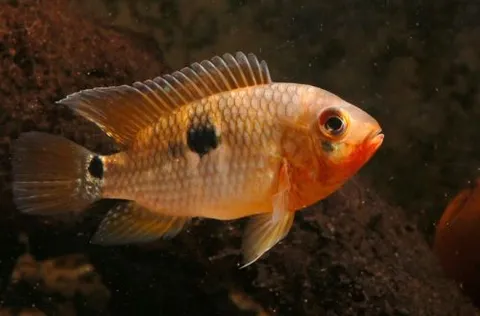
Aequidens tetramerus
Aequidens tetramerus, known scientifically as Aequidens tetramerus, belongs to the famous family Cichlidae. This is a rather large fish, attracting attention with its bright coloration. Many aquarists appreciate it for…
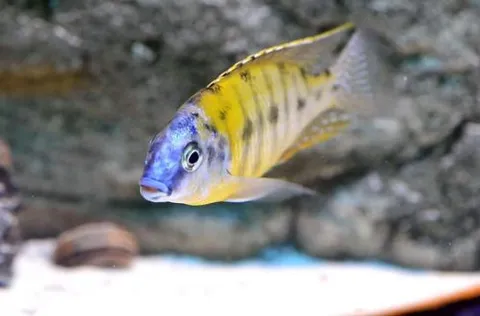
Protomelas fenestratus
Protomelas fenestratus, known as Fenestratus, belongs to the Cichlidae family. This species is endemic and found exclusively in Lake Malawi, located on the African continent.
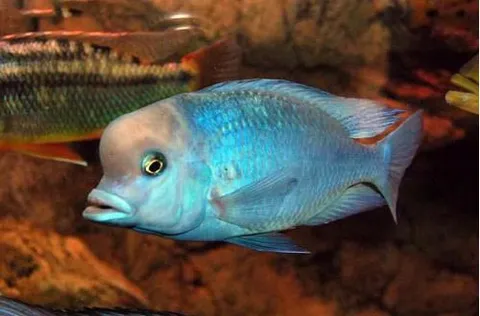
Cyrtocara moorii
Cyrtocara moorii, also known as the Blue Dolphin Cichlid, belongs to the Cichlidae family. The fish gets its name from its distinctive head shape: the presence of a nuchal hump and an elongated mouth give it a…
Nanochromis parilus
Nanochromis parilus, also known as Nanochromis transvestitus, belongs to the Cichlidae family. This fish is not the most vibrant, unlike other cichlids, and its poor compatibility with conspecifics, as well as its need…