Temperature23 – 28 °C
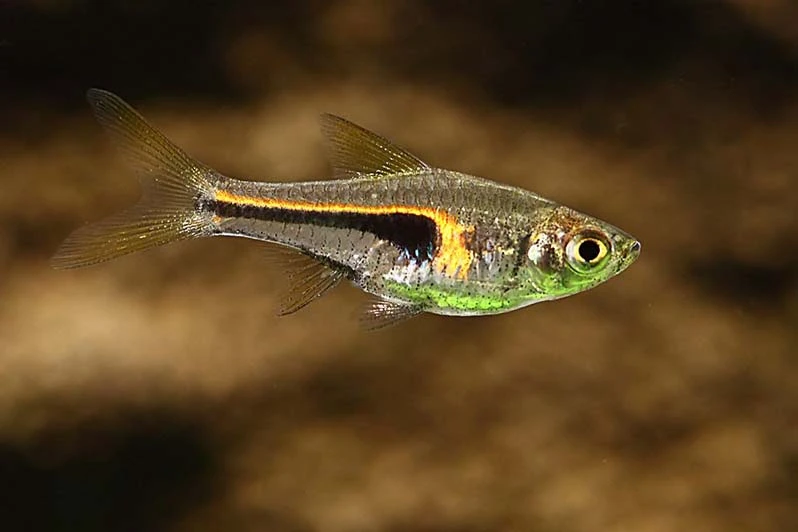
Trigonostigma hengeli, known as the Glowlight Rasbora or Hengel's Rasbora, belongs to the carp family (Cyprinidae). This small and graceful fish is notable for a bright streak on its side, resembling a neon spark. When a school of these fish swims, it creates an impression of gentle shimmering, especially effective under properly chosen lighting.
This slender fish typically does not exceed 3 cm in length. Its coloration can vary from translucent ivory to delicate pink or orange hues, and the fins often have a lemon-yellow tone. The most striking distinguishing feature is a thin black marking running along the rear part of the body, above which is a bright, neon-like streak.
Hengel's Rasbora received its scientific description in 1956. Its range is restricted to the Greater Sunda Islands: collections are known from Jambi province on Sumatra and, apparently, from Indonesian West Kalimantan on Borneo; the exact extent of the range remains unclear. In the wild, these fish are often found in numerous schools, sometimes filling slow-moving water currents. They prefer forest streams and rivers, whose water has a characteristic brownish tint due to a high concentration of tannins. These substances form during the decomposition of organic matter, such as leaves and grass. The diet of Rasboras in nature consists of small insects, worms, crustaceans, and other zooplankton.
Hengel's Rasboras are schooling fish, so it is recommended to keep a group of at least 8 individuals in an aquarium. Within such a group, a hierarchy forms, but this does not lead to conflicts or injuries. These fish behave peacefully both with each other and with other aquarium inhabitants. Males display the brightest coloration in the presence of females, competing for their attention. As tankmates for Hengel's Rasbora, choose equally small and active fish, avoiding larger species that might be perceived as a threat.
Creating favorable conditions for these fish does not require any special or expensive equipment. It is sufficient to regularly change part of the water and clean the substrate of organic pollutants. Given that the fish originate from slow-moving bodies of water, powerful filtration and intense aeration in the aquarium are not mandatory. Lighting should be moderate; too bright light can suppress the fish's natural coloration. In aquarium design, preference is given to dense plant thickets that reach the water surface. They should be placed mainly along the walls to leave ample open swimming space. Floating plants will provide additional shading. Dark substrate is also a good choice, and natural snags will serve not only as decor but also as a source of tannins, bringing the water parameters closer to natural conditions.
Being an omnivorous species, Hengel's Rasbora in a home aquarium needs a varied diet, which should be based on high-quality dry foods from reputable manufacturers. Additionally, the menu can be enriched with live foods, such as Artemia or bloodworms. Observing Rasboras during feeding is enjoyable: the fish swim up to the feeder, grab a piece of food, and immediately dive to a shallow depth to swallow it.
The breeding process of this fish, despite some difficulties, largely replicates the approaches used for breeding Espei Rasbora. For spawning, it is recommended to use a separate tank where special conditions must be provided: the water should be very soft (1-2 dGH) and slightly acidic (pH 5.3–5.7), with a temperature between 26–28°C. A simple air-driven filter will be sufficient for filtration. As decoration, plants with broad leaves can be used, and coarse gravel with particles at least 0.5 cm in size should be placed on the bottom. The aquarium should be filled to no more than 20 cm, and the lighting should be subdued; even room light will be sufficient. Several sexually mature pairs are introduced into the prepared tank and actively fed live foods or high-protein dry foods. Raising the temperature to the maximum permissible level and abundant feeding stimulate the onset of spawning. After courtship, the male leads the female to his chosen plant, where the eggs will be laid on the underside of a leaf. After spawning, the males and females should be returned to the main aquarium, and the water level in the spawning tank lowered to 10 cm, ensuring that the eggs remain submerged. Fry hatch in approximately 24 hours and begin free-swimming after another 2 weeks. They should be fed with micro-food or Artemia nauplii.
Under proper maintenance, diseases do not pose a serious threat to these fish. However, changes in the hydrochemical composition of the water, especially fluctuations in pH and dGH, as well as insufficient or unbalanced nutrition, increase the risk of diseases such as dropsy, fin rot, and ichthyophthiriosis. More detailed information on the symptoms and treatment methods for these ailments can be found in the "Fish Diseases" section.
When purchasing, choose active, mobile individuals that stay in a school. Avoid fish with signs of emaciation, damaged fins, whitish spots or film on the body, which may indicate infectious diseases. Healthy rasboras have clear eyes and no unnatural abdominal distension. Since this species is often confused with the closely related Harlequin and Espei Rasboras, carefully examine the coloration: Hengel's Rasbora has a more transparent body, and the dark marking is in the form of a thin wedge with a characteristic bright orange neon stripe above it. In the store, fish may appear pale due to stress, but they should exhibit typical species-specific behavior, showing no signs of apathy or constant presence at the water surface.
The essentials: size, tank volume, water parameters and care
An adult reaches 3 cm in length. Plan the tank around the maximum size: the fish quickly outgrows a cramped setup.
The recommended volume is 54 L. A smaller tank speeds up nitrate build-up and raises stress levels.
Temperature 23–28 °C, pH 6–6.5, hardness 5–12 dGH. Stability matters more than exact values: sudden swings are harder on the fish than a small deviation from the ideal.
Around 3 years when kept properly. Lifespan depends directly on tank volume, water quality and a varied diet.
Temperament: peaceful (regular). Keep this in mind when choosing tank mates.
Recommended setup: schooling (usually from 5–6 individuals and more). Ignoring this is a common cause of stress and disease.
Diet type: any (universal). Feed small portions that are finished within a couple of minutes — overfeeding does more harm than underfeeding.
The scientific name of the species is Trigonostigma hengeli, family Cyprinids (Cyprinidae). It also appears in the literature as: Rasbora hengeli.
The water suits 197 of 208 plants in the catalogue — the easiest ones are shown first.
Afzelius's AnubiasAnacharisAnubiasBrazilian PennywortDwarf CloverDwarf CloverDwarf HygrophilaDwarf SagittariaDwarf ValGuppy GrassHornwortJava FernJava MossMoneywortMud SwordNair's LagenandraNarrow Leaf AnacharisNarrow-leaf CloverStringy MossSüsswassertangTaiwan MossTape GrassTemple PlantUssuri Watermilfoil
Matched by family, categories and overlapping keeping conditions
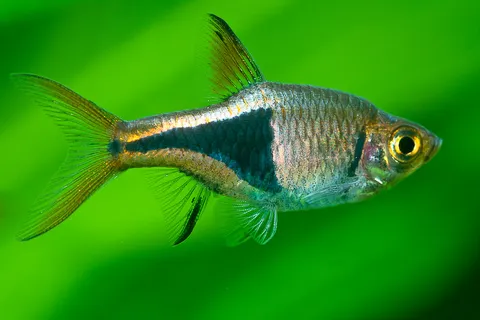
Trigonostigma heteromorpha
The Harlequin Rasbora, also known as the Wedge-spot Rasbora (Trigonostigma heteromorpha), belongs to the family Cyprinidae. This fish has been popular among aquarists since the early 20th century. Thanks to targeted…
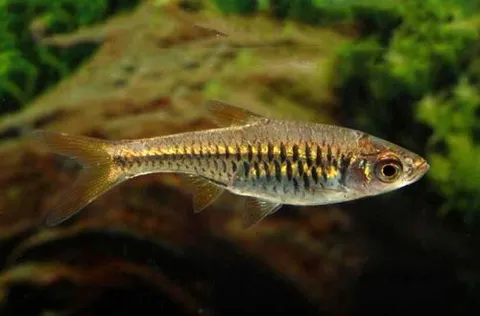
Rasbora reticulata
Rasbora reticulata, known as the Reticulated Rasbora, is a member of the carp family (Cyprinidae). This fish originates from Southeast Asia. It is found on Sumatra and on Nias Island, which lies to the west of it. It…
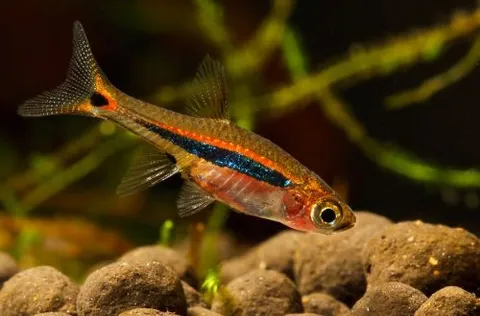
Boraras urophthalmoides
Boraras urophthalmoides, known as the Firefly Rasbora, belongs to the family Cyprinidae. This fish is characterized by its miniature size, bright and vibrant coloration, and high activity. Its keeping and breeding do…
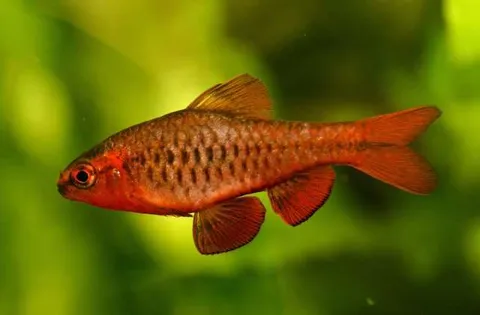
Puntius titteya
This species, the Cherry Barb, or Cherry Puntius (Puntius titteya), belongs to the Cyprinidae family. Thanks to its vibrant red coloration, this fish can brighten up any aquarium. It easily becomes a true pet due to its…