Temperature22 – 28 °C
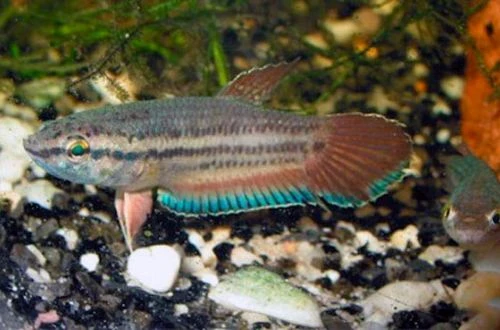
Betta picta, known as the Javanese Betta, belongs to the family Osphronemidae (Labyrinth fish or Gourami). Interestingly, despite its name and classification, this species shows more resemblance to Gouramis than to typical Betta fish. This species is not recommended for novice aquarists due to its need to maintain specific water parameters within a strictly defined, rather narrow range of values.
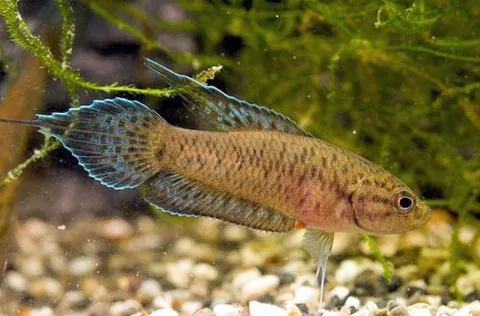
Adults of this fish reach a length of 4 to 5 centimeters. Its body is elongated, with a noticeably large head. The anal fin extends from the middle of the body all the way to the caudal fin, which has a rounded shape. The other fins are short and pointed. The coloration varies from gray to silvery or golden hues. Interrupted dark stripes run along the body in rows. The fins are reddish with a blue outline. Males typically have significantly brighter coloration than females.
Its origin is linked to Southeast Asia. The fish is considered endemic to the island of Java, where its primary habitat is in the river systems of the central and western regions. It prefers to inhabit small streams and rivers originating in the hills, favoring calm backwaters and areas near the bank. The natural environment is characterized by clear water, and the substrate is formed by fallen leaves mixed with rocks. Sometimes these fish can also be found in man-made bodies of water, such as ponds.
This species is relatively peaceful, but in certain situations, they may show intolerance towards their own kind. This is especially characteristic of males, who, when space is limited, begin to perceive each other as rivals in the struggle for female attention. In small aquariums, it is recommended to keep them individually or in pairs (one male and one female). They coexist well with calm, non-aggressive fish of similar size.
The optimal aquarium volume for keeping one or two fish starts from 50–60 liters. When decorating the aquarium, it is desirable to recreate conditions close to the natural habitat of these fish. In particular, subdued lighting should be provided, numerous shelters made of snags should be arranged, or decorative elements capable of serving as refuges should be placed. The presence of aquatic vegetation, including floating species, will also contribute to the fish's comfort. In general, Betta picta does not have excessive requirements; some aquarists even do without substrate, and use ordinary hollow PVC tubes or inverted ceramic pots for shelters. Successful keeping of this species directly depends on maintaining stable water parameters within acceptable temperature and hydrochemical limits. This requires regular aquarium maintenance procedures, including the removal of organic waste and partial water changes with fresh, pre-conditioned water. Installing a high-quality filtration system will significantly reduce the labor intensity of care and allow for less frequent maintenance.
It is recommended to use both live and frozen foods, such as Artemia, Daphnia, and bloodworms. In addition, specialized commercial foods developed for the Gourami group, offered by various manufacturers, will also be suitable.
Under favorable conditions, spawning of these fish is not uncommon. When the breeding season arrives, after a short courtship period during which the fish perform a peculiar "embrace dance," spawning occurs. The female releases eggs one by one, and the male, after fertilizing each, immediately takes it into his mouth. This process continues until the entire clutch is in his mouth. The male incubates the future offspring throughout the incubation period, which lasts 9–12 days, after which the hatched fry begin to swim freely. Parents are probably not a threat to their own offspring, which cannot be said about other fish, so it is recommended to transfer the fry to a separate aquarium with similar water conditions.
Most health problems in fish often arise from unsuitable keeping conditions. Maintaining a stable and comfortable habitat is a key factor for successful keeping. If symptoms of illness appear, the first step is to check the water quality. If deviations are found, it is important to take immediate measures to eliminate them. If the symptoms do not disappear or worsen, medicinal treatment may be required.
When choosing a Javanese Betta at the store, pay attention to the fish's activity and appearance. A healthy specimen should show curiosity, have no visible fin damage, ulcers, white film, or spots on the scales. Avoid fish with clamped fins, rapid breathing, or an unnaturally bloated belly, which may indicate illness or internal parasites. It is advisable to purchase specimens that actively respond to food and do not constantly hide in the corners of the aquarium. Given that this species can be territorial, ask the seller about their keeping conditions in the store: if the fish are kept in overcrowded tanks, the risk of stress and infections is significantly higher.
The essentials: size, tank volume, water parameters and care
An adult reaches 4–5 cm in length. Plan the tank around the maximum size: the fish quickly outgrows a cramped setup.
The recommended volume is 50 L. A smaller tank speeds up nitrate build-up and raises stress levels.
Temperature 22–28 °C, pH 5.5–7.5, hardness 1–5 dGH. Stability matters more than exact values: sudden swings are harder on the fish than a small deviation from the ideal.
Around 3 years when kept properly. Lifespan depends directly on tank volume, water quality and a varied diet.
Temperament: peaceful (regular). Keep this in mind when choosing tank mates.
Recommended setup: pair (male/female). Ignoring this is a common cause of stress and disease.
Diet type: small / appropriate size / pieces. Feed small portions that are finished within a couple of minutes — overfeeding does more harm than underfeeding.
The scientific name of the species is Betta picta, family Osphronemidae. It also appears in the literature as: Betta trifasciata, Panchax pictum.
The water suits 197 of 208 plants in the catalogue — the easiest ones are shown first.
Afzelius's AnubiasAnacharisAnubiasBrazilian PennywortDwarf CloverDwarf CloverDwarf HygrophilaDwarf SagittariaDwarf ValGuppy GrassHornwortJava FernJava MossMoneywortMud SwordNair's LagenandraNarrow Leaf AnacharisNarrow-leaf CloverStringy MossSüsswassertangTaiwan MossTape GrassTemple PlantUssuri Watermilfoil
Matched by family, categories and overlapping keeping conditions
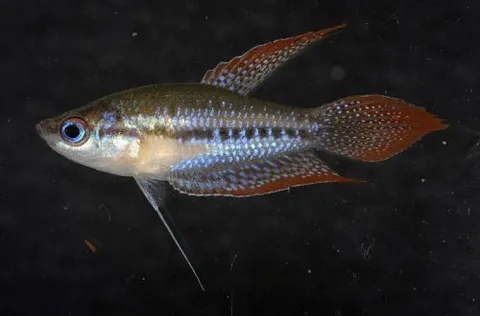
Trichopsis schalleri
Schaller's Gourami, scientifically known as Trichopsis schalleri, belongs to the family Osphronemidae. The fish is named after Dietrich Schaller, a tropical fish exporter who first introduced this species to the…
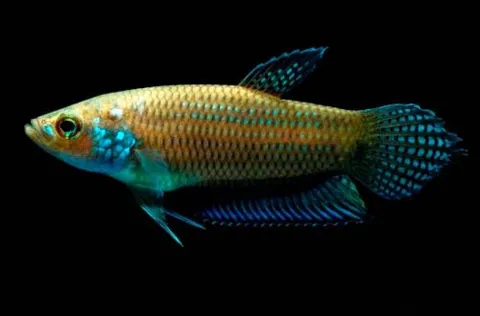
Betta stigmosa
The Stigmosa Betta, officially known as Betta stigmosa, belongs to the family Osphronemidae. It is a calm and undemanding fish, but it is not suited to the ordinary community aquarium: it is kept on its own or with very…
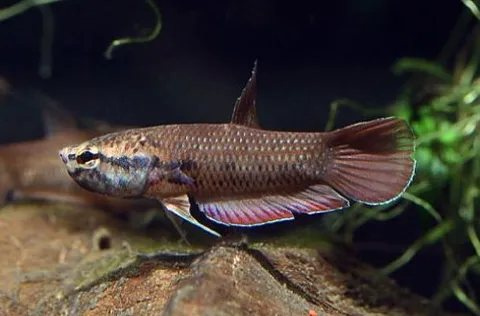
Betta falx
Betta falx, or Falx Betta, belongs to the family Osphronemidae. This fish, known by the scientific name Betta falx, is a representative of the fighting fish group, yet its calm disposition distinguishes it from its more…
Malpulutta kretseri
Malpulutta kretseri, also known as Kretser's Paradise Fish, bears the scientific name Malpulutta kretseri and belongs to the family Osphronemidae. It was named in honour of the Sri Lankan lawyer De Kretser, who…