Temperature23 – 27 °C
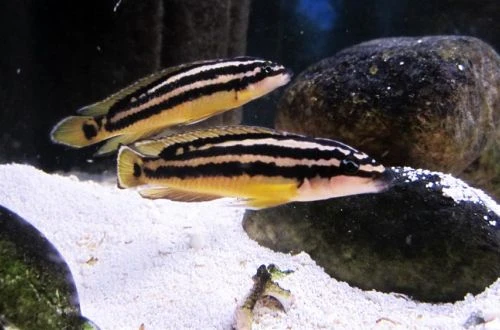
Julidochromis ornatus, or Ornate Julie, is a fish from the Cichlidae family. This species is characterized by its activity and bright coloration, as well as exhibiting complex intraspecific interactions. Its keeping and breeding are not difficult if proper water parameters and a balanced diet are provided.
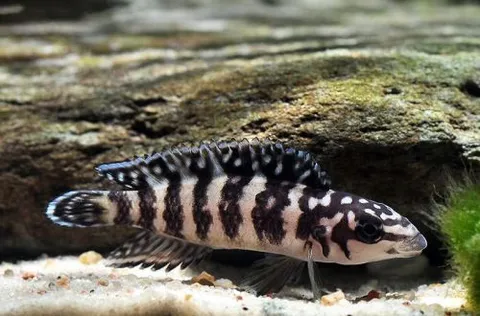
Adults of this fish reach a length of up to 8 cm. Sexual dimorphism is weakly expressed, making it difficult to visually distinguish males from females. The fish has an elongated body with extended fins; the dorsal fin extends from the head to the tail. The coloration is characterized by a yellow base color with several horizontal rows of dark stripes.
This species is endemic to Lake Tanganyika in Africa, whose shoreline borders several countries. A significant part of the border passes through the Democratic Republic of Congo and Tanzania. Julidochromis ornatus is found in the northern part of the lake, preferring areas with rocky shores.
Julidochromis exhibit a behavior unique to most fish: once mature, the male and female form a strong pair that lasts throughout their lives. Other members of the species are perceived as rivals and will be subjected to aggression. In a small aquarium, it is recommended to keep only one pair, whereas in a significantly larger tank, several dozen fish can be housed. In the latter case, aggression is dispersed, as each pair occupies its own territory on the bottom. Compatibility is possible with other species of comparable size that inhabit the water column or surface.
For keeping a single pair of Julidochromis ornatus, an aquarium of at least 70 liters is suitable. The decor should include rock formations and a sandy substrate, which helps recreate their natural rocky habitat. Maintaining high water quality with appropriate hydrochemical parameters is a key condition for successful keeping. This is achieved by using an efficient filtration system, regular cleaning of the aquarium from organic deposits (uneaten food, excrement), and weekly partial water changes (15–20% of the total volume).
The diet of these fish should be rich in protein components, such as live or frozen bloodworms and brine shrimp. It is also important to include vegetable supplements, for example, spirulina flakes or pieces of nori. Dry foods are used in limited quantities, primarily as a source of vitamins and trace elements.
Breeding Julidochromis ornatus usually presents no difficulties, even for beginner aquarists. The main task is to form a male/female pair. Simply placing individuals of different sexes together in an aquarium does not guarantee offspring and can even lead to the death of the weaker fish. It is important that the pair forms naturally, when the fish grow together from a juvenile age. For spawning, a cave or grotto-like shelter is required, where the female will lay her eggs. After fertilization, she remains near the clutch, while the male guards the entrance to the shelter. The incubation period is approximately 2–3 days. The parents care for the fry until they reach a length of about 2 cm. After this, the adults are ready for the next spawning, and the fry should be moved to a separate aquarium.
The main cause of most diseases in Lake Tanganyika cichlids is unsuitable keeping conditions and poor-quality food, which often leads, for example, to African Bloat. At the first symptoms, it is necessary first to check the water parameters and ensure there are no high concentrations of dangerous substances such as ammonia, nitrites, and nitrates. If the readings deviate from the norm, they should be brought into order, and only then should treatment begin.
When purchasing, choose active individuals with clean fins and no visible body damage. It is important to avoid fish with signs of emaciation, sunken bellies, or unnaturally bloated abdomens, as this may indicate digestive problems or infectious diseases. Since sexual dimorphism is weakly expressed, determining sex visually is extremely difficult, so to form a pair, a group of several young individuals is often acquired, allowing them to choose a partner naturally. Before purchasing, clarify the keeping conditions at the store: the fish should be in water with parameters close to those natural for Lake Tanganyika. Avoid buying fish that appear apathetic, stay near the surface, or show signs of stress, as adaptation to new conditions may be difficult. During transport, ensure adequate aeration, as the species is sensitive to water quality and oxygen levels.
The essentials: size, tank volume, water parameters and care
An adult reaches 8 cm in length. Plan the tank around the maximum size: the fish quickly outgrows a cramped setup.
The recommended volume is 70 L. A smaller tank speeds up nitrate build-up and raises stress levels.
Temperature 23–27 °C, pH 7.5–9, hardness 10–25 dGH. Stability matters more than exact values: sudden swings are harder on the fish than a small deviation from the ideal.
Around 7 years when kept properly. Lifespan depends directly on tank volume, water quality and a varied diet.
Temperament: semi-peaceful (aggression when space is limited). Keep this in mind when choosing tank mates.
Recommended setup: pair (male/female). Ignoring this is a common cause of stress and disease.
Diet type: mixed diet (meat + plant-based). Feed small portions that are finished within a couple of minutes — overfeeding does more harm than underfeeding.
The scientific name of the species is Julidochromis ornatus, family Cichlids (Cichlidae).
The water suits 114 of 208 plants in the catalogue — the easiest ones are shown first.
African Onion PlantAfzelius's AnubiasAmazon FrogbitAmazon SwordAnacharisAnubiasArrowhead CryptDwarf CloverDwarf CloverDwarf HygrophilaDwarf SagittariaDwarf ValGuppy GrassHornwortJava MossMoneywortMud SwordNair's LagenandraNarrow Leaf AnacharisNarrow-leaf CloverStringy MossTaiwan MossTape GrassUssuri Watermilfoil
Matched by family, categories and overlapping keeping conditions
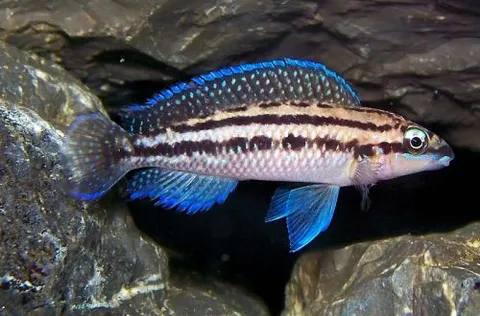
Julidochromis dickfeldi
Julidochromis dickfeldi, scientifically known as Julidochromis dickfeldi, belongs to the Cichlidae family. These fish form strong pair bonds and display pronounced jealousy towards their conspecifics. However, they can…
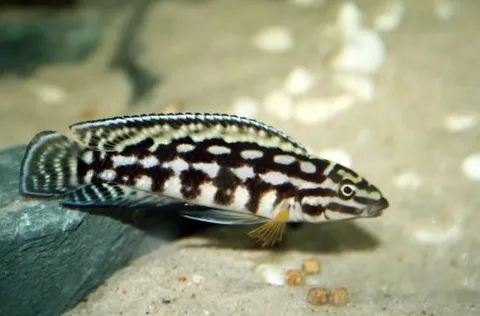
Julidochromis marlieri
Julidochromis marlieri, known in the aquarium hobby as Marlier's Julidochromis, belongs to the Cichlidae family. These vibrant and active fish exhibit unique features of intraspecific interaction. As they develop, they…
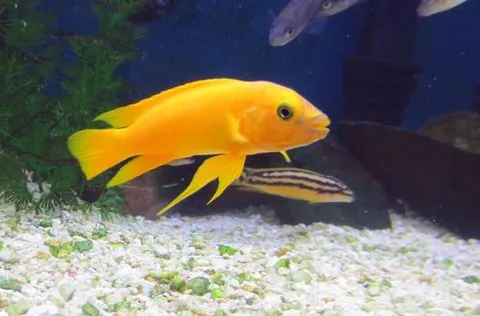
Neolamprologus leleupi
An endemic of the African Lake Tanganyika, located in East Africa, the orange lamprologus, or lemon cichlid (scientific name Neolamprologus leleupi), belongs to the family Cichlidae. These fish are found along rocky…
Julidochromis transcriptus
The Masked Julie, also known by its scientific name Julidochromis transcriptus, belongs to the Cichlidae family. These agile fish always attract attention with their activity. They are not difficult to keep and breed,…