Temperature23 – 27 °C
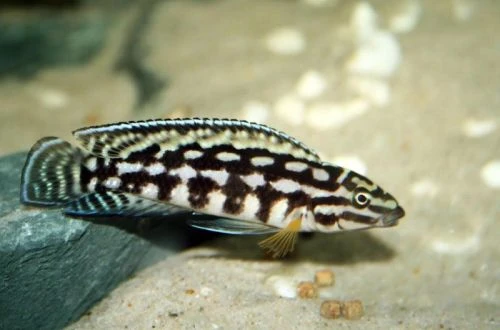
Julidochromis marlieri, known in the aquarium hobby as Marlier's Julidochromis, belongs to the Cichlidae family. These vibrant and active fish exhibit unique features of intraspecific interaction. As they develop, they are capable of forming a permanent male-female pair that remains throughout their life cycle. Keeping and breeding this species is not particularly difficult, and they coexist well with many inhabitants of their natural habitat. Nevertheless, due to the specifics of their behavior, this species is not recommended for aquarists taking their first steps in this hobby.
Adults grow to approximately 15 centimeters in length. Sexual dimorphism is not pronounced, making it extremely difficult for an inexperienced observer to distinguish males from females. The fish's body is adorned with a characteristic pattern of large white spots arranged in rows on a dark background. The fins and caudal fin are edged with a thin blue line.
This species is endemic to Lake Tanganyika, located in Africa and divided among four countries, with the largest part of the coastline belonging to Tanzania and the Democratic Republic of Congo. These fish inhabit rocky coastal areas in the northern and southern parts of the lake.
Marlier's Julidochromis are territorial fish, so in small aquariums, they will actively fight with conspecifics for their section of the bottom. This rivalry can sometimes be very aggressive, occasionally leading to the death of a weaker individual. In large volume aquariums, it is permissible to keep a group of these fish. It is important to remember that as they mature, they form pairs that stay together throughout their lives. They generally treat representatives of other species calmly.
For a single pair of Marlier's Julidochromis, an aquarium of at least 100 liters will be required. The interior design of the aquarium should mimic their natural environment, which is characterized by its simplicity. The main elements are sandy substrate and clusters of stones or rocks forming numerous caves, grottoes, and crevices. To successfully keep these fish, it is crucial to maintain stable water conditions with appropriate hydrochemical parameters. In particular, a powerful filtration system will be needed. Additionally, it is necessary to regularly clean the aquarium of organic pollutants and perform partial water changes weekly, replacing 15–20% of the total volume with fresh water.
For these fish, a diet including frozen meaty or live foods, supplemented with plant components, is necessary. Examples include bloodworms or Artemia in combination with spirulina flakes or finely chopped nori algae. The inclusion of dry sinking foods is possible to provide vitamins and trace elements, but they should not form the basis of the diet.
Breeding Julidochromis is quite simple if a stable pair has already formed. To achieve this, a group of young fish can be purchased; after a year or a year and a half, a suitable male and female will naturally form a pair from among them. An alternative, easier path is to find an already formed adult pair. It is important to remember that simply introducing a male to a female, especially if they did not grow up together, does not guarantee breeding success. In such a situation, the fish may not get along, and in an unfavorable case, the female even risks dying. In suitable conditions, the pair will find a reliable hiding place where they will lay their eggs, the number of which rarely exceeds 100. After the eggs are fertilized, the female remains in the shelter, providing protection to the clutch, while the male vigilantly patrols the approaches to the nest. The incubation period ends in approximately 3 days. Parental care continues until the fry grow to 2 cm. Upon reaching this size, the adult fish are usually ready for a new clutch.
The main cause of most diseases in Lake Tanganyika cichlids is unsuitable keeping conditions and poor-quality food, which often leads, for example, to African Bloat. At the first symptoms, it is necessary first to check the water parameters and ensure there are no high concentrations of dangerous substances such as ammonia, nitrites, and nitrates. If the readings deviate from the norm, they should be brought into order, and only then should treatment begin.
When selecting individuals, pay attention to the fish's activity: healthy Julidochromis should show curiosity, exploring rocks and decorations, rather than constantly hiding in corners. Avoid fish with signs of emaciation, fin damage, or unnatural behavior, such as swaying in place or impaired coordination. Visual inspection should confirm clean scales without white spots, ulcers, or film. It is recommended to purchase a group of young fish (about 6-10 individuals) so that they can independently form a stable pair, as forced pairing of adults often leads to aggressive conflicts and the death of the weaker partner.
The essentials: size, tank volume, water parameters and care
An adult reaches 15 cm in length. Plan the tank around the maximum size: the fish quickly outgrows a cramped setup.
The recommended volume is 100 L. A smaller tank speeds up nitrate build-up and raises stress levels.
Temperature 23–27 °C, pH 7.5–9.5, hardness 10–25 dGH. Stability matters more than exact values: sudden swings are harder on the fish than a small deviation from the ideal.
Around 10 years when kept properly. Lifespan depends directly on tank volume, water quality and a varied diet.
Temperament: semi-peaceful (aggression when space is limited). Keep this in mind when choosing tank mates.
Recommended setup: pair (male/female). Ignoring this is a common cause of stress and disease.
Diet type: mixed diet (meat + plant-based). Feed small portions that are finished within a couple of minutes — overfeeding does more harm than underfeeding.
The scientific name of the species is Julidochromis marlieri, family Cichlids (Cichlidae).
The water suits 114 of 208 plants in the catalogue — the easiest ones are shown first.
African Onion PlantAfzelius's AnubiasAmazon FrogbitAmazon SwordAnacharisAnubiasArrowhead CryptDwarf CloverDwarf CloverDwarf HygrophilaDwarf SagittariaDwarf ValGuppy GrassHornwortJava MossMoneywortMud SwordNair's LagenandraNarrow Leaf AnacharisNarrow-leaf CloverStringy MossTaiwan MossTape GrassUssuri Watermilfoil
Matched by family, categories and overlapping keeping conditions
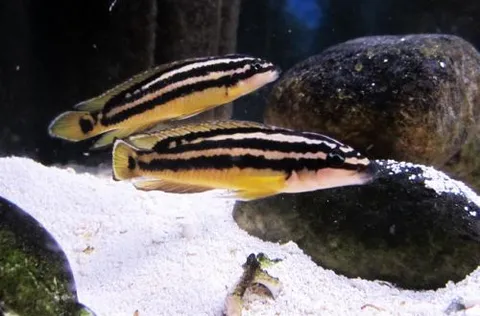
Julidochromis ornatus
Julidochromis ornatus, or Ornate Julie, is a fish from the Cichlidae family. This species is characterized by its activity and bright coloration, as well as exhibiting complex intraspecific interactions. Its keeping and…
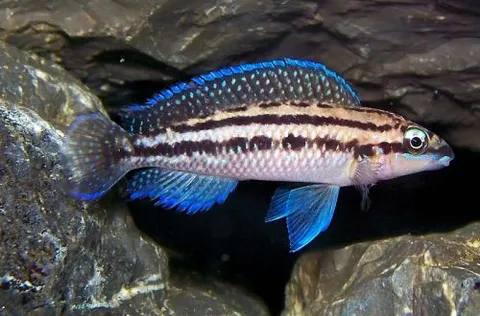
Julidochromis dickfeldi
Julidochromis dickfeldi, scientifically known as Julidochromis dickfeldi, belongs to the Cichlidae family. These fish form strong pair bonds and display pronounced jealousy towards their conspecifics. However, they can…
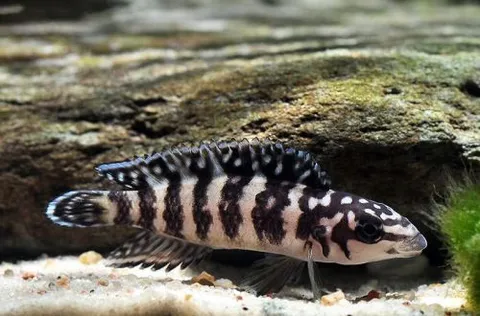
Julidochromis transcriptus
The Masked Julie, also known by its scientific name Julidochromis transcriptus, belongs to the Cichlidae family. These agile fish always attract attention with their activity. They are not difficult to keep and breed,…
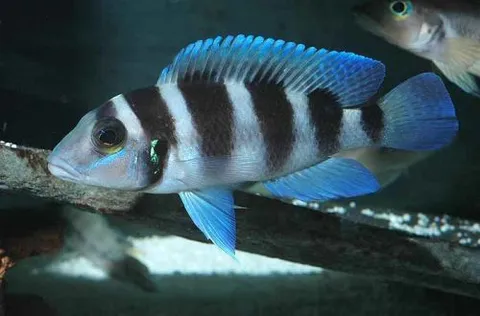
Neolamprologus tretocephalus
Neolamprologus tretocephalus, also known as the Blue Lamprologus or Five-striped Zebra Cichlid, belongs to the Cichlidae family. Despite its vibrant coloration, activity, and relative ease of keeping, the fish exhibits…