Temperature26 – 28 °C
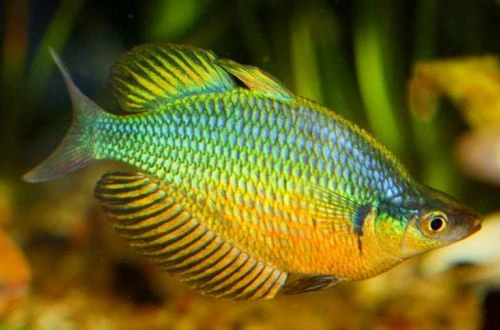
The fish, known by its scientific name Glossolepis kabia, or Kabi Rainbowfish, is a member of the family Melanotaeniidae (Rainbowfishes). Its native habitat is Papua New Guinea, where it lives in the Sepik and Ramu river basins. These two rivers merge during the rainy season, forming an extensive floodplain.
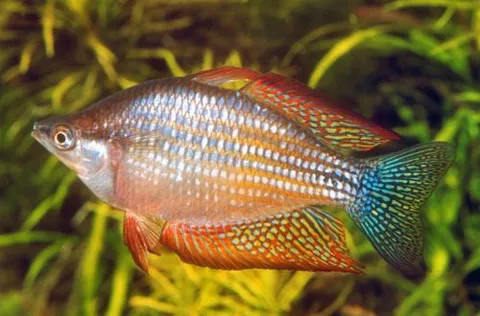
Graduated coloration is characteristic of adult specimens, which reach up to 8 cm in length. The upper part of their body shimmers with greenish or bluish-silver hues. Below, in the abdominal area, orange tones can be observed, created by bright orange stripes that appear particularly contrasting on the belly and are less pronounced on the back.
The species inhabits the Sepik and Ramu river systems on the island of New Guinea. In nature, it populates floodplain waters, swampy lagoons, lakes, and small tributaries. It prefers areas with dense aquatic vegetation, where the water varies from clear to moderately turbid, and the current is absent or weak. Young individuals often gather in groups near submerged snags, branches, or among coastal reed beds.
This peaceful and active fish coexists excellently with its own kind and with other Rainbowfish species. It is recommended to keep a school of 6–8 individuals. Other fish of comparable size and temperament are suitable for harmonious coexistence.
An aquarium of 100–110 liters or more is suitable for keeping Kabi Rainbowfish. Simple decor is preferred: the presence of dense aquatic plants and driftwood shelters will be beneficial. This fish adapts easily to various conditions, and its keeping is not difficult. Aquarium care for Kabi Rainbowfish is similar to the requirements of most aquarium inhabitants: it is necessary to maintain clean water with optimal pH and GH values, and to provide regular feeding. The diet can consist of popular dry, frozen, and freeze-dried foods.
Common dry, frozen, and freeze-dried foods can be used as the basis of their diet.
Reproduction occurs throughout the year, although spawning intensity decreases during the dry season. The fish lay their eggs among fine-leaved plants. The eggs are relatively small, which ensures higher fecundity compared to other rainbowfish species. Fry emerge after a few days and require fine starter food. For successful breeding, it is recommended to keep a group of fish with a predominance of females.
The species is sensitive to deteriorating water quality and the accumulation of organic waste, which can provoke bacterial infections and fin rot. Diseases common to the Melanotaeniidae family, such as ichthyophthiriasis or oodinium, can occur under stress or sharp changes in conditions. Prevention includes regular water changes, maintaining stable environmental parameters, and a complete diet.
When purchasing, choose active individuals with clean fins and no damage to their scales. Healthy fish should show interest in food and have a bright coloration characteristic of the species. Avoid specimens with signs of emaciation, sunken bellies, or apathetic behavior. It is optimal to acquire young individuals, as they adapt more easily to aquarium conditions than adult fish caught in the wild.
The essentials: size, tank volume, water parameters and care
An adult reaches 8 cm in length. Plan the tank around the maximum size: the fish quickly outgrows a cramped setup.
The recommended volume is 100 L. A smaller tank speeds up nitrate build-up and raises stress levels.
Temperature 26–28 °C, pH 6–7.5, hardness 2–15 dGH. Stability matters more than exact values: sudden swings are harder on the fish than a small deviation from the ideal.
Around 5 years when kept properly. Lifespan depends directly on tank volume, water quality and a varied diet.
Temperament: peaceful (regular). Keep this in mind when choosing tank mates.
Recommended setup: medium group (6–8 individuals). Ignoring this is a common cause of stress and disease.
Diet type: any (universal). Feed small portions that are finished within a couple of minutes — overfeeding does more harm than underfeeding.
The scientific name of the species is Glossolepis kabia, family Rainbowfishes (Melanotaeniidae). It also appears in the literature as: Melanotaenia kabia, Melanotaenia rosacea.
The water suits 174 of 208 plants in the catalogue — the easiest ones are shown first.
Afzelius's AnubiasAnacharisAnubiasBrazilian PennywortDwarf CloverDwarf CloverDwarf HygrophilaDwarf SagittariaDwarf ValGuppy GrassHornwortJava FernJava MossMoneywortMud SwordNair's LagenandraNarrow Leaf AnacharisNarrow-leaf CloverSüsswassertangTaiwan MossTape GrassTemple PlantUssuri WatermilfoilWater Wisteria
Matched by family, categories and overlapping keeping conditions
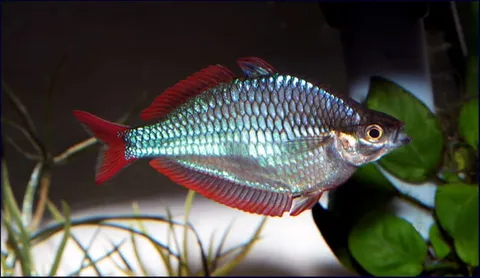
Melanotaenia praecox
Melanotaenia praecox, also known as the Neon Rainbowfish or Dwarf Rainbowfish, is a member of the family Melanotaeniidae. A relatively small schooling fish, it attracts attention with its beautiful neon shimmer in its…
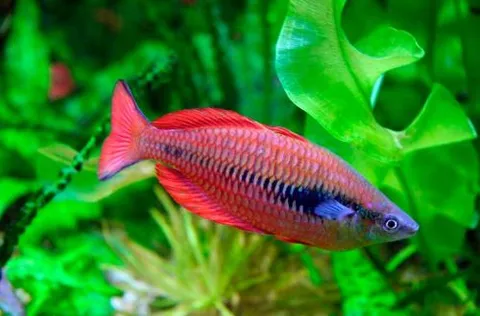
Melanotaenia parva
The scientific name Melanotaenia parva belongs to the family Melanotaeniidae, commonly known as Rainbowfishes. This fish is also known as the Kurumoi Lake Rainbowfish, named after Lake Kurumoi on the Cenderawasih…
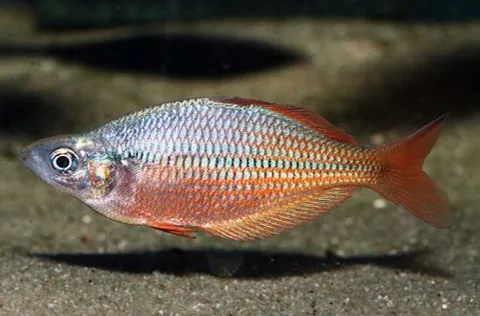
Melanotaenia splendida rubrostriata
The Red-striped Rainbowfish (scientific name Melanotaenia splendida rubrostriata), also known as the Red-banded Rainbowfish, belongs to the family Melanotaeniidae. This species can be an excellent choice even for…
Melanotaenia splendida inornata
The Cherry Rainbowfish, also known as the Cherry Melanotaenia (scientific name Melanotaenia splendida inornata), belongs to the family Melanotaeniidae. It is an excellent choice for beginner aquarists because it is…