Temperature21 – 28 °C
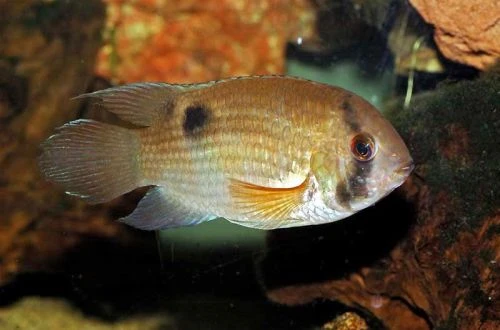
The Keyhole Cichlid, scientifically known as Cleithracara maronii, belongs to the Cichlidae family and is often referred to as the “Keyhole” cichlid. Despite its subdued coloration, this species is valued for its peaceful nature and ease of care, allowing it to play a supporting role in community tanks. These fish perfectly complement more colorful tankmates, and for beginner aquarists, they can serve as an excellent option for gaining initial experience.
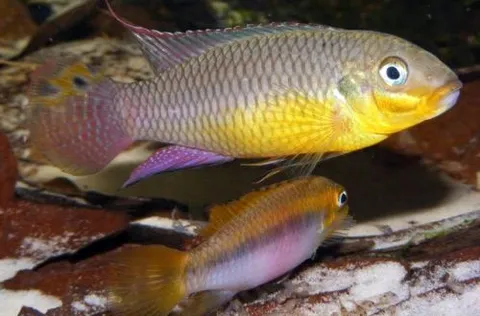
Adult male Keyhole Cichlids reach approximately 11 cm in length and are distinguished by more pointed dorsal and anal fins compared to females. Females are noticeably smaller, with a length of about 7 cm. The body coloration of these fish varies from light gray to yellowish or orange. A characteristic feature is a dark spot located above the lateral line, directly beneath the dorsal fin. Also notable is an oblique vertical stripe crossing the eye, the shape of which resembles a keyhole.
The natural habitat of the Keyhole Cichlid is South America, specifically the territories of modern-day Guyana, Suriname, Venezuela (in the Orinoco River delta region), and the island of Trinidad. They prefer numerous slow-flowing rivers and streams located amidst dense tropical forests. The bottoms of such bodies of water are typically covered with a layer of fallen leaves, branches, and tree fruits. The high concentration of tannins released by organic matter gives the water its characteristic rich brown hue.
The Keyhole Cichlid is a peaceful and calm fish, although it does exhibit territorial behavior. Adult individuals form pairs and occupy a specific area. They get along well not only with their own kind but also with other species of similar size and temperament. Suitable tankmates include characins, some South American cichlids, corydoras, and many others.
For a single pair of Keyhole Cichlids, an aquarium of at least 80 liters is recommended. You can be creative with the decor, but the fish will look most harmonious in conditions that mimic their natural environment: a sandy substrate with several flat stones, plenty of driftwood, and dense plant thickets. Unlike other cichlids, this species is not prone to damaging vegetation, so both artificial and live plants can be used freely. Special attention should be paid to water quality; its parameters should be soft and acidic (low dGH and pH). Essential conditions include a powerful filtration system, regular partial water changes, and timely substrate cleaning. It is important to remember that strong filters can create excessive current, which is not favored by these fish, who prefer calm waters.
These fish readily accept most standard prepared foods designed for aquarium inhabitants. If desired, a nutritious mixture of fresh ingredients can be prepared for them. For example, a common recipe includes finely grated mollusk meat, shrimp, as well as vegetables and fruits. All components are thoroughly mixed with gelatin, rolled into a thin layer, and after setting, cut into small discs, which are then fed to the fish.
Breeding this species is not particularly difficult; no specific conditions are required to obtain offspring. The main requirement is to maintain cleanliness in the aquarium and, as a result, ensure high water quality. The male and female form a permanent pair that remains together even after the breeding season. As a spawning substrate, they choose a flat stone, a wide plant leaf, or a glass surface, to which they attach their eggs with an adhesive substance. The female stays near the clutch, guarding it, while the male defends the boundaries of their territory. Parental care continues even after the fry hatch, sometimes for several months. It is worth noting that young, inexperienced pairs sometimes eat their first brood, especially if they feel threatened by other inhabitants. In a densely populated aquarium, even with parental protection, the chances of offspring survival are low, so a separate tank is often used for successful spawning.
The main cause of most diseases in these fish is unsuitable keeping conditions and poor-quality nutrition. If initial symptoms are observed, it is first necessary to check water parameters and the concentration of dangerous substances such as ammonia, nitrites, and nitrates. If the indicators deviate from the norm, they should be brought back into order, and only then should treatment begin.
When selecting individuals in a store, pay attention to their activity and the cleanliness of their skin. Healthy fish should show curiosity, have no visible injuries, ulcers, white film, or signs of emaciation. Avoid specimens with unnaturally sunken bellies, clamped fins, or fish that constantly hide in a corner and refuse offered food. Since this species is timid, in a store environment, the fish may appear pale or hide, which is a normal stress reaction. However, they should react quickly to external stimuli. It is recommended to purchase young individuals from the same group so that they can later form a stable pair independently.
The essentials: size, tank volume, water parameters and care
An adult reaches 7–11 cm in length. Plan the tank around the maximum size: the fish quickly outgrows a cramped setup.
The recommended volume is 80 L. A smaller tank speeds up nitrate build-up and raises stress levels.
Temperature 21–28 °C, pH 4–7.5, hardness 2–15 dGH. Stability matters more than exact values: sudden swings are harder on the fish than a small deviation from the ideal.
Around 8 years when kept properly. Lifespan depends directly on tank volume, water quality and a varied diet.
Temperament: peaceful (regular). Keep this in mind when choosing tank mates.
Recommended setup: mixed (solitary / pair / group). Ignoring this is a common cause of stress and disease.
Diet type: any (universal). Feed small portions that are finished within a couple of minutes — overfeeding does more harm than underfeeding.
The scientific name of the species is Cleithracara maronii, family Cichlids (Cichlidae). It also appears in the literature as: Acara maronii, Aequidens maronii.
The water suits 198 of 208 plants in the catalogue — the easiest ones are shown first.
Afzelius's AnubiasAnacharisAnubiasBrazilian PennywortDwarf CloverDwarf CloverDwarf HygrophilaDwarf SagittariaDwarf ValGuppy GrassHornwortJava FernJava MossMoneywortMud SwordNair's LagenandraNarrow Leaf AnacharisNarrow-leaf CloverStringy MossSüsswassertangTaiwan MossTape GrassTemple PlantUssuri Watermilfoil
Matched by family, categories and overlapping keeping conditions
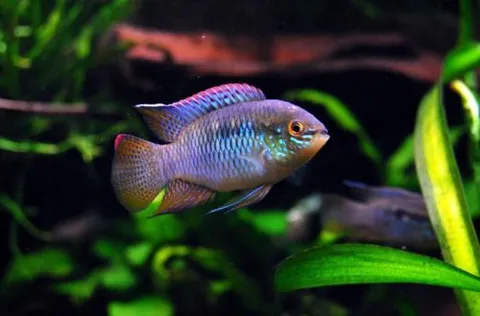
Laetacara curviceps
The Curviceps Acara, scientifically named Laetacara curviceps, belongs to the Cichlidae family. It is a peaceful and brightly colored fish, capable of becoming a beautiful adornment for many tropical aquariums. Its…
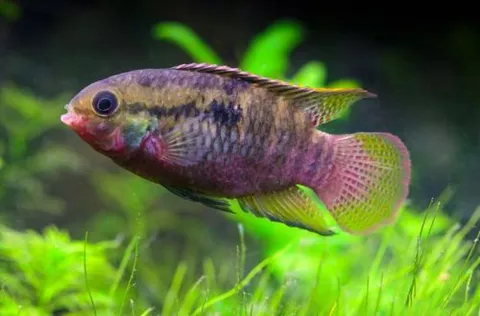
Laetacara dorsigera
The Laetacara dorsigera, otherwise known as the Red-breasted Acara (scientific name Laetacara dorsigera), belongs to the family Cichlidae. This American cichlid is characterized by its peaceful disposition. It does not…
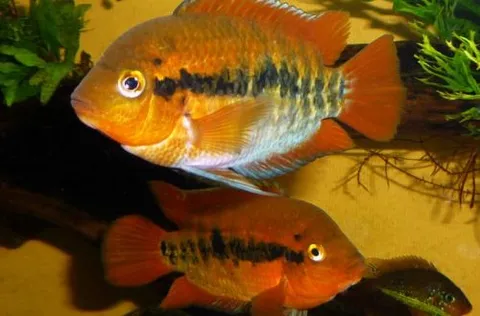
Herotilapia multispinosa
The Yellow Herotilapia, also known as the Rainbow Cichlid (scientific name Herotilapia multispinosa), belongs to the family Cichlidae. Previously, this species was named Archocentrus multispinosus. It is easy to keep…
Pelvicachromis taeniatus
A representative of the Cichlidae family, Kribensis taeniatus, also known by its scientific name Pelvicachromis taeniatus, is an attractive and rather undemanding fish. This fish readily coexists with many other…