Temperature22 – 26 °C
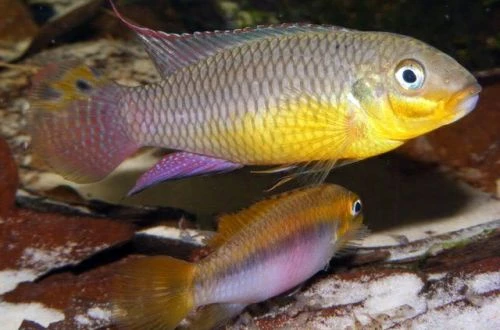
A representative of the Cichlidae family, Kribensis taeniatus, also known by its scientific name Pelvicachromis taeniatus, is an attractive and rather undemanding fish. This fish readily coexists with many other freshwater species. Its keeping and successful breeding do not pose significant difficulties, making it an excellent choice even for beginner aquarists.
Adult males reach approximately 8 cm in size, while females remain somewhat smaller, growing no more than 6 cm. In addition to size differences, males have more elongated dorsal and anal fins. Their coloration is predominantly gray, with a yellow belly and pinkish fins. Females have a similar color pattern, but during spawning, their belly acquires a rich scarlet hue.
The natural habitat of this species covers the equatorial part of the African continent, including the territories of Nigeria and Cameroon. Here, Kribensis taeniatus inhabits rivers and streams that flow under the canopy of tropical forests. The bodies of water they inhabit are characterized by slow currents and abundant aquatic vegetation. The bottom is often strewn with numerous snags, fallen leaves, and other organic debris.
These fish are distinguished by their calm and peaceful disposition, which makes them compatible with other non-aggressive species of comparable size. It is important to avoid introducing large, overly active, or, even worse, predatory fish into the aquarium. During the breeding period, the male's behavior changes: he selects a suitable area on the aquarium bottom for the future clutch and aggressively defends it from potential competitors. However, this usually does not pose a serious danger to other inhabitants. It is recommended to keep them in pairs or groups, with several females per male. It is also desirable for the fish to grow up together from a young age. It has been observed that newly introduced conspecifics may be attacked. For this reason, it is preferable to acquire fish from a single breeder, already accustomed to cohabitation.
For comfortable living for one pair of these fish, the minimum aquarium volume should be at least 60 L. Sand or fine gravel is preferred as a substrate. The decor should include both live and artificial plants, as well as many shelters. These can be not only snags but also various decorative elements or even ordinary ceramic pots lying on their side, creating cave-like structures. Plants should be arranged in dense groups in certain areas, leaving open spaces for swimming. The fish appreciate subdued lighting, so shade-loving plant varieties are best. The key to successful keeping is maintaining stable water conditions and regular aquarium maintenance. The hydrochemical composition of the water should be slightly acidic in pH with low carbonate hardness. To maintain high water quality, it is necessary to perform weekly water changes of 15–20% of its volume, promptly remove organic waste, and install an effective filtration system. These measures will also help prevent the accumulation of dangerous nitrogen cycle products in the aquarium.
The fish is not particularly demanding about its diet and readily accepts most offered foods. However, if breeding is the goal, the diet should primarily consist of frozen or live foods, such as bloodworms or Artemia nauplii.
Under favorable conditions, breeding Kribensis taeniatus does not present significant difficulties, especially if a stable group of fish has already formed. As mentioned, attempts to combine adult individuals from different aquariums, for example, a male and a female, can lead to problems. For spawning, the male chooses a sheltered spot, resembling a cave, where the female lays her eggs. She stays with the clutch until the fry hatch, while the male guards the approaches to the shelter. The incubation period lasts approximately 2–3 days. After another week, the fry begin to swim freely and leave their shelter. The parents continue to care for the offspring for some time.
Kribensis possesses good endurance. As a rule, diseases are caused by contact with sick fish or a significant deterioration in keeping conditions and the quality of the offered food.
When purchasing, choose active individuals with clean fins and no visible damage or sores on the body. Avoid fish that appear emaciated, have a sunken belly, or stay at the water surface, breathing heavily. In the store, fish may appear pale due to stress, but their coloration should quickly recover in a calm environment. — give preference to individuals from the same aquarium, as introducing new fish to an already established group can lead to intraspecific aggression — carefully observe their behavior: healthy fish show curiosity and explore the bottom, rather than constantly hiding in corners or behind the filter — ask the seller about the keeping conditions and diet to ensure a smooth transition for the fish into your aquarium.
The essentials: size, tank volume, water parameters and care
An adult reaches 6–8 cm in length. Plan the tank around the maximum size: the fish quickly outgrows a cramped setup.
The recommended volume is 60 L. A smaller tank speeds up nitrate build-up and raises stress levels.
Temperature 22–26 °C, pH 5–7, hardness 5–12 dGH. Stability matters more than exact values: sudden swings are harder on the fish than a small deviation from the ideal.
Around 5 years when kept properly. Lifespan depends directly on tank volume, water quality and a varied diet.
Temperament: peaceful (regular). Keep this in mind when choosing tank mates.
Recommended setup: mixed (solitary / pair / group). Ignoring this is a common cause of stress and disease.
Diet type: any (universal). Feed small portions that are finished within a couple of minutes — overfeeding does more harm than underfeeding.
The scientific name of the species is Pelvicachromis taeniatus, family Cichlids (Cichlidae). It also appears in the literature as: Pelmatochromis calliptera, Pelmatochromis klugei, Pelmatochromis kribensis.
The water suits 198 of 208 plants in the catalogue — the easiest ones are shown first.
Afzelius's AnubiasAnacharisAnubiasBrazilian PennywortDwarf CloverDwarf CloverDwarf HygrophilaDwarf SagittariaDwarf ValGuppy GrassHornwortJava FernJava MossMoneywortMud SwordNair's LagenandraNarrow Leaf AnacharisNarrow-leaf CloverStringy MossSüsswassertangTaiwan MossTape GrassTemple PlantUssuri Watermilfoil
Matched by family, categories and overlapping keeping conditions
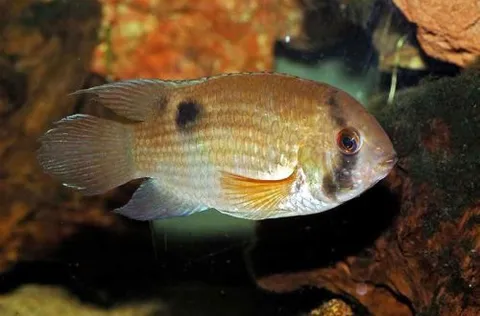
Cleithracara maronii
The Keyhole Cichlid, scientifically known as Cleithracara maronii, belongs to the Cichlidae family and is often referred to as the “Keyhole” cichlid. Despite its subdued coloration, this species is valued for its…
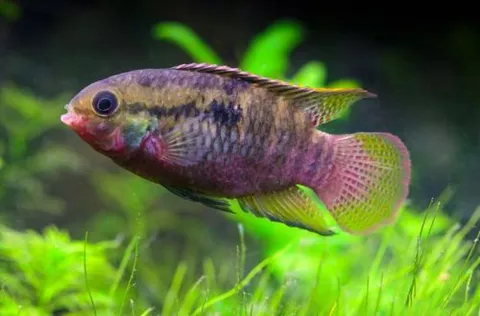
Laetacara dorsigera
The Laetacara dorsigera, otherwise known as the Red-breasted Acara (scientific name Laetacara dorsigera), belongs to the family Cichlidae. This American cichlid is characterized by its peaceful disposition. It does not…
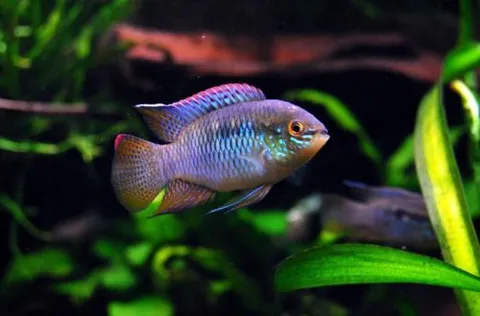
Laetacara curviceps
The Curviceps Acara, scientifically named Laetacara curviceps, belongs to the Cichlidae family. It is a peaceful and brightly colored fish, capable of becoming a beautiful adornment for many tropical aquariums. Its…
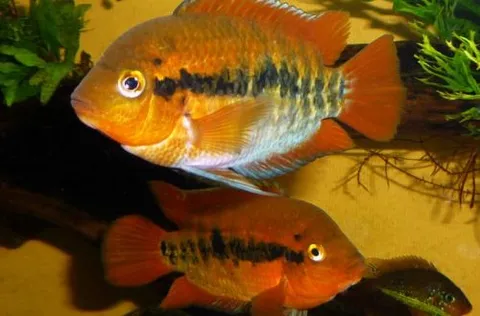
Herotilapia multispinosa
The Yellow Herotilapia, also known as the Rainbow Cichlid (scientific name Herotilapia multispinosa), belongs to the family Cichlidae. Previously, this species was named Archocentrus multispinosus. It is easy to keep…