Temperature24 – 29 °C
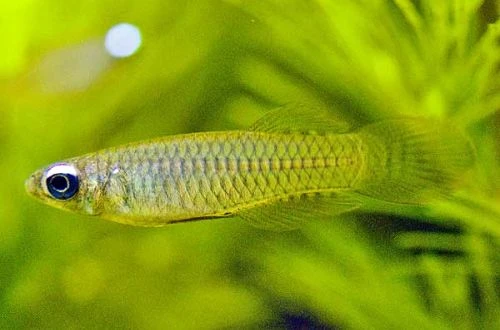
The scientific name Micropanchax kingii groups the Lampeye Killifish with the Poeciliidae family. This is a schooling fish of modest size, reaching only 3 cm in length. Although they may seem unremarkable individually, a group of these tiny, shimmering creatures can transform an aquarium, providing a magnificent spectacle.
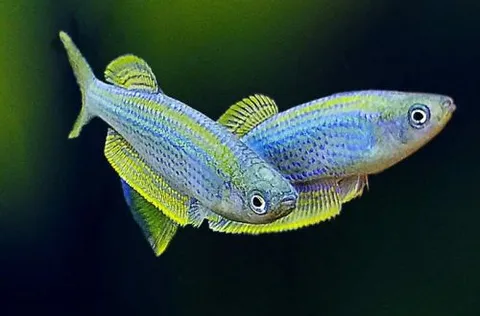
The fish has an elongated and rather slender body, with a slightly flattened head, which positions the mouth high up. The fins, including the caudal fin, are rounded. The dorsal fin is set closer to the rear of the body. The coloration is usually subdued, varying from creamy to light brown hues, often with an iridescent sheen. A characteristic luminous spot on the upper part of the eyeball stands out particularly, becoming brightly visible under good lighting.
This species is widely distributed throughout the aquatic systems of Central Africa, covering territories of modern states such as Chad, Cameroon, Sudan, and Nigeria. They can be found in lakes, marshy areas, and shallow river waters. Their diet primarily consists of insect larvae, various invertebrates, and small crustaceans.
Lampeye killifish are schooling and peaceful fish; they should be kept in groups of at least 5–6 individuals. The larger the 'school,' the more comfortable the fish will feel, so it is recommended to acquire as many as possible. They coexist well with other small aquarium fish species. However, it should be remembered that any large inhabitants pose a potential threat to them.
Despite the small size of these fish, the aquarium volume should not be less than 80 liters, providing sufficient swimming space. A key condition for successful keeping is maintaining high water quality, so effective filtration and regular partial water changes (approximately 25–30%) every 4–5 days are necessary. In addition to a filter, the minimum equipment set includes a heater, aerator, and lighting system. It is recommended to have a lid on the aquarium, as Lampeye Killifish can easily be startled by sudden noises, bumps, or abrupt turning on/off of lights, which can provoke panic and accidental jumping out of the water. Using a dark substrate in the decor helps to highlight the fish's light coloration. Dense plant thickets serve as important hiding places, which is especially relevant for such miniature inhabitants.
This species is carnivorous, representing small predators. In home conditions, they should be offered frozen or live foods, such as daphnia, cyclops, or brine shrimp. It is also acceptable to include finely chopped frozen products like fish, shrimp, or worms in their diet.
Due to conflicting information regarding the breeding of this species in home conditions, beginners should not expect easy offspring from Lampeye Killifish. In nature, the reproduction process occurs by scattering eggs on fine-leaved aquatic vegetation. Fry hatch after 2–4 weeks, depending on environmental conditions, with water purity being critically important for their successful development.
Under conditions where all keeping parameters are normal, health problems rarely arise. Nevertheless, the high demands for water quality mean that the risk of diseases, especially bacterial infections, should not be underestimated.
When choosing Lampeye Killifish, preference should be given to active individuals with clean, transparent fins and no visible body damage. It is important to ensure that the fish show no signs of emaciation or skin lesions, as this species is sensitive to transport conditions and water quality. Healthy fish should exhibit schooling behavior and the characteristic eye sparkle, which is a species-specific trait. Since this species is rarely widely available, when purchasing, it is necessary to clarify the keeping conditions at the store and carefully inspect neighboring aquariums for the absence of infectious diseases. Avoid purchasing individuals that keep to themselves, appear sluggish, or show signs of bacterial lesions, as the adaptation of such fish to new conditions is extremely difficult.
The essentials: size, tank volume, water parameters and care
An adult reaches 3.5 cm in length. Plan the tank around the maximum size: the fish quickly outgrows a cramped setup.
The recommended volume is 80 L. A smaller tank speeds up nitrate build-up and raises stress levels.
Temperature 24–29 °C, pH 6.5–7, hardness 4–8 dGH. Stability matters more than exact values: sudden swings are harder on the fish than a small deviation from the ideal.
Around 3 years when kept properly. Lifespan depends directly on tank volume, water quality and a varied diet.
Temperament: peaceful (regular). Keep this in mind when choosing tank mates.
Recommended setup: schooling (usually from 5–6 individuals and more). Ignoring this is a common cause of stress and disease.
Diet type: meat / protein (live, frozen, fresh). Feed small portions that are finished within a couple of minutes — overfeeding does more harm than underfeeding.
The scientific name of the species is Micropanchax kingii, family Poeciliidae. It also appears in the literature as: Haplochilichthys bukobanus, Haplochilichthys kingi, Haplochilus kingii.
The water suits 195 of 208 plants in the catalogue — the easiest ones are shown first.
Afzelius's AnubiasAnacharisAnubiasBrazilian PennywortDwarf CloverDwarf CloverDwarf HygrophilaDwarf SagittariaDwarf ValGuppy GrassHornwortJava FernJava MossMoneywortMud SwordNair's LagenandraNarrow Leaf AnacharisNarrow-leaf CloverStringy MossSüsswassertangTaiwan MossTape GrassTemple PlantUssuri Watermilfoil
Matched by family, categories and overlapping keeping conditions
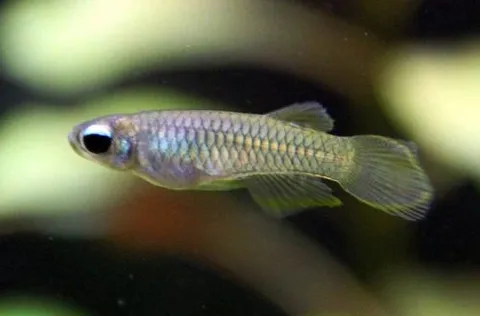
Poropanchax normani
Norman's Lampeye, also known as Poropanchax normani, belongs to the family Poeciliidae (livebearers). These peaceful schooling fish are easy to keep and breed, making them a wonderful addition to any freshwater…
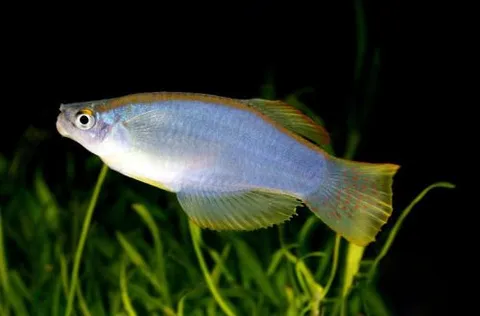
Procatopus similis
The Nigerian or Iridescent Lampeye, scientifically known as Procatopus similis, is a member of the Poeciliidae family. Despite its modest size, this fish attracts attention with its amazing, iridescent body coloration,…
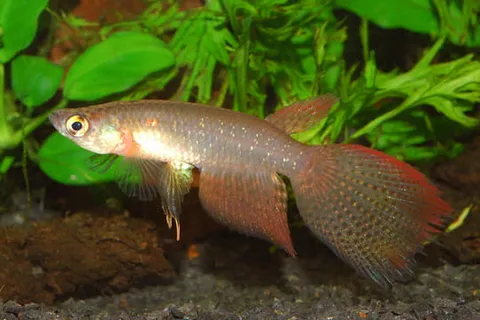
Pterolebias longipinnis
Pterolebias longipinnis, known as the Golden Pterolebias, belongs to the family Rivulidae. These fish are rarely found outside their natural habitat. The reason for this is their very short lifespan, usually not…
Lamprichthys tanganicanus
The Tanganyika Killifish, also known as Lamprichthys tanganicanus, belongs to the family Poeciliidae. It is noteworthy that, despite its common name, it is not related to traditional Killifish. However, it is a close…