Temperature24 – 26 °C
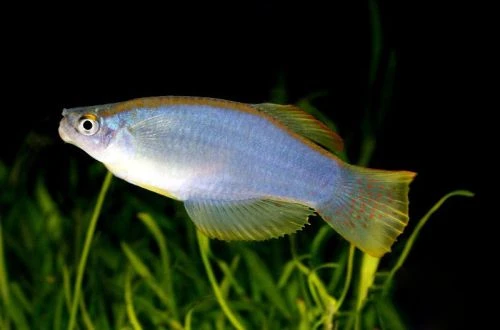
The Nigerian or Iridescent Lampeye, scientifically known as Procatopus similis, is a member of the Poeciliidae family. Despite its modest size, this fish attracts attention with its amazing, iridescent body coloration, displaying a multitude of hues. It can truly adorn an aquarium, but its care requires some experience and is therefore not recommended for beginner aquarists.
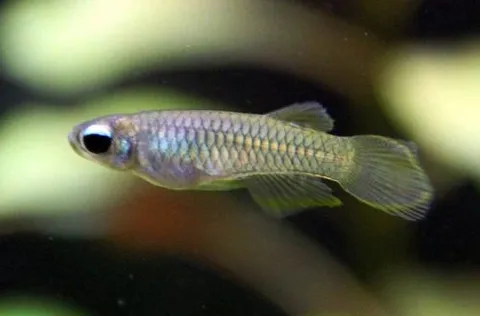
This fish is relatively small, reaching a length of about 6 cm. Its body is elongated, with a slightly arched back, and its head is slightly flattened from above. The structure of its mouth is optimized for collecting food directly from the water surface. A small spine can be seen on the lower part of the gill cover. The fins are rounded, and the dorsal fin is located closer to the caudal fin. The eye of this fish is adorned with a bright spot that reflects light, creating a glowing effect, which is the basis of its name. The coloration is characterized by iridescence and smooth transitions between various colors. The main part of the body has a blue-green tint, which smoothly changes to pale white on the belly. A red stripe runs along the back, continuing onto the tail. The caudal fin can be yellowish or blue, dotted with dark spots. Males differ from females in their brighter and more expressive coloration.
European researchers first discovered this species in 1927, while studying the fauna and flora in the colonial possessions of Central Africa. Lampeyes inhabit fast-flowing coastal and lowland rivers and streams found in the territories of modern Nigeria, Equatorial Guinea, and neighboring countries. Their diet consists of insect larvae, small aquatic crustaceans, and river worms.
This peaceful, even somewhat timid species, coexists perfectly with other calm fish that can adapt to conditions of constant water flow. It is important to note that they should be kept in groups of at least 6 individuals.
Keeping the Iridescent Lampeye is associated with certain difficulties, mainly due to the species' extreme sensitivity to water purity and quality. It is crucial to ensure high-performance filtration, as well as weekly water changes of 30% of the volume, which is a mandatory condition. After each feeding, food residues should be carefully removed to avoid contamination of the aquarium with decomposition products. An effective filtration system will simultaneously create the necessary current. To maintain a sufficient oxygen level, an aerator with several diffusers will be required. In addition, important equipment includes a heater and a lighting system. For decor, a dark substrate is preferred, which will advantageously highlight the fish's coloration. Any substrate that is easily cleaned with a siphon, such as fine gravel or coarse sand, will work. Plants are recommended to be planted in separate pots, which will prevent damage to their roots during regular substrate cleaning. Although floating plants can reduce the fish's desire to jump out of the aquarium (which is characteristic of all Killifish), a lid will handle this task more reliably.
As a carnivorous species, these fish in a home aquarium should receive a variety of fresh or frozen meaty foods in sufficient quantities, such as Artemia, bloodworms, or mosquito larvae.
Breeding in home conditions presents significant difficulty, as there is no single reliable method to stimulate spawning. If you still wish to attempt this, it is recommended to seek help from experienced breeders.
Procatopus similis is not the hardiest species. Even minor changes in water quality immediately affect the fish's well-being, leading to common problems such as bacterial infections.
When selecting individuals, attention should be paid to their activity and the cleanliness of their skin. Healthy fish should be mobile, have bright coloration, and clean, undamaged fins. Avoid purchasing specimens with signs of emaciation, sunken bellies, plaque, or spots on the body, as the species is extremely sensitive to keeping conditions and transport stress. Given their timid nature, fish may hide in the store, so it is important to assess their behavior during feeding: healthy individuals show interest in food. It is recommended to acquire a group of 6 or more individuals, as solitary keeping causes them severe stress. Before purchasing, clarify the conditions in which the fish were kept to avoid a sharp transition to different water parameters.
The essentials: size, tank volume, water parameters and care
An adult reaches 6 cm in length. Plan the tank around the maximum size: the fish quickly outgrows a cramped setup.
The recommended volume is 120 L. A smaller tank speeds up nitrate build-up and raises stress levels.
Temperature 24–26 °C, pH 6–8, hardness 5–12 dGH. Stability matters more than exact values: sudden swings are harder on the fish than a small deviation from the ideal.
Around 4 years when kept properly. Lifespan depends directly on tank volume, water quality and a varied diet.
Temperament: peaceful, active/mobile. Keep this in mind when choosing tank mates.
Recommended setup: medium group (6–8 individuals). Ignoring this is a common cause of stress and disease.
Diet type: meat / protein (live, frozen, fresh). Feed small portions that are finished within a couple of minutes — overfeeding does more harm than underfeeding.
The scientific name of the species is Procatopus similis, family Poeciliidae. It also appears in the literature as: Procatopus abbreviatus, Procatopus glaucicaudis, Procatopus glaucicaudus.
The water suits 196 of 208 plants in the catalogue — the easiest ones are shown first.
Afzelius's AnubiasAnacharisAnubiasBrazilian PennywortDwarf CloverDwarf CloverDwarf HygrophilaDwarf SagittariaDwarf ValGuppy GrassHornwortJava FernJava MossMoneywortMud SwordNair's LagenandraNarrow Leaf AnacharisNarrow-leaf CloverStringy MossSüsswassertangTaiwan MossTape GrassTemple PlantUssuri Watermilfoil
Matched by family, categories and overlapping keeping conditions
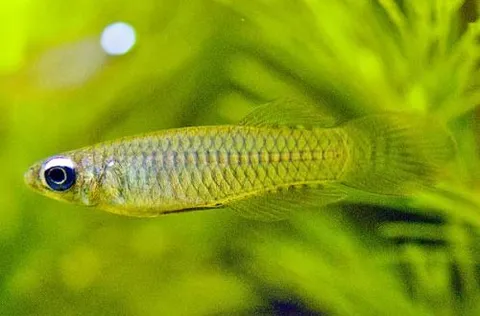
Micropanchax kingii
The scientific name Micropanchax kingii groups the Lampeye Killifish with the Poeciliidae family. This is a schooling fish of modest size, reaching only 3 cm in length. Although they may seem unremarkable individually,…
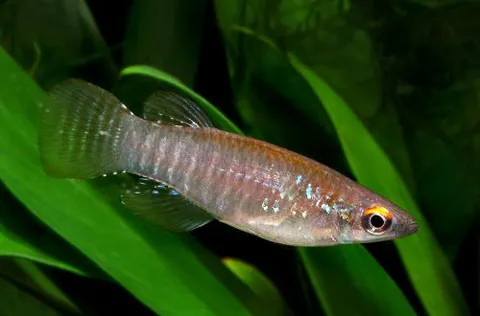
Aplocheilichthys spilauchen
Aplocheilichthys spilauchen, known scientifically as Aplocheilichthys spilauchen, is a member of the Poeciliidae family. This small but elegant fish attracts attention with its unusual coloration. It looks particularly…
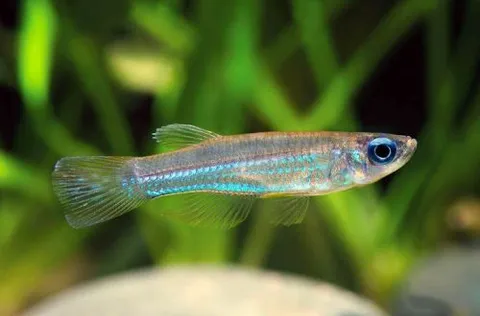
Poropanchax luxophthalmus
The Neon Lampeye, scientifically known as Poropanchax luxophthalmus (formerly classified as Aplocheilichthys luxophthalmus), is a member of the Poeciliidae family. This beautiful schooling fish is easy to keep and…
Poropanchax normani
Norman's Lampeye, also known as Poropanchax normani, belongs to the family Poeciliidae (livebearers). These peaceful schooling fish are easy to keep and breed, making them a wonderful addition to any freshwater…