Temperature23 – 25 °C
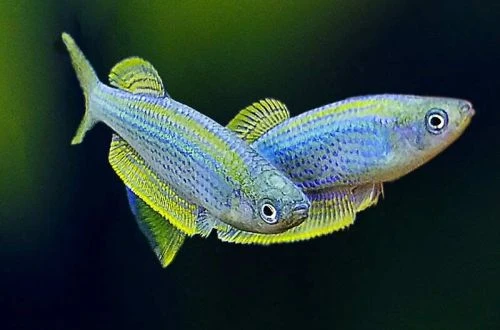
The Tanganyika Killifish, also known as Lamprichthys tanganicanus, belongs to the family Poeciliidae. It is noteworthy that, despite its common name, it is not related to traditional Killifish. However, it is a close relative of Guppies, Swordtails, and Platies, although it differs from them in its reproductive method: it is not live-bearing but lays eggs.
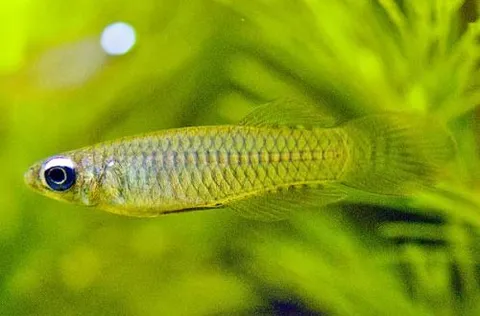
Adults grow up to 15 cm in length. Males have a yellow-grey coloration adorned with numerous rows of blue dotted lines, consisting of so-called “luminescent” speckles. Their anal fin is quite long and extends from the middle of the belly to the tail. Females appear significantly more modest: their coloration is predominantly solid silver. There are also differences in the size and shape of the anal fin in females — it is short and triangular.
This species is endemic to Lake Tanganyika, located in the eastern part of the African continent. Its natural habitats are the coastal waters of the lake, where it prefers to stay in open areas.
This is a peaceful, active fish that needs the company of its own kind; therefore, it is recommended to keep them in schools of at least 6–8 individuals. Males may compete with each other for the attention of females, but their rivalry is purely for display, and no cases of injury among them have been observed. Despite the fact that this fish originates from Tanganyika, it should not be housed with cichlids living in the same lake. In limited aquarium space, there is a high probability that territorial cichlids may attack harmless Lamprichthys. However, schooling species such as Cyprichromis leptosoma get along quite well with them.
For a small school of 6–8 individuals, the optimal aquarium volume starts from 200 liters. The decor can be simple, as the typical biotope of Lake Tanganyika is not very diverse. It mainly consists of rock formations and sandy shoals, and similar aquarium decoration will be quite acceptable. Adding Vallisneria thickets will help introduce green accents to the design. The water in the lake is characterized by high pH and GH values; these parameters must be created and maintained in the aquarium. For this purpose, it is extremely important to regularly perform partial water changes with fresh water and remove accumulating organic waste, which can negatively affect the hydrogen index. The fish can be excessively sensitive to sudden light activation. The contrast between night and day can cause the fish anxiety, prompting them to hit the aquarium walls. Therefore, in the morning, before turning on the main aquarium lighting, it is advisable to first turn on the room light for some time. If the light fixture is equipped with brightness control, morning lighting should start at minimum values, gradually bringing them up to the usual level.
It is recommended to include a mix of live and frozen foods in their diet, such as Artemia, mosquito larvae, and Daphnia. Nevertheless, some aquarists successfully feed them exclusively with high-quality dry foods, which, as it turns out, does not negatively affect either the fish's coloration or their reproductive capacity.
As mentioned earlier, Lamprichthys tanganicanus belongs to the same family as many popular aquarium livebearers (e.g., Guppies, Swordtails). However, through evolution, it has retained its traditional method of reproduction — by laying eggs. In their natural habitat, the fish lay eggs in rock crevices, where they are relatively safe. In aquarium conditions, in the absence of suitable shelters, the eggs can be scattered throughout the bottom.
Lamprichthys tanganicanus is extremely sensitive to any mechanical damage to its scales and fins. Even minor injuries sustained during transportation or sudden movements quickly lead to the development of secondary fungal and bacterial infections, which often result in the death of the fish. The species tolerates poorly elevated nitrate levels and organic waste in the water, which provokes a weakening of the immune system. Prevention includes maintaining stable water parameters, regular water changes, and eliminating stress factors, such as sudden lighting activation, which can cause fish to injure themselves on decorations or aquarium walls.
When purchasing, active individuals with undamaged fins and scales should be chosen, as any signs of lesions indicate a high risk of fish mortality. It is recommended to acquire young individuals up to 6 cm in size, as they tolerate transportation and adaptation to new conditions more easily. In the store, it is important to pay attention to the behavior of the fish: healthy individuals stay in a school, are active, and do not show signs of timidity or apathy. Avoid purchasing fish if there are individuals in the aquarium with visible growths, ulcers, or fin rot.
The essentials: size, tank volume, water parameters and care
An adult reaches 15 cm in length. Plan the tank around the maximum size: the fish quickly outgrows a cramped setup.
The recommended volume is 200 L. A smaller tank speeds up nitrate build-up and raises stress levels.
Temperature 23–25 °C, pH 8–8.5, hardness 14–25 dGH. Stability matters more than exact values: sudden swings are harder on the fish than a small deviation from the ideal.
Around 5 years when kept properly. Lifespan depends directly on tank volume, water quality and a varied diet.
Temperament: peaceful (regular). Keep this in mind when choosing tank mates.
Recommended setup: group (8–10 individuals). Ignoring this is a common cause of stress and disease.
Diet type: any (universal). Feed small portions that are finished within a couple of minutes — overfeeding does more harm than underfeeding.
The scientific name of the species is Lamprichthys tanganicanus, family Poeciliidae. It also appears in the literature as: Haplochilus tanganicanus, Lamprichthys curtianalis, Mohanga tanganicana.
The water suits 70 of 208 plants in the catalogue — the easiest ones are shown first.
Amazon SwordAnacharisArrowhead CryptAsian WatermossBalansa Water TrumpetBarth's SwordBlue BuceBoivin's AponogetonCreeping JennyCrinkled AponogetonDelta ArrowheadDitch StonecropDwarf CloverDwarf CloverDwarf HairgrassEelgrassFeathered LimnophilaGuppy GrassHornwortMoneywortMud SwordNarrow Leaf AnacharisNarrow-leaf CloverUssuri Watermilfoil
Matched by family, categories and overlapping keeping conditions
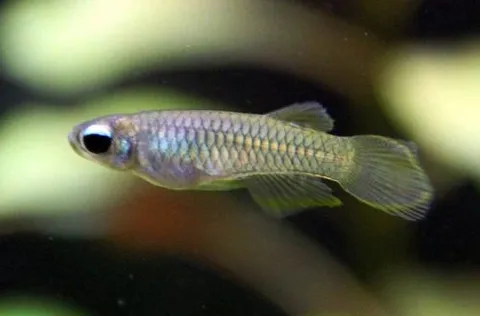
Poropanchax normani
Norman's Lampeye, also known as Poropanchax normani, belongs to the family Poeciliidae (livebearers). These peaceful schooling fish are easy to keep and breed, making them a wonderful addition to any freshwater…
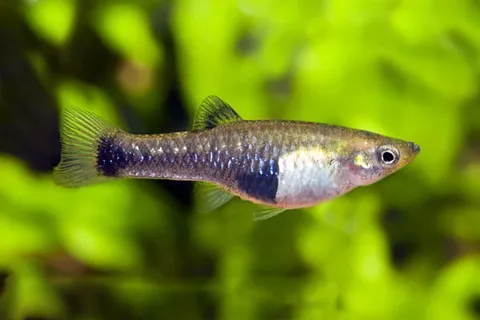
Limia melanogaster
Limia melanogaster, known as the Blackbelly Limia, belongs to the family Poeciliidae. These fish are characterized by their undemanding nature, successful breeding, and good compatibility with various tank mates. Such…
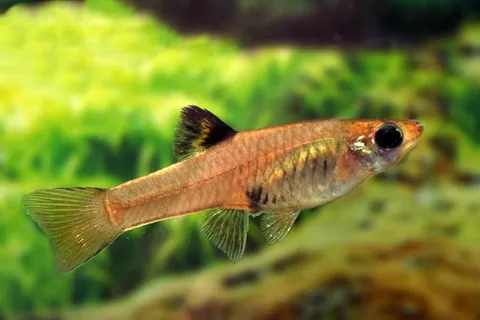
Xenophallus umbratilis
Xenophallus umbratilis, also known as the Golden Teddy, is a species belonging to the family Poeciliidae. This fish boasts an attractive and intense coloration. However, keeping it in an aquarium involves a number of…
Micropanchax kingii
The scientific name Micropanchax kingii groups the Lampeye Killifish with the Poeciliidae family. This is a schooling fish of modest size, reaching only 3 cm in length. Although they may seem unremarkable individually,…