Temperature20 – 24 °C
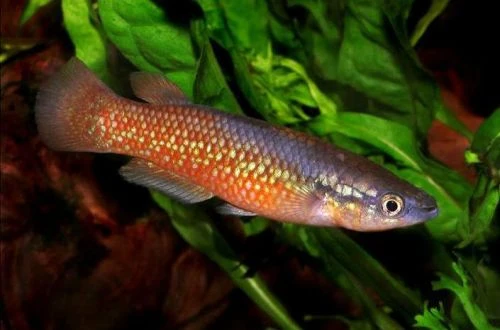
The Madagascar Panchax, also known by its scientific name Pachypanchax sakaramyi, belongs to the family Aplocheilidae. This killifish is remarkably popular among aquarists, despite its critically low numbers in the wild. Many breeders and hobbyists successfully breed it, valuing it for its ease of care and unpretentiousness. Under suitable conditions, it regularly produces offspring.
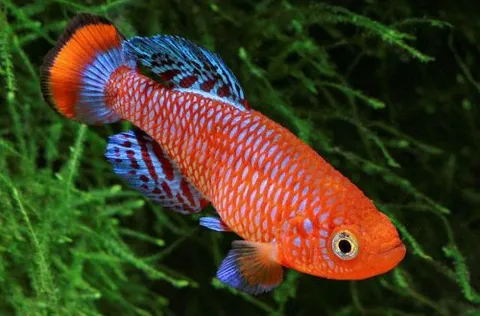
This species is a rather large representative of the killifish group; adult specimens in an aquarium can grow up to 9 cm in length. A distinctive feature of males is their size; they are larger than females and have a bright reddish body coloration, speckled with light spots, and their back shimmers with a violet hue. Females, in contrast, appear duller; their coloration is silvery, and the characteristic spots on their body are barely noticeable and very faint.
The natural habitats of this species are found in a few river systems in northern Madagascar, near Antsiranana. It occurs in both fast-flowing mountain streams and rivers flowing through plains under the canopy of tropical forests, where aquatic vegetation is not abundant. Nowadays, encountering this species in the wild has become almost impossible. This is due to the deterioration of its natural habitat, caused by anthropogenic impacts such as deforestation, reduced river flow, and pollution. Additionally, the Panchax faces severe competition from invasive species introduced by humans, such as gambusia.
This is a relatively peaceful fish, capable of coexisting with most other species of similar temperament, however, smaller fish may become targets of harassment or attack. Within the species, relationships are built around the dominance of an alpha male. When keeping multiple males, skirmishes are inevitable, although they rarely lead to serious physical injuries. Nevertheless, the optimal solution remains a group consisting of one male and two or three females.
A group of several adult specimens will feel comfortable in a tank of 80 L or more, with the principle of "the bigger, the better" applying. The decor can be quite simple: use several plants with large leaves, including floating ones. Sand or stones, supplemented with large boulders placed throughout the bottom, are suitable as substrate. Equipment required includes a heater, lighting system, and aerator. Special attention should be paid to the choice of filtration. It is recommended to purchase the most powerful filtration system possible, commensurate with your financial capabilities and the volume of the aquarium, as the Madagascar Panchax requires crystal clear water and tolerates any pollution poorly. If this is not possible, it will be necessary to increase the volume of weekly water changes from 15–20% to 30%. It is important that the replacement water is identical to the aquarium water in terms of temperature and hydrochemical parameters (pH and dGH).
The fish is undemanding in terms of food and readily accepts any dry food rich in protein. It is desirable to include protein-rich foods in the daily diet, such as mosquito larvae, small flies, worms, bloodworms, or daphnia, which can be offered live or frozen. Feeding is recommended 2–3 times a day, providing an amount of food that will be consumed within 5 minutes; uneaten remnants should be removed immediately.
Offspring can appear throughout the year. Under certain conditions, spawning can be organized directly in a community tank. Such conditions include keeping only this species, without representatives of others. There must also be reliable shelters for the fry, such as dense thickets of fine-leaved plants like Java moss or Riccia. The female lays eggs among these plants, and after some time, fry appear there. They remain in these shelters until they reach a sufficient size to swim freely with adults. Parents generally do not eat their offspring, provided they receive an adequate amount of protein-rich food.
In a balanced aquarium where a stable biological system has been established and water purity is maintained, health problems usually do not arise. No specific diseases inherent to this species have been noted either.
When purchasing, choose active, mobile individuals with clean fins and no visible damage or sores on their bodies. Avoid fish with signs of lethargy, clamped fins, or atypical behavior, such as constantly staying at the bottom or in a corner of the aquarium. Given the species' endangered status, it is recommended to acquire specimens only from reputable breeders who can confirm their captive-bred origin, as all individuals in aquarium culture are descended from a limited number of producers.
The essentials: size, tank volume, water parameters and care
An adult reaches 9 cm in length. Plan the tank around the maximum size: the fish quickly outgrows a cramped setup.
The recommended volume is 100 L. A smaller tank speeds up nitrate build-up and raises stress levels.
Temperature 20–24 °C, pH 6.5–7.5, hardness 2–12 dGH. Stability matters more than exact values: sudden swings are harder on the fish than a small deviation from the ideal.
Around 4 years when kept properly. Lifespan depends directly on tank volume, water quality and a varied diet.
Temperament: territorial (often aggressive). Keep this in mind when choosing tank mates.
Recommended setup: harem (1 male and several females). Ignoring this is a common cause of stress and disease.
Diet type: meat with plant additives (omnivores). Feed small portions that are finished within a couple of minutes — overfeeding does more harm than underfeeding.
The scientific name of the species is Pachypanchax sakaramyi, family Aplocheilidae. It also appears in the literature as: Haplochilus playfairii, Pachypanchax playfairii, Panchax sakaramyi.
The water suits 196 of 208 plants in the catalogue — the easiest ones are shown first.
Afzelius's AnubiasAnacharisAnubiasBrazilian PennywortDwarf CloverDwarf CloverDwarf HygrophilaDwarf SagittariaDwarf ValGuppy GrassHornwortJava FernJava MossMoneywortMud SwordNarrow Leaf AnacharisNarrow-leaf CloverStringy MossSüsswassertangTaiwan MossTape GrassTemple PlantUssuri WatermilfoilWater Wisteria
Matched by family, categories and overlapping keeping conditions
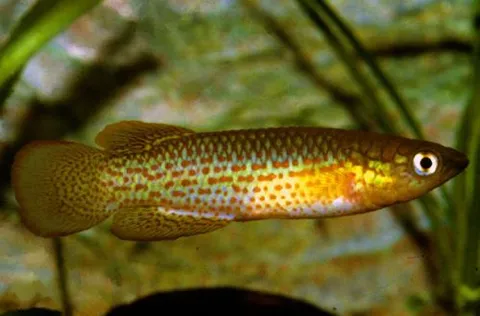
Pachypanchax playfairii
Pachypanchax playfairii, or Playfair's Panchax, belongs to the family Aplocheilidae. This tropical killifish, native to the Seychelles, is quite large among members of the Killifish genus. It exhibits a high degree of…
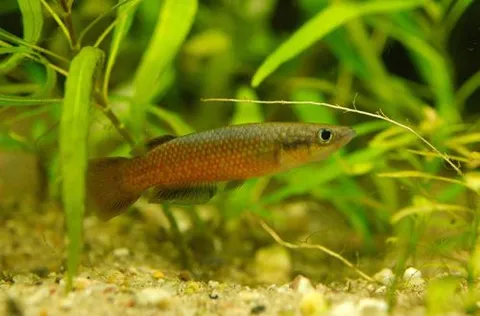
Pachypanchax omalonotus
Pachypanchax omalonotus, or Omalonotus Panchax, belongs to the family Aplocheilidae. This species is well-known in aquaristics and is distinguished by a variety of colorations depending on geographic origin. Numerous…
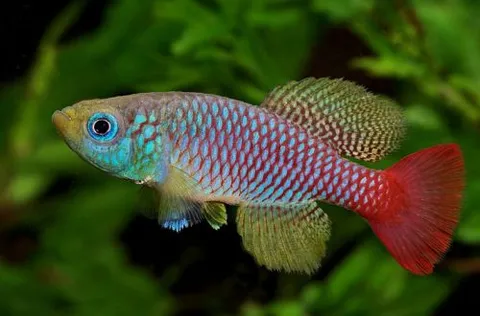
Nothobranchius foerschi
Nothobranchius foerschi, or Foersch's Nothobranch, belongs to the family Nothobranchiidae. This small African fish attracts attention with its beauty, but one of its characteristics is an extremely limited lifespan. In…
Nothobranchius rachovii
Nothobranchius rachovii, more commonly known as Rachow's Nothobranch, is a member of the family Nothobranchiidae. This fish attracts with its bright and beautiful appearance, displaying one of the most colorful guises…