Temperature24 – 28 °C
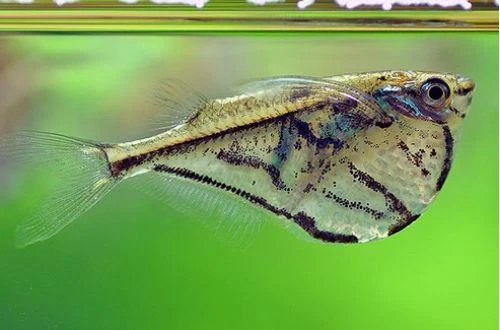
The scientific name Carnegiella strigata belongs to the family Gasteropelecidae, whose name translates to "axe-shaped belly." This name is reflected in the appearance of the marbled hatchetfish or Carnegiella. As an amazing representative of characins, it stands out not only for its unusual body shape but also for its peculiar behavior. The hatchetfish can jump out of the water, pursuing insects flying past, with its pectoral fins helping it in flight like wings.
The first thing that catches the eye when encountering this fish is its shape, resembling a miniature axe or hatchet with a wide blade. The body is noticeably flattened laterally and elongated, with the belly prominently protruding forward. The pectoral fins are positioned perpendicular to the body and, when extended sideways, resemble wings. The mouth is located at the top of the head, which is convenient for feeding from the water surface. The coloration is light, adorned with irregular black stripes creating a marble-like pattern. Differences between males and females are subtle. When viewed from above, the female is only slightly plumper than the male, but during spawning, her belly becomes noticeably rounded.
The habitat of this fish covers the entire Amazon River basin in South America, including territories of countries such as Colombia, Suriname, Peru, and Brazil. It prefers to live in forest streams and channels rich in aquatic vegetation. These fish live in shoals, spending most of their time near the water surface, where they feed on crustaceans and insects.
The marbled hatchetfish is a schooling species, so it is necessary to keep at least 6 individuals. It is peaceful and shy, preferring the company of related species, such as the common hatchetfish, or other small, calm fish from among tetras or catfishes.
This fish is sensitive to water quality and requires a high standard. It is recommended to use a high-performance canister filter. Since each piece of equipment specifies the minimum aquarium size it is designed for, you should choose a filter rated for a larger volume than your aquarium. Excess capacity will help avoid situations where water quality deteriorates due to filter clogging after prolonged operation. Given the fish's preference for acidic water, an alder cone filter medium can be used. Other essential equipment includes an air pump, heater, and lighting system. Floating plants are welcome in the aquarium setup, but it is important to leave open areas on the water surface for feeding. The substrate should preferably be sand; its decoration depends on your taste, as this area of the aquarium is not of particular interest to the fish.
For this carnivorous species, the presence of meat products in the diet, such as bloodworms, is crucial. Although Carnegiella is described as omnivorous in many sources, it cannot survive by feeding exclusively on dry food. The optimal diet should include special dry foods with freeze-dried meat products (it is important to check the ingredients before purchasing), or regular food, always supplemented with protein-rich foods such as mosquito larvae, bloodworms, daphnia, and others. It is extremely important that the food remains floating, as food that sinks to the bottom will be ignored.
Breeding marbled hatchetfish requires certain efforts and the organization of a separate tank. A spawning aquarium of at least 40 liters will provide comfortable conditions for a pair of fish. Initially, the water parameters in the spawning tank should completely match those of the main aquarium. Equipment includes a canister filter (without the need for high performance), a heater, an air pump, and a low-power lighting system. The setup uses both floating plants and rooted species with wide or medium leaves. The substrate should be sand, and decorative elements can be anything, though they can also be omitted. Several females and males are moved into this separate tank. Then, the water is gradually adjusted to 5.5–6.5 dGH. You can add a few dried leaves and a bag of alder cones to the aquarium. The water will become darker, but without cloudiness, as the filter will remove all impurities. Lighting is set to half the intensity compared to the main aquarium. They are fed flying insects (fruit flies, mosquitoes or their larvae, bloodworms). Such environmental conditions should stimulate spawning after some time. The female lays eggs in clusters on plant leaves or their exposed roots, after which the male fertilizes them. After spawning, the parents are returned to the main aquarium to prevent them from eating their own eggs. Fry hatch the very next day and begin free-swimming by the fifth day. They should be fed micro-food, finely ground flakes, granules, or Artemia nauplii.
During acclimatization in a new aquarium, skin diseases are often possible; similar problems also arise with deteriorating water quality. Otherwise, in a balanced aquarium, the fish feels excellent, and health problems usually do not occur.
When purchasing, choose active individuals that stay in a shoal near the water surface. Avoid fish with damaged fins, signs of emaciation, or an unnatural coating on their scales, as the species is sensitive to stress and water quality. Keep in mind that Carnegiella are often prone to skin diseases during adaptation, so carefully inspect them for white spots or sores in the retail aquarium.
The essentials: size, tank volume, water parameters and care
An adult reaches 5 cm in length. Plan the tank around the maximum size: the fish quickly outgrows a cramped setup.
The recommended volume is 60 L. A smaller tank speeds up nitrate build-up and raises stress levels.
Temperature 24–28 °C, pH 5–7, hardness 5–10 dGH. Stability matters more than exact values: sudden swings are harder on the fish than a small deviation from the ideal.
Around 5 years when kept properly. Lifespan depends directly on tank volume, water quality and a varied diet.
Temperament: peaceful (regular). Keep this in mind when choosing tank mates.
Recommended setup: medium group (6–8 individuals). Ignoring this is a common cause of stress and disease.
Diet type: meat with plant additives (omnivores). Feed small portions that are finished within a couple of minutes — overfeeding does more harm than underfeeding.
The scientific name of the species is Carnegiella strigata, family Freshwater Hatchetfish (Gasteropelecidae). It also appears in the literature as: Carnegiella fasciatus, Carnegiella vesca, Gasteropelecus fasciatus.
The water suits 197 of 208 plants in the catalogue — the easiest ones are shown first.
Afzelius's AnubiasAnacharisAnubiasBrazilian PennywortDwarf CloverDwarf CloverDwarf HygrophilaDwarf SagittariaDwarf ValGuppy GrassHornwortJava FernJava MossMoneywortMud SwordNair's LagenandraNarrow Leaf AnacharisNarrow-leaf CloverStringy MossSüsswassertangTaiwan MossTape GrassTemple PlantUssuri Watermilfoil
Matched by family, categories and overlapping keeping conditions
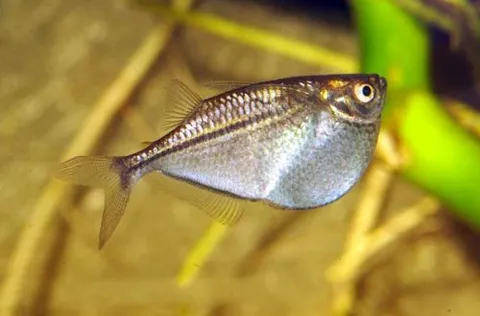
Gasteropelecus levis
The Silver Hatchetfish (scientific name Gasteropelecus levis) belongs to the family Gasteropelecidae. The genus name comes from the Greek gaster ("belly") and pelekys ("hatchet") and refers to the sharply keeled body…
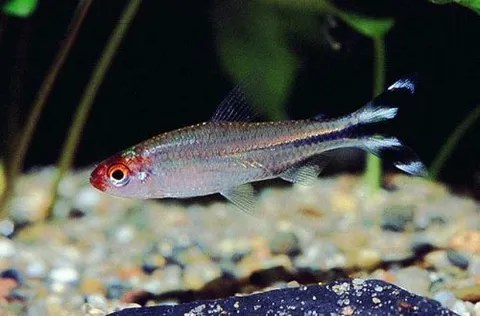
Petitella georgiae
A member of the Acestrorhamphidae family, Petitella georgiae, is scientifically known as the “False Rummy-Nose Tetra” or “False Rummy-Nose.” As its name suggests, this fish bears a striking resemblance to two closely…
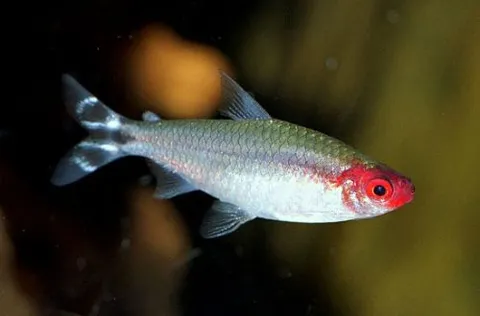
Petitella bleheri
The Bleeding Heart Tetra, also known as the Rummy-nose Tetra (Petitella bleheri), belongs to the family Acestrorhamphidae. Its peaceful nature and availability have made it extremely popular among aquarists worldwide.…
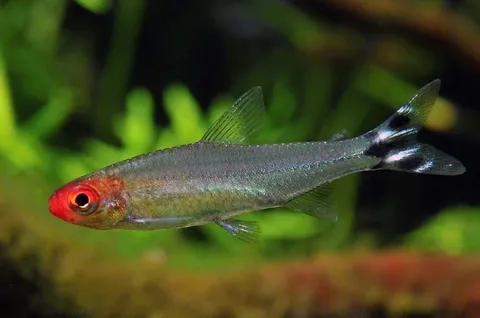
Petitella rhodostoma
The Rummy-nose Tetra, also known by its scientific name Petitella rhodostoma, belongs to the family Acestrorhamphidae. This fish deservedly enjoys popularity because it is quite undemanding, easily coexists with many…