Temperature24 – 28 °C
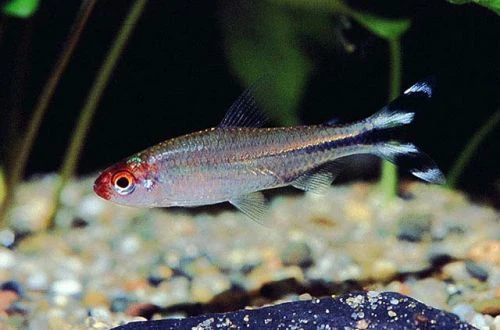
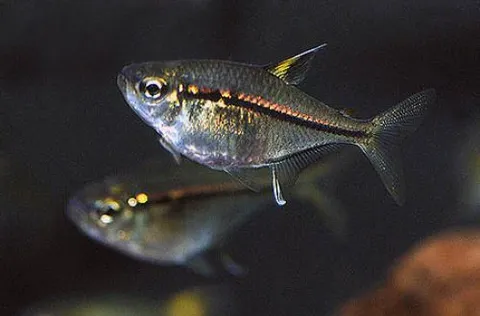
A member of the Acestrorhamphidae family, Petitella georgiae, is scientifically known as the “False Rummy-Nose Tetra” or “False Rummy-Nose.” As its name suggests, this fish bears a striking resemblance to two closely related species—the Rummy-Nose Tetra and the Brilliant Rummy-Nose Tetra. The differences between them are so minimal that even experienced aquarists sometimes struggle with their identification.
Adults reach approximately 5 cm in length. A distinctive feature of their coloration is a gray or silvery body combined with a red head. It is important to note that the red pigment does not extend beyond the gill covers, as is often observed in the Rummy-Nose Tetra, and has a less intense hue compared to the Brilliant Rummy-Nose Tetra. Another unique characteristic shared by all three similar species is the distinctive black and white pattern on the caudal fin. In the False Rummy-Nose Tetra, the central black stripe does not terminate at the tail but smoothly continues along the caudal peduncle.
The native habitat of this fish is South America, where it lives in the vast basins of major Amazon tributaries such as the Purus, Rio Negro, and Madeira, within Peru and Brazil. It prefers small streams and rivers flowing under the dense canopy of tropical forests. The bottom of these waters is typically covered with a layer of fallen leaves, branches, and various snags. The water there is stained dark due to the high concentration of tannins, which are formed by the decomposition of plant organic matter.
The False Rummy-Nose Tetra is characterized by a peaceful disposition and prefers to be in a group of its congeners, so it is advisable to acquire them in schools of at least 10 individuals. These fish coexist well with other calm species of comparable size, such as Apistogramma, other small South American cichlids, Corydoras catfish, tetras, as well as various small barbs and rasboras.
For the comfortable existence of a school of 6–10 individuals, an aquarium of at least 70 liters is recommended. For decor, it is preferable to use a dark substrate with natural driftwood. Although aquatic plants are not mandatory, several floating species can be placed to create subdued lighting. Using leaves and bark from certain tree species is an excellent choice; as they decompose, they will enrich the water with tannins, mimicking natural conditions and giving it a characteristic tea-like tint. Their diet includes almost all types of appropriately sized foods—dry, frozen, and live.
These fish accept almost all appropriately sized foods: dry, frozen, and live. The False Rummy-Nose Tetra is a peaceful species for which it is important to be in the company of its own kind, so it is recommended to acquire them in schools of at least 10 individuals. They coexist well with other peaceful species of comparable size, such as Apistogramma and other small South American cichlids, Corydoras catfish, tetras, as well as various small barbs and rasboras.
Under proper conditions, with a balanced, protein-rich diet, the likelihood of spawning significantly increases. When the breeding period arrives, females either scatter their eggs across the bottom or deposit them among fine-leaved plants, mosses, or ferns, if present in the aquarium. Parental instincts are not developed in these fish, so there is no care for the offspring. They are prone to eating both their own eggs and fry. If breeding is planned, it is advisable to arrange spawning in a separate tank, where males and females are placed in advance. Females can be distinguished by their noticeably enlarged bellies. The hatching of fry from eggs occurs within 24–36 hours. After 3–4 days, they begin to swim freely. From this point, they can be fed special powdered foods, suspensions, or, if available, live foods, such as Artemia nauplii.
The primary threat to the health of these fish is unfavorable keeping conditions. Diseases can also arise from contact with infected new individuals, injuries, or poor nutrition. Upon detecting the first symptoms, the first step should be to thoroughly check the quality of the aquarium environment and rectify any identified problems. If the fish's condition does not improve or worsens, medicinal treatment will be required.
When selecting individuals, attention should be paid to their activity and the integrity of their fins. Healthy fish should swim in a school, show curiosity, and have no visible damage, ulcers, or white spots on their bodies. Avoid purchasing fish that appear lethargic, stay alone near the surface or bottom, or have an unnaturally bloated belly, which may indicate internal organ problems. Since the species is sensitive to environmental quality, it is important to assess the conditions in the seller's aquarium: the water should be clear, without a strong odor, and the coexistence with other species should be peaceful. Signs of stress in individuals in the store may include pale coloration and erratic swimming. It is recommended to purchase a group of 6–10 individuals at once, as solitary keeping negatively affects their behavior and immunity.
The essentials: size, tank volume, water parameters and care
An adult reaches 5 cm in length. Plan the tank around the maximum size: the fish quickly outgrows a cramped setup.
The recommended volume is 70 L. A smaller tank speeds up nitrate build-up and raises stress levels.
Temperature 24–28 °C, pH 5–7, hardness 1–12 dGH. Stability matters more than exact values: sudden swings are harder on the fish than a small deviation from the ideal.
Around 5 years when kept properly. Lifespan depends directly on tank volume, water quality and a varied diet.
Temperament: peaceful (regular). Keep this in mind when choosing tank mates.
Recommended setup: group (8–10 individuals). Ignoring this is a common cause of stress and disease.
Diet type: any (universal). Feed small portions that are finished within a couple of minutes — overfeeding does more harm than underfeeding.
The scientific name of the species is Petitella georgiae, family Acestrorhamphidae.
The water suits 197 of 208 plants in the catalogue — the easiest ones are shown first.
Afzelius's AnubiasAnacharisAnubiasBrazilian PennywortDwarf CloverDwarf CloverDwarf HygrophilaDwarf SagittariaDwarf ValGuppy GrassHornwortJava FernJava MossMoneywortMud SwordNair's LagenandraNarrow Leaf AnacharisNarrow-leaf CloverStringy MossSüsswassertangTaiwan MossTape GrassTemple PlantUssuri Watermilfoil
Matched by family, categories and overlapping keeping conditions
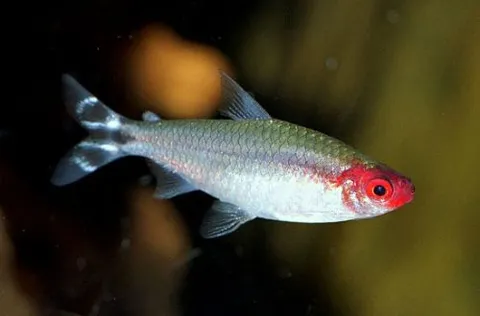
Petitella bleheri
The Bleeding Heart Tetra, also known as the Rummy-nose Tetra (Petitella bleheri), belongs to the family Acestrorhamphidae. Its peaceful nature and availability have made it extremely popular among aquarists worldwide.…
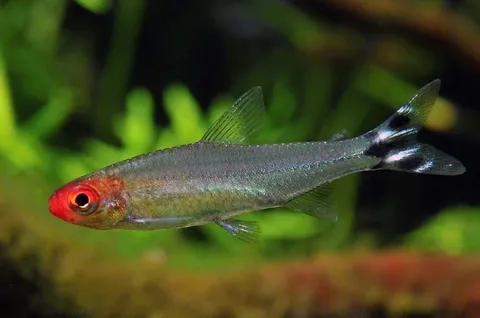
Petitella rhodostoma
The Rummy-nose Tetra, also known by its scientific name Petitella rhodostoma, belongs to the family Acestrorhamphidae. This fish deservedly enjoys popularity because it is quite undemanding, easily coexists with many…
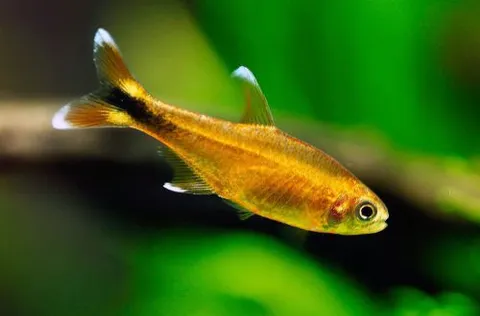
Hasemania nana
The Copper Tetra, also known as Hasemania (scientific name — Hasemania nana), belongs to the family Acestrorhamphidae. This fish is considered an excellent choice for a community tank. Its popularity is due to its…
Hemigrammus ulreyi
Hemigrammus ulreyi, known as Ulrey's Tetra, belongs to the family Acestrorhamphidae. This species is an unpretentious and peaceful fish that easily adapts to a community of other aquarium inhabitants of similar size and…