Temperature24 – 28 °C
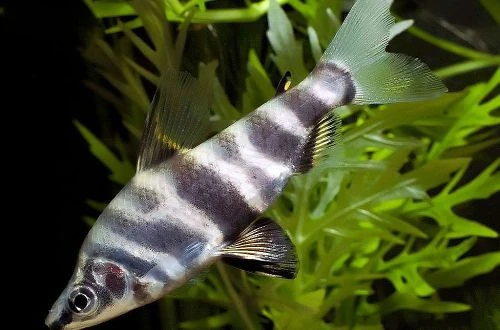
Abramites hypselonotus, known as the Marbled Headstander, is a member of the Anostomidae family. This fish is quite rare in home aquariums, partly due to difficulties in breeding and its peculiar "character". Most specimens available in trade today are wild-caught.
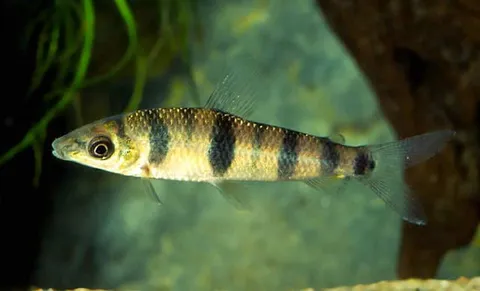
Adults of this fish can reach up to 14 cm in length, with sexual dimorphism being poorly expressed. Their body has a silvery hue, adorned with wide vertical black bands. The fins remain transparent. A distinctive feature is a small hump on the back, which is almost imperceptible in young fish.
The natural habitat of this species extends throughout the Amazon and Orinoco river basins in South America, covering Bolivia, Brazil, Colombia, Ecuador, Guyana, Peru, and Venezuela. Abramites prefer main river channels, their tributaries, as well as backwaters, often with murky water, and areas subject to seasonal floods.
The Marbled Headstander is classified as a conditionally peaceful species, but it can show aggression towards smaller fish or its own kind, and is prone to nipping the long fins of other fish. It is recommended to keep these fish individually in spacious aquariums, in the company of other large and robust species of comparable or slightly larger size.
The wide natural range of the Marbled Headstander makes it undemanding regarding aquarium decor. However, it should be noted that these fish are prone to damaging and eating soft-leaved plants. They also demonstrate high adaptability to various water parameters, which simplifies aquarium preparation, but harbors one potential problem. The conditions at the seller's may differ significantly from those at home. Therefore, before purchasing, it is crucial to find out the key water parameters (pH and dGH) and try to match them as closely as possible to your own conditions. The standard set of aquarium equipment includes a filtration and aeration system, lighting, and a heater. An aquarium lid is essential to prevent the fish from jumping out. Weekly maintenance involves changing 15–20% of the water volume with fresh water and regularly cleaning the substrate of organic debris and uneaten food.
In its natural environment, the Marbled Headstander feeds on a variety of small live foods, such as insects, crustaceans and their larvae, as well as organic detritus, seeds, plant remains, and algae, usually foraging from the bottom. In a home aquarium, live or frozen foods can be offered, such as bloodworms, daphnia, or brine shrimp. It is important to supplement the diet with plant components: these can be finely chopped green vegetables, algae, or special dry flakes with a plant base.
Breeding in home conditions is considered a challenging task. Fish become sexually mature at 1.5–2 years of age. To stimulate spawning, hormonal preparations and a gradual increase in water temperature to 26–28 °C are often used. The spawning tank should be 100–150 liters in volume with soft, slightly acidic water. Spawning is usually in pairs; a female can lay up to 500 eggs. Parents do not care for their offspring and may eat the eggs, so they are removed immediately after the process is complete. The incubation period lasts about a day, after which the larvae begin free swimming. Fry are fed infusoria, rotifers, and brine shrimp nauplii.
Balanced nutrition and properly selected keeping conditions are the best prevention of diseases in freshwater fish. If the first signs of illness appear, such as changes in coloration or behavior, the first step should be to check the water parameters and quality. If necessary, all values should be brought back to normal, and only then should treatment begin.
When purchasing, choose active specimens without visible damage to the skin or fins. It is important to consider that most specimens for sale are wild-caught, so they may experience significant stress during transport and changes in water parameters. — avoid specimens with signs of emaciation or a sunken belly — pay attention to the integrity of the scales and the absence of white spots or film — ask the seller about the current water parameters (pH and general hardness) to ensure smooth adaptation during transfer.
The essentials: size, tank volume, water parameters and care
An adult reaches 14 cm in length. Plan the tank around the maximum size: the fish quickly outgrows a cramped setup.
The recommended volume is 150 L. A smaller tank speeds up nitrate build-up and raises stress levels.
Temperature 24–28 °C, pH 6–7, hardness 2–16 dGH. Stability matters more than exact values: sudden swings are harder on the fish than a small deviation from the ideal.
Around 12 years when kept properly. Lifespan depends directly on tank volume, water quality and a varied diet.
Temperament: peaceful, but may bite fins. Keep this in mind when choosing tank mates.
Recommended setup: mixed (solitary / pair / group). Ignoring this is a common cause of stress and disease.
Diet type: meat with plant additives (omnivores). Feed small portions that are finished within a couple of minutes — overfeeding does more harm than underfeeding.
The scientific name of the species is Abramites hypselonotus, family Anostomidae. It also appears in the literature as: Abramites microcephalus, Abramites solarii, Abramites ternetzi.
This fish damages plants, especially when its diet is short of vegetable food.
African Onion PlantAfrican Water FernAfzelius's AnubiasAmazon FrogbitAmazon SwordAnacharisAnubiasArrowhead CryptAsian WatermossBalansa Water TrumpetBanana PlantBarth's SwordBeckett's Water TrumpetBladderwort CarpetBlue BuceBog MossBoivin's AponogetonBolivian Chain SwordBrazilian PennywortBroad-leaf Water SpriteBrookweedBrown's LimnophilaBuceCardinal PlantCaribbean MintCarolina Micro SwordChristmas MossCognac AmmanniaCongo AnubiasCreeping JennyCreeping RushCreeping SpotflowerCreeping StaurogyneCrinkled AponogetonCupheaCutleaf WatermilfoilCylindricfruit LudwigiaDark SwordDense MayacaDitch Stonecrop
Matched by family, categories and overlapping keeping conditions
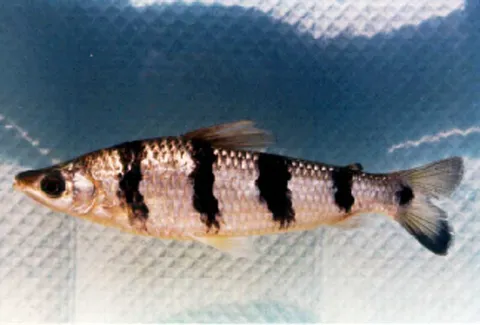
Schizodon fasciatus
The scientific name Schizodon fasciatus refers to the banded Schizodon, a member of the family Anostomidae. This fish is native to South America, where it can be found both in the upper reaches of the Amazon and in…
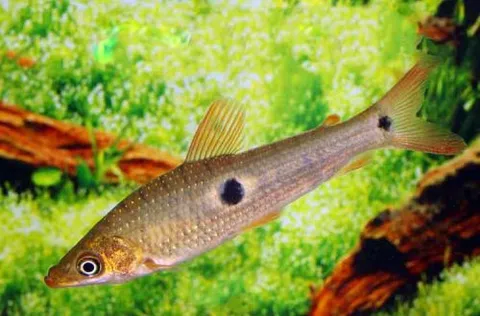
Pseudanos trimaculatus
The Three-spot Anostomus, scientifically known as Pseudanos trimaculatus, belongs to the family Anostomidae, or Headstanders. Previously, this fish was classified as Anostomus trimaculatus, and this name is still found…
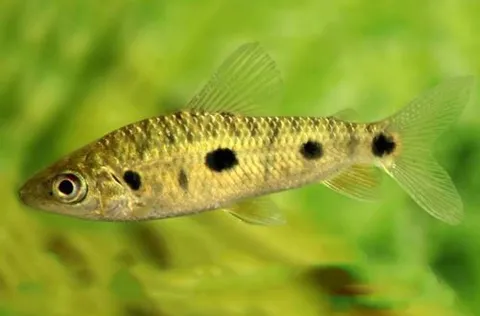
Leporinus steyermarki
Leporinus steyermarki, also known as the Venezuelan Leporinus, is a representative of the family Anostomidae. This fish was named in honor of Julian Steyermark, who led a botanical expedition to Venezuela in 1953 and…
Leporinus pellegrinii
Leporinus pellegrinii, also known as Pellegrin's Leporinus, is a member of the family Anostomidae. Its homeland is the vast expanses of South America; in particular, it is widely distributed throughout the entire length…