Temperature23 – 28 °C
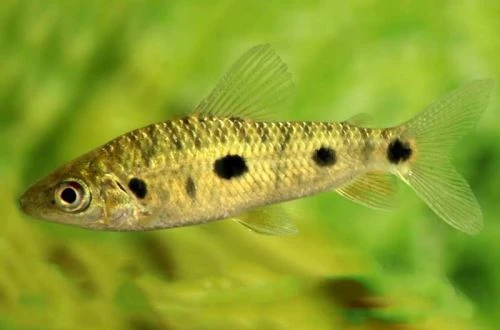
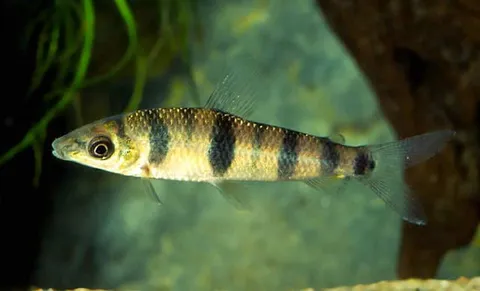
Leporinus steyermarki, also known as the Venezuelan Leporinus, is a representative of the family Anostomidae. This fish was named in honor of Julian Steyermark, who led a botanical expedition to Venezuela in 1953 and discovered it.
Adults of this fish can reach up to 30 cm in length. Their coloration is a pale golden background adorned with a pattern of dark rounded spots and gray vertical stripes. Sexual dimorphism in the species is weakly expressed, and males and females have few noticeable differences.
The natural habitat of this fish is South America. It is found predominantly in the river systems of Venezuela, where the current can be fast, and in some places, even turbulent.
In their natural environment, these fish form large groups. For an aquarium, it would be most natural to acquire a small school consisting of 8–10 individuals. It has been observed that with fewer numbers, especially in conditions of insufficient space, they can show aggression towards both conspecifics and other species. In spacious aquariums, Leporinus are peaceful towards other calm species of similar size, but small fish may be at risk. They exhibit good companionship with some South American cichlids, Plecostomus, Corydoras catfish, and other species.
The optimal aquarium volume for a group of 8–10 young fish should be at least 500–600 liters. For keeping a single specimen, a smaller tank is permissible. When decorating, it is recommended to use large snags, a rocky substrate, boulders, and thickets of hardy plants with tough leaves. Venezuelan Leporinus prefer a plant-based diet, so delicate plants are likely to be damaged or eaten. It is important that the diet includes foods with a high content of plant components. Creating an imitation of an internal current will be beneficial; this can be achieved by directing a stream of water along the aquarium using one or more filters, or by using a special pump. Despite an enhanced filtration system, regular aquarium maintenance is necessary. Cleanliness is maintained by regularly cleaning the substrate and decor elements, performing partial water changes with fresh water, and removing accumulated organic waste.
In nature, it is an omnivorous species. In aquarium conditions, the diet should be varied and include both animal and plant components. It is recommended to use high-quality dry foods in the form of granules or flakes, supplementing them with frozen or live foods such as bloodworms, krill, and small crustaceans. To maintain health and satisfy natural needs, it is necessary to regularly offer plant-based supplements, for example, spirulina tablets or blanched vegetables.
Breeding in an aquarium is considered a difficult task and is rarely practiced. In their natural environment, spawning occurs in pairs in areas densely overgrown with aquatic vegetation. Stimulating the process requires specific water parameters and a significant amount of space. Due to the tendency of the parents to eat their own eggs, adult fish must be removed from the spawning tank after spawning is complete.
The species is distinguished by robust health when kept under appropriate conditions. The main risks are associated with deteriorating water quality, which can lead to bacterial infections or parasitic infestations. Prevention includes maintaining stable environmental parameters, effective filtration, and regular partial water changes. They are sensitive to abrupt changes in water chemistry and high concentrations of organic waste.
When purchasing, choose active fish with clean scales and no visible fin damage or body sores. It is important to ensure that the fish exhibits normal feeding behavior and does not appear emaciated. It is recommended to avoid individuals that stay near the water surface or show lethargic behavior, as this may indicate health problems or transport stress.
The essentials: size, tank volume, water parameters and care
An adult reaches 30 cm in length. Plan the tank around the maximum size: the fish quickly outgrows a cramped setup.
The recommended volume is 500 L. A smaller tank speeds up nitrate build-up and raises stress levels.
Temperature 23–28 °C, pH 6.5–7, hardness 4–12 dGH. Stability matters more than exact values: sudden swings are harder on the fish than a small deviation from the ideal.
Around 7 years when kept properly. Lifespan depends directly on tank volume, water quality and a varied diet.
Temperament: semi-peaceful (dangerous to smaller ones). Not a predatory species, but small fish that fit in its mouth will eventually be eaten.
Recommended setup: both solitary and in group (flexible). Ignoring this is a common cause of stress and disease.
Diet type: plant-based (algae, vegetables). Feed small portions that are finished within a couple of minutes — overfeeding does more harm than underfeeding.
The scientific name of the species is Leporinus steyermarki, family Anostomidae.
The water suits 197 of 208 plants in the catalogue — the easiest ones are shown first.
Afzelius's AnubiasAnacharisAnubiasBrazilian PennywortDwarf CloverDwarf CloverDwarf HygrophilaDwarf SagittariaDwarf ValGuppy GrassHornwortJava FernJava MossMoneywortMud SwordNair's LagenandraNarrow Leaf AnacharisNarrow-leaf CloverStringy MossSüsswassertangTaiwan MossTape GrassTemple PlantUssuri Watermilfoil
Matched by family, categories and overlapping keeping conditions
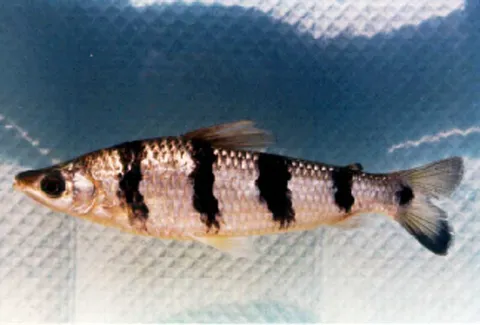
Schizodon fasciatus
The scientific name Schizodon fasciatus refers to the banded Schizodon, a member of the family Anostomidae. This fish is native to South America, where it can be found both in the upper reaches of the Amazon and in…
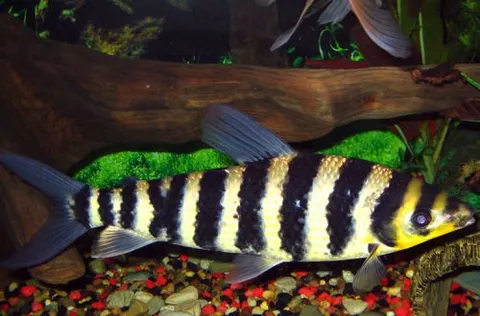
Leporinus fasciatus
The Banded Leporinus, scientifically known as Leporinus fasciatus, belongs to the Anostomidae family. For many years, this fish has attracted the attention of aquarists due to its characteristic alternating black and…
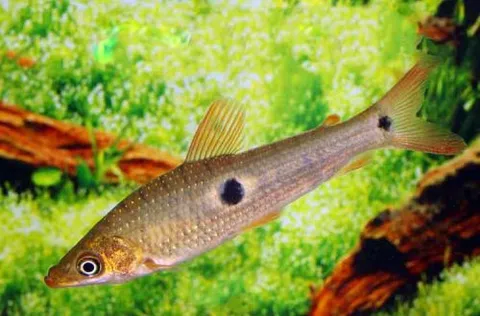
Pseudanos trimaculatus
The Three-spot Anostomus, scientifically known as Pseudanos trimaculatus, belongs to the family Anostomidae, or Headstanders. Previously, this fish was classified as Anostomus trimaculatus, and this name is still found…
Leporinus pellegrinii
Leporinus pellegrinii, also known as Pellegrin's Leporinus, is a member of the family Anostomidae. Its homeland is the vast expanses of South America; in particular, it is widely distributed throughout the entire length…