Temperature20 – 28 °C
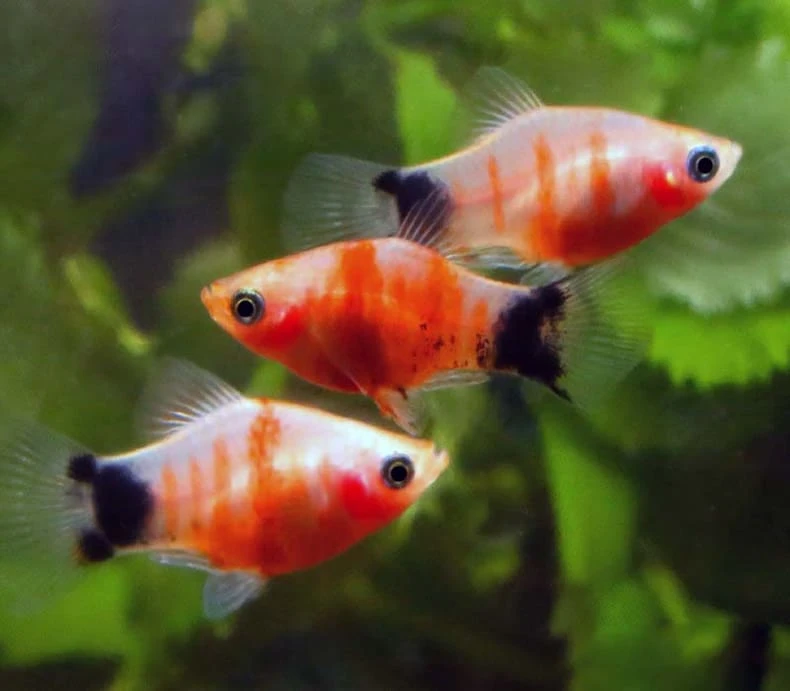
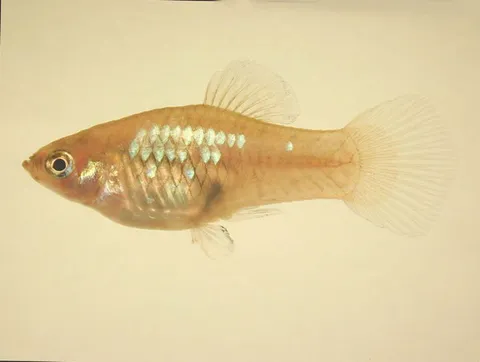
The Platy sold under the trade name "Mickey Mouse" (Platy Mickey Mouse) is not found in the wild. This fish is a selective breeding form of the common Platy (Xiphophorus maculatus). It received its recognizable name due to a unique pattern at the base of its tail: a large black spot surrounded by two smaller ones, resembling the famous symbol of the cartoon character Mickey Mouse. The body coloration can be quite diverse, varying from golden, orange, and red hues to blue and green tones.
The Mickey Mouse Platy is a selectively bred form of the species Xiphophorus maculatus, distinguished by a characteristic pattern at the base of the caudal fin: a large dark spot in the center and two smaller ones on the sides, visually resembling the silhouette of the famous cartoon character's head. The fish have a dense, moderately high body, 4–7 cm long. The main coloration varies from golden and orange to red and blue. Sexual dimorphism is pronounced: males are smaller than females, have a more slender body, and an anal fin transformed into a copulatory organ — the gonopodium.
In nature, the original species inhabits fresh and brackish waters of the Atlantic coast from Mexico to Honduras and the southern USA. The fish prefer sections of rivers with dense vegetation and slow currents. In their natural environment, water parameters can vary significantly, but for aquarium populations, the stability of hydrochemical indicators is critically important.
These are active, peaceful, and schooling fish that feel comfortable in a group. Intraspecific conflicts between males are minimized by maintaining a proportion where there are 2–3 females per male. Platies are compatible with most similarly sized peaceful fish, such as guppies, swordtails, corydoras, and other calm species, but they should not be kept with aggressive cichlids or large predators.
This hardy and easy-to-care-for fish will be an excellent choice for beginner aquarists. The Mickey Mouse Platy successfully adapts to various keeping conditions, including small aquariums. For the comfortable existence of 3–4 adult individuals, an aquarium of at least 50–60 liters is recommended. When decorating the aquarium, it is advisable to use many aquatic plants. In hobby aquariums, algae often forms on vegetation, which will serve as an additional food source for these fish. To maintain comfortable conditions, water with elevated pH and GH values is necessary. These platies can also be kept in brackish water. Like all aquarium inhabitants, Platies require clean water. Regular aquarium maintenance and an effective filtration system will help maintain high water quality, preventing the accumulation of organic waste. The diet can consist of dry foods, but it is important that they contain plant components. Additionally, the daily menu can be enriched with live or frozen foods, such as daphnia, bloodworms, artemia, and mosquito larvae. These fish are distinguished by their peaceful and friendly nature towards other species. Good neighbors for them will be all livebearing fish, as well as species that prefer a slightly alkaline environment. To reduce intraspecific competition, it is recommended to maintain a ratio of two or more females per male. Sexual maturity occurs at approximately four months. Females give birth to fully formed fry. An important feature is that they can retain male sperm for a long time, allowing them to produce offspring under favorable conditions even in the absence of males. The incubation period lasts about 30–40 days, and one brood can number dozens of fry. To protect the young from predation by adult fish, the fry should be separated.
The species is omnivorous. The diet should include high-quality dry foods, frozen or live products such as bloodworms, daphnia, and tubifex. To maintain health and vibrant coloration, regular inclusion of plant supplements in the menu is recommended, as platies often eat soft algae in the aquarium. Food should be given in small portions 1–2 times a day.
Platies are livebearing fish, reaching sexual maturity at 4–8 months of age. Spawning occurs in the community tank, but to preserve the maximum number of fry, it is recommended to use a breeding box with dense, fine-leaved plants. Pregnancy lasts about 28–40 days, after which the female gives birth to 40 to 80 fully formed fry, capable of independent feeding.
The fish are highly resilient but sensitive to sudden changes in water parameters and poor feeding. If keeping conditions are violated, fungal infections or fin rot may occur. Prevention involves maintaining cleanliness, weekly water changes, and providing a complete diet.
When purchasing, choose active, mobile individuals with clean scales and spread fins, without signs of plaque or erosion. It is important to look for the absence of sunken bellies and spots on the body, other than the characteristic "Mickey Mouse" pattern. It is recommended to acquire fish from a single source to avoid introducing infections from different batches.
The essentials: size, tank volume, water parameters and care
An adult reaches 5–7 cm in length. Plan the tank around the maximum size: the fish quickly outgrows a cramped setup.
The recommended volume is 60 L. A smaller tank speeds up nitrate build-up and raises stress levels.
Temperature 20–28 °C, pH 7–8.2, hardness 10–30 dGH. Stability matters more than exact values: sudden swings are harder on the fish than a small deviation from the ideal.
Around 4 years when kept properly. Lifespan depends directly on tank volume, water quality and a varied diet.
Temperament: peaceful (regular). Keep this in mind when choosing tank mates.
Recommended setup: mixed (solitary / pair / group). Ignoring this is a common cause of stress and disease.
Diet type: any (universal). Feed small portions that are finished within a couple of minutes — overfeeding does more harm than underfeeding.
The scientific name of the species is Xiphophorus maculatus, family Poeciliidae. It also appears in the literature as: Platypoecilus aurata, Platypoecilus cyanellus, Platypoecilus maculatus.
The water suits 114 of 208 plants in the catalogue — the easiest ones are shown first.
African Onion PlantAfzelius's AnubiasAmazon FrogbitAmazon SwordAnacharisAnubiasArrowhead CryptDwarf CloverDwarf CloverDwarf HygrophilaDwarf SagittariaDwarf ValGuppy GrassHornwortJava MossMoneywortMud SwordNair's LagenandraNarrow Leaf AnacharisNarrow-leaf CloverStringy MossTaiwan MossTape GrassUssuri Watermilfoil
Matched by family, categories and overlapping keeping conditions
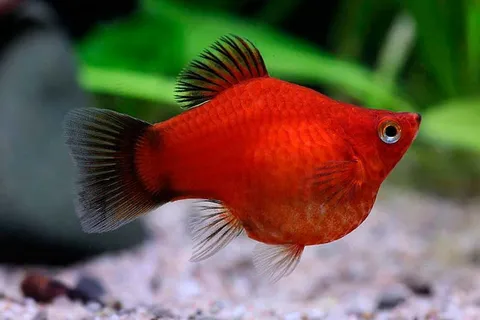
Xiphophorus maculatus
The Balloon Platy, also known as the Disc Platy, is known in the English-speaking commercial world as the Balloon Platy. A distinctive feature of this fish is its peculiar appearance: it has a strongly arched, hunched…
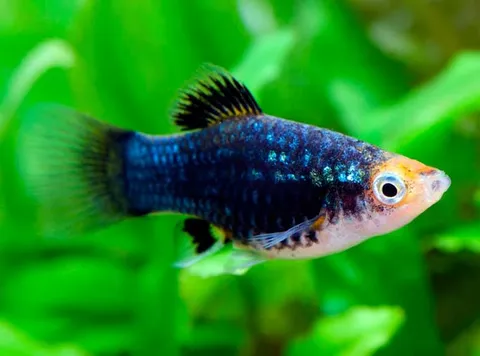
Xiphophorus maculatus
Platy Black is the trade name for this variety of Black Platy in the English-speaking market. This fish is not found in nature, as it is an artificially bred color variation derived from the common Platy (Xiphophorus…
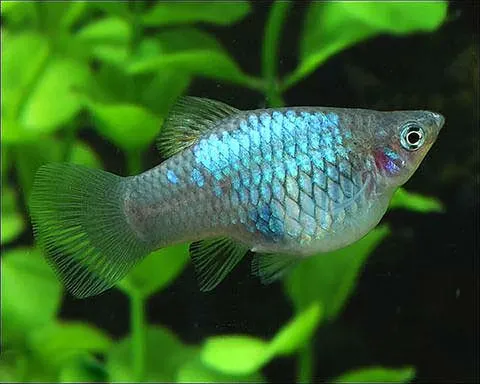
Xiphophorus maculatus
The Blue Platy, also known by the commercial English names Platy Blue, Blue Moon Platy, and Platy Neon Blue, is a selectively bred form of the common Platy and does not exist in the wild. Its main distinguishing feature…
Xiphophorus maculatus
The Platy, or Spotted Platy (scientific name Xiphophorus maculatus), belongs to the family Poeciliidae. Its hardiness and vibrant coloration make it one of the most sought-after aquarium fish. However, it should be…