Temperature24 – 28 °C
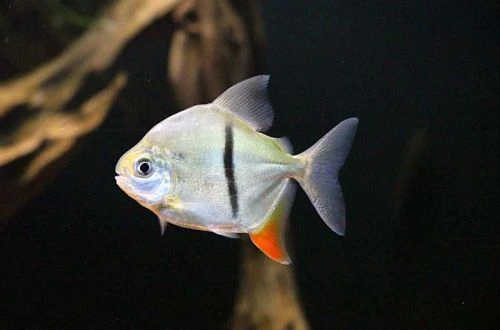
Myloplus schomburgkii, also known as the Schomburgk's Myloplus or Disk Tetra, bears the scientific name Myloplus schomburgkii and belongs to the family Serrasalmidae (Piranhas). This species is a herbivorous relative of the well-known Piranhas. Its natural habitat is located in South America, where it prefers bodies of water with abundant aquatic vegetation and submerged snags. Its distribution range covers both the middle and lower Amazon River basins, as well as the upper Orinoco basin.
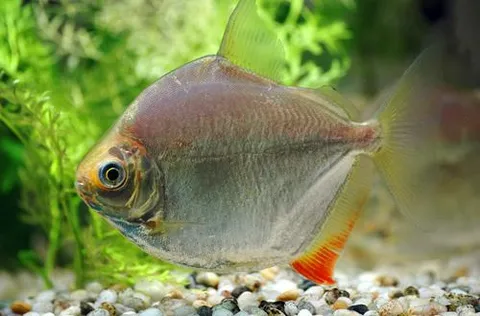
Adults typically reach an average length of up to 25 cm; however, specimens over 40 cm long are known. The fish has a high body, disc-shaped. Its coloration is silvery, with red hues along the edges of the body and on the fins. A distinctive feature is a prominent vertical black band running through the middle of the body.
The species is widespread in South America, inhabiting the Amazon and Orinoco river basins. It is found in Brazil, Peru, Venezuela, and Suriname. These fish live in rivers with flowing water, preferring areas with abundant vegetation and snags, which serve as natural shelters. Water parameters in nature correspond to a tropical climate with temperatures ranging from 23 to 27 degrees Celsius.
This fish, being peaceful and active, can nevertheless, as mentioned, pose a danger to smaller aquarium inhabitants. Myloplus schomburgkii is well compatible with most other species of comparable size. Since it inhabits the upper and middle water layers, excellent compatibility is achieved with bottom dwellers such as Plecostomus or Armored Catfish.
For keeping a group of 5–6 fish, the optimal aquarium volume starts from 300 liters. Myloplus schomburgkii are excellent swimmers, so they need large open spaces for free movement. Nevertheless, it is important to plan for hiding places in the aquarium design, for example, using natural snags such as branches or tree roots. Since this species is predominantly herbivorous, most aquarium plants will likely be eaten or significantly damaged. Therefore, it is recommended to use artificial plants or fast-growing species with tough leaves, such as Anubias, Hornwort, and similar. Keeping these fish will require the aquarist to maintain consistently low pH and dH values. To prevent the accumulation of excess organic waste, regular partial water changes with simultaneous substrate cleaning, as well as the uninterrupted operation of the filtration system, are vital. The diet should primarily consist of plant-based foods. These can be commercial dry foods — flakes and pellets — made from algae, vegetables, and fruits, as well as fresh products such as cucumber slices, zucchini, lettuce leaves, spinach, or green peas. It is important not to limit the diet to only plant products; it is necessary to include regular foods (in small quantities), for example, flakes for American cichlids containing protein components, or periodically offer live/frozen brine shrimp and bloodworms. It should be noted that they may eat smaller fish if given the opportunity.
The diet should primarily be based on plant components. These can be ready-made commercial foods, such as dry flakes and pellets, produced from algae, vegetables, and fruits, as well as fresh products: slices of cucumber, zucchini, lettuce leaves, spinach, green peas, and others. It is important to remember that one should not be limited to exclusively plant-based food. It is also necessary to include regular foods (in small quantities), for example, flakes for American cichlids containing protein components, or periodically offer live or frozen brine shrimp and bloodworms. If given the chance, these fish can catch and eat smaller fish. Myloplus is a peaceful and active fish, however, as noted, it can pose a threat to small aquarium inhabitants. Compatibility with most other species of comparable size is usually good. The fish inhabits the upper and middle water layers, which makes it an excellent companion for bottom-dwelling species such as Plecostomus and Armored Catfish. An unbalanced diet is the most common cause of diseases in Myloplus schomburgkii. A lack of essential trace elements and vitamins leads to a weakening of the body, after which the immune system is unable to effectively resist infections. Upon the appearance of early signs of illness (such as lethargy, refusal to eat, emaciation, etc.), the aquarist should carefully analyze the composition of the food being provided.
Information on breeding this species in aquarium conditions is practically nonexistent. The fish are egg-layers. It is known that in nature they exhibit schooling behavior, however, data on spawning stimulation, egg care, and fry rearing in captivity are insufficient to formulate recommendations.
The most common cause of diseases in Myloplus schomburgkii is an unbalanced diet. If the fish's body does not receive the necessary trace elements and vitamins, it weakens, and the immune system loses its ability to resist infections. At the first signs of illness, such as lethargy, refusal to eat, or emaciation, the composition and quality of the food provided should be reviewed first and foremost.
When choosing individuals, pay attention to the following signs: — activity and absence of visible damage on the body or fins — clean skin without white coating or ulcers — normal plumpness, absence of a sunken belly — calm behavior in a school, as the fish are social and should be kept in groups. It is important to consider that these fish have powerful jaws and are capable of inflicting serious bites, so caution must be exercised during inspection and transportation.
The essentials: size, tank volume, water parameters and care
An adult reaches 25 cm in length. Plan the tank around the maximum size: the fish quickly outgrows a cramped setup.
The recommended volume is 300 L. A smaller tank speeds up nitrate build-up and raises stress levels.
Temperature 24–28 °C, pH 6–7, hardness 2–10 dGH. Stability matters more than exact values: sudden swings are harder on the fish than a small deviation from the ideal.
Around 12 years when kept properly. Lifespan depends directly on tank volume, water quality and a varied diet.
Temperament: semi-peaceful (dangerous to smaller ones). Not a predatory species, but small fish that fit in its mouth will eventually be eaten.
Recommended setup: small group (5–6 individuals). Ignoring this is a common cause of stress and disease.
Diet type: plant-based (algae, vegetables). Feed small portions that are finished within a couple of minutes — overfeeding does more harm than underfeeding.
The scientific name of the species is Myloplus schomburgkii, family Piranhas (Serrasalmidae). It also appears in the literature as: Myletes palometa, Myletes schomburgkii, Myleus schomburgkii.
The water suits 196 of 208 plants in the catalogue — the easiest ones are shown first.
Afzelius's AnubiasAnacharisAnubiasBrazilian PennywortDwarf CloverDwarf CloverDwarf HygrophilaDwarf SagittariaDwarf ValGuppy GrassHornwortJava FernJava MossMoneywortMud SwordNair's LagenandraNarrow Leaf AnacharisNarrow-leaf CloverStringy MossSüsswassertangTaiwan MossTape GrassTemple PlantUssuri Watermilfoil
Matched by family, categories and overlapping keeping conditions
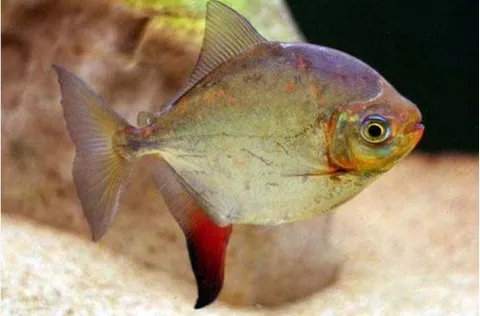
Myloplus rubripinnis
The Moon Myloplus, or Redhook Myloplus (scientific name Myloplus rubripinnis), belongs to the family Serrasalmidae, also known as the Piranha family. This is a large schooling fish that exhibits a peaceful temperament…
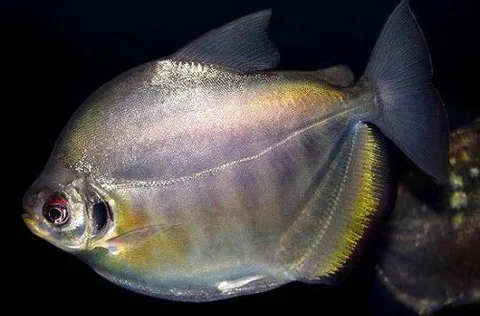
Mylossoma duriventre
The fish Mylossoma duriventre, known as Mylossoma duriventre, belongs to the family Serrasalmidae, or piranhas. Its natural range covers the tropical and subtropical regions of South America, found in the Amazon,…
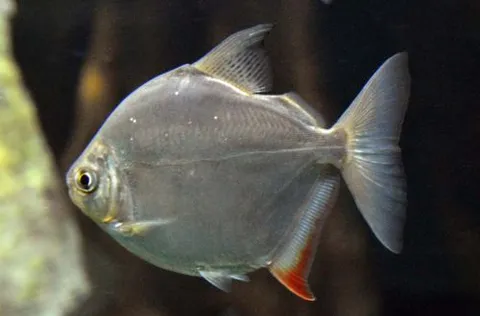
Metynnis hypsauchen
The Common Metynnis, also known by its scientific name Metynnis hypsauchen, belongs to the family Serrasalmidae, which also includes piranhas. However, unlike its formidable relatives, this fish exhibits much more…
Metynnis argenteus
Metynnis argenteus, known as the Silver Dollar or Silver Metynnis, belongs to the family Serrasalmidae, also called the Piranha family. This fish got its name due to its widespread popularity among North American…