Temperature22 – 28 °C
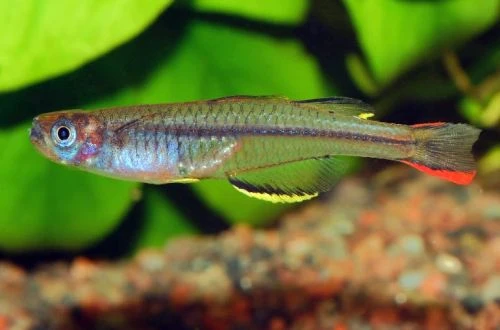
A member of the family Pseudomugilidae, scientifically named Pseudomugil novaeguineae, is known as the New Guinea Blue-eye. This rainbowfish is notable for its vibrant coloration. Although it is considered a peaceful and active species, its intraspecific relationships can be complex. Keeping these fish requires certain efforts to maintain high water quality, so they are not recommended for novice aquarists.
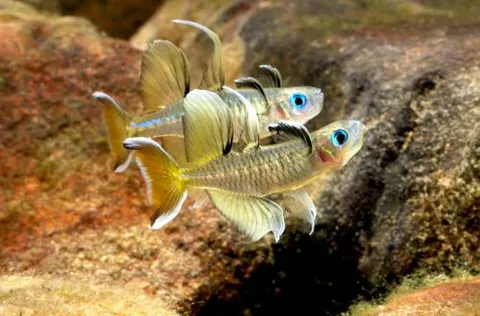
Adults reach approximately 4 cm in length. Their bodies are semi-transparent, with a slight turquoise sheen on the belly and head. The eyes of these fish have a bluish iris and a barely noticeable golden rim around the pupil. Males are usually more brightly colored than females. Their caudal fins are edged in red, and their pelvic and anal fins in yellow. The forked dorsal fin also stands out with black or yellow markings along its edges.
As the name suggests, this fish is native to the island of New Guinea, as well as the neighboring Indonesian Aru Islands. Its natural habitat consists of shallow, slow-flowing streams and small rivers that run through dense tropical forests in lowland areas.
These active and peaceful fish coexist well with other species of comparable size. However, during the breeding season, males may show excessive attention to females, forcing the latter to seek shelter until they are ready to spawn. Given this behavioral trait, it is recommended to keep only one male with several females in a small aquarium. In other cases, it is also desirable for the number of females to exceed that of males.
For a small group of 4–6 fish, the optimal aquarium size starts from 60 liters. In this case, the width of the tank is more important than its depth, as the New Guinea Blue-eye primarily inhabits the upper layers of the water. When decorating the aquarium, key attention should be paid to the upper layer, where open swimming areas and sheltered zones, created by clusters of floating plants, should be harmoniously combined. The main difficulty in keeping them lies in the need to maintain the water pH level within a narrow range of 5.5–6.5 and to prevent the accumulation of organic waste, which can lead to an increase in nitrate levels—products of the nitrogen cycle. Thus, an effective filtration system and regular aquarium maintenance, including partial water changes and substrate cleaning, are mandatory conditions.
These fish prefer small live or frozen foods. They can also be accustomed to dry diets, such as flakes or granules, provided they have a high protein content. To ensure their vibrant coloration, it is worth prioritizing only high-quality food products.
At the time of preparing this text, little reliable information on the reproduction of the New Guinea Blue-eye has been published. Successful spawning depends on a combination of several conditions: a balanced diet and high water quality. The closer the aquarium conditions are to their natural habitat, the higher the probability of successful reproduction. The bright red eggs are laid among dense thickets of fine-leaved plants, mosses, or ferns.
Under favorable conditions, cases of disease in these fish are rare. If the first symptoms of an ailment appear, such as lethargy, body deformation, or the appearance of spots, it is first necessary to check the water quality. Often, bringing all environmental parameters back to normal allows the fish's body to cope with the disease on its own. Otherwise, medication may be required.
When purchasing, choose active and mobile individuals with clean fins and no visible skin damage. Avoid fish with signs of emaciation, sunken bellies, or unnatural coating on the body. Since the species is schooling, it is recommended to acquire a group of 6-8 individuals to reduce stress during relocation and adaptation to new conditions. In the store, pay attention to the keeping conditions: healthy fish should display bright coloration characteristic of their sex and actively respond to feeding. Be sure to ask the seller how long the fish have been in quarantine, as recently imported specimens may be susceptible to stress and infections.
The essentials: size, tank volume, water parameters and care
An adult reaches 4 cm in length. Plan the tank around the maximum size: the fish quickly outgrows a cramped setup.
The recommended volume is 60 L. A smaller tank speeds up nitrate build-up and raises stress levels.
Temperature 22–28 °C, pH 5.5–6.5, hardness 10–18 dGH. Stability matters more than exact values: sudden swings are harder on the fish than a small deviation from the ideal.
Around 2 years when kept properly. Lifespan depends directly on tank volume, water quality and a varied diet.
Temperament: peaceful (regular). Keep this in mind when choosing tank mates.
Recommended setup: small group (5–6 individuals). Ignoring this is a common cause of stress and disease.
Diet type: any (universal). Feed small portions that are finished within a couple of minutes — overfeeding does more harm than underfeeding.
The scientific name of the species is Pseudomugil novaeguineae, family Pseudomugilidae.
The water suits 198 of 208 plants in the catalogue — the easiest ones are shown first.
Afzelius's AnubiasAnacharisAnubiasBrazilian PennywortDwarf CloverDwarf CloverDwarf HygrophilaDwarf SagittariaDwarf ValGuppy GrassHornwortJava FernJava MossMoneywortMud SwordNair's LagenandraNarrow Leaf AnacharisNarrow-leaf CloverStringy MossSüsswassertangTaiwan MossTape GrassTemple PlantUssuri Watermilfoil
Matched by family, categories and overlapping keeping conditions
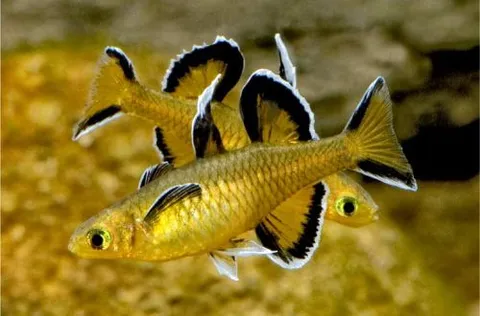
Pseudomugil mellis
The Honey Blue-eye, or Pseudomugil mellis, belonging to the family Pseudomugilidae, is an interesting choice for aquarists. This active fish is distinguished by its bright coloration and peaceful nature, and is also…
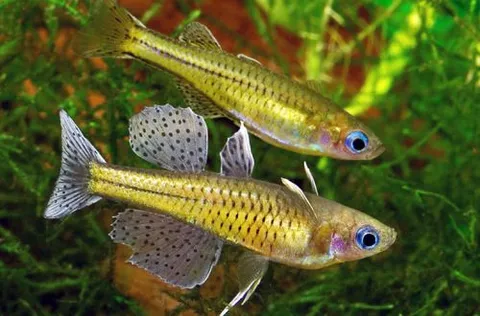
Pseudomugil gertrudae
Pseudomugil gertrudae, also known as the Spotted Blue-eye, belongs to the family Pseudomugilidae. This species was named in honor of Gertrude, the wife of Dr. Hugo Merton, a German naturalist who first discovered it in…
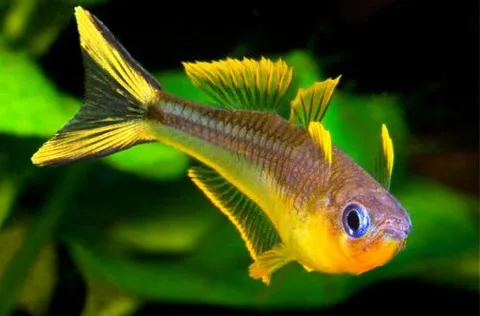
Pseudomugil furcatus
The Forktail Rainbowfish, or Popondetta furcata (Pseudomugil furcatus), a representative of the family Pseudomugilidae, is a vibrant and attractive addition to any freshwater aquarium. This species became available to…
Pseudomugil signifer
Pseudomugil signifer, or the Australian blue-eye (scientific name Pseudomugil signifer), is a member of the family Pseudomugilidae. This remarkable fish is captivating not only for its unusual appearance but also for…