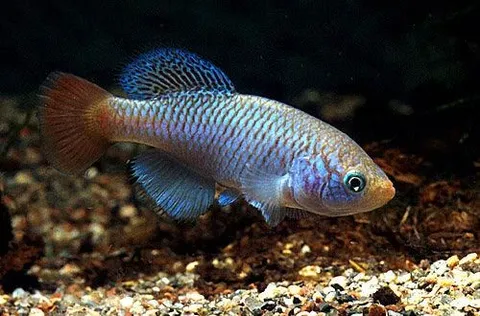
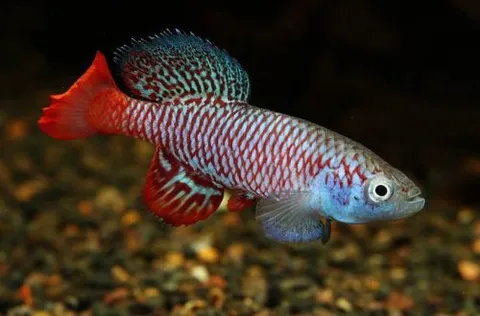
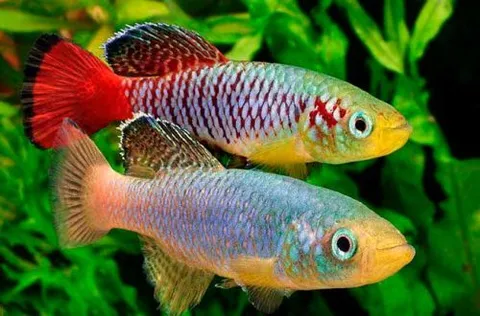
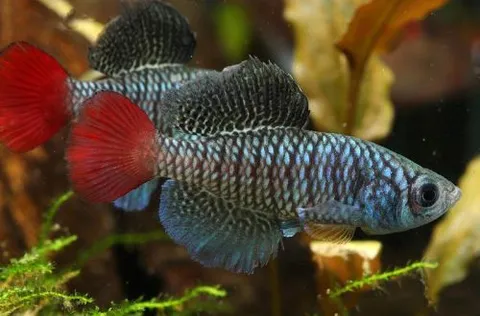
Among all known vertebrates, these fish stand out for their astonishingly short lifespan. In natural conditions, their life lasts only from 1 to 5 months, while in an aquarium environment, they can live from 3 to 16 months. This feature is due to their unique nature: in the process of evolution, to survive in shallow water bodies of a hot climate that periodically dry up, the fish have developed an extraordinary adaptation, which consists of accelerated development from fry to adult. This allows them to lay eggs before the water body completely dries up. Subsequently, these eggs remain in the silt, which turns into a layer of dried mud during the dry season. In this semi-dried state, the eggs can remain for several months, awaiting the onset of a new rainy season. Due to these characteristic features, Nothobranchius furzeri is not often found as a pet in aquariums, but it is an excellent object for laboratory research. The size of adult individuals usually reaches about 3 centimeters in length, although specimens growing up to almost 6 centimeters have been recorded. Lifespan directly affects their size. This species is characterized by bright sexual dimorphism. Males are noticeably larger than females and have more contrasting coloration, dominated by red hues. Their fins and tail often contain yellow pigment. Females are smaller and colored in more subdued silvery or gray tones.