Temperature18 – 24 °C
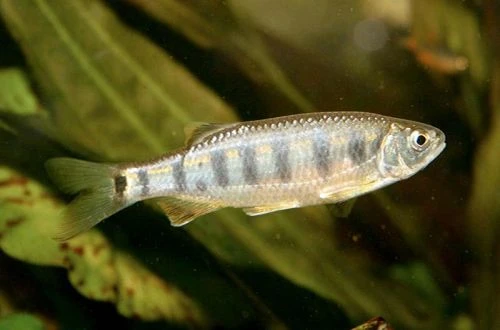
The fish, known by the scientific name Opsarius dogarsinghi, or Dogarsingh's Baril, belongs to the Carp family (Cyprinidae). It received its name in honour of Sardar Dogar Singh, State Overseer of Manipur, India, who gave material assistance in collecting specimens — including the type of this species — and helped arrange survey tours.
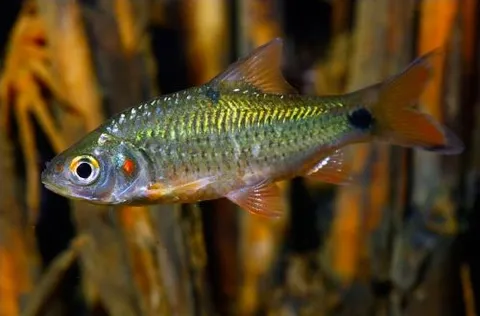
Adults can reach a length of approximately 8 cm. They are characterized by a gray back and a light silvery belly. A metallic sheen is noticeable on the body. The pattern consists of 8–9 dark blue vertical stripes. Two short barbels can be seen near the mouth. During the breeding season, males, unlike females, may develop small tubercles on their heads and orange pigmentation on the lower part of their bodies.
The habitats of this fish cover the extensive basin of the Chindwin River. It is found in the northeastern regions of India and the western regions of Myanmar. Typically, Opsarius dogarsinghi prefers sections of rivers located in hilly, sometimes even mountainous terrain. Its typical habitat is a full-flowing stream with a fast current, the bottom of which is strewn with stones and boulders.
Opsarius dogarsinghi are active and fast fish. They can cause discomfort to slower or smaller species, which will also lose out to them in competition for food. When choosing tank mates, it is advisable to focus on active fish of similar size. In addition, it is necessary to consider the characteristics of their natural habitat, which is characterized by strong or moderate currents, which, of course, limits the number of compatible species. Good tank mates might include, for example, some species of Barbs, Loaches, and representatives of catfish.
It is desirable that the aquarium be set up to imitate a section of a turbulent river. The substrate should be formed from stones, sand, and fine gravel, complementing the composition with several secured snags. To create the necessary current, pumps or powerful internal filters can be used. In such an environment with artificial current, only undemanding plant species, such as Anubias, as well as various mosses and ferns, can successfully grow. Since Opsarius dogarsinghi originates from flowing waters, it needs clean, oxygen-rich water. For long-term keeping of these fish, it is important to ensure enhanced aeration, prevent the accumulation of organic waste, and maintain a temperature regime within 18–24°C. One should not rely solely on the filtration system to maintain water purity; weekly partial water changes (30–50% of the total volume) with fresh water are mandatory. Since the fish are prone to jumping, a lid on the aquarium becomes a necessity.
In their natural environment, these fish feed on small invertebrates such as insects, crustaceans, and larvae. If possible, they may also eat fry. For keeping in a home aquarium, it is recommended to offer high-protein foods, which should be supplemented with live or frozen bloodworms and similar products.
Cases of successful breeding of this species in aquarium conditions have been recorded, however, detailed information on stimulation methods and specific process parameters is currently unavailable. In nature, these fish are rheophilic species, so spawning likely requires conditions that mimic flowing waters with clean, oxygen-rich water and a stony substrate.
The species is extremely sensitive to water quality and the accumulation of organic waste, which often leads to bacterial infections and a deterioration of overall health. To prevent diseases, it is necessary to maintain a high level of dissolved oxygen, ensure active water circulation, and strictly adhere to a schedule of regular water changes. Fish are prone to stress when environmental parameters are unstable, so they should not be placed in biologically immature aquariums.
When selecting individuals, attention should be paid to their activity and the integrity of their skin. Healthy fish should exhibit typical species behavior, actively swim in the water column, and show no visible damage to fins, ulcers, or spots on the body. Avoid purchasing specimens that appear lethargic, stay near the surface, or show signs of emaciation, as this species tolerates transportation and adaptation to new conditions poorly.
The essentials: size, tank volume, water parameters and care
An adult reaches 8 cm in length. Plan the tank around the maximum size: the fish quickly outgrows a cramped setup.
The recommended volume is 540 L. A smaller tank speeds up nitrate build-up and raises stress levels.
Temperature 18–24 °C, pH 6–7.5, hardness 2–15 dGH. Stability matters more than exact values: sudden swings are harder on the fish than a small deviation from the ideal.
Around 5 years when kept properly. Lifespan depends directly on tank volume, water quality and a varied diet.
Temperament: semi-peaceful (including aggression during spawning / intraspecific conflicts). Keep this in mind when choosing tank mates.
Recommended setup: small group (5–6 individuals). Ignoring this is a common cause of stress and disease.
Diet type: any (universal). Feed small portions that are finished within a couple of minutes — overfeeding does more harm than underfeeding.
The scientific name of the species is Opsarius dogarsinghi, family Cyprinids (Cyprinidae). It also appears in the literature as: Opsarius dogarsinghi.
The water suits 196 of 208 plants in the catalogue — the easiest ones are shown first.
Afzelius's AnubiasAnacharisAnubiasBrazilian PennywortDwarf CloverDwarf CloverDwarf HygrophilaDwarf SagittariaDwarf ValGuppy GrassHornwortJava FernJava MossMoneywortMud SwordNarrow Leaf AnacharisNarrow-leaf CloverStringy MossSüsswassertangTaiwan MossTape GrassTemple PlantUssuri WatermilfoilWater Wisteria
Matched by family, categories and overlapping keeping conditions
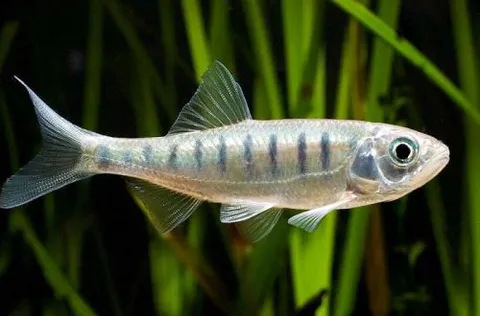
Opsarius barna
The Barna Barbel, scientifically known as Opsarius barna, belongs to the extensive carp family (Cyprinidae). Its name in Russian is a transcription of the Bengali word traditionally used by locals to refer to this…
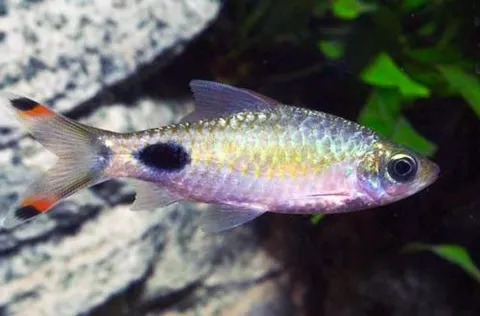
Puntius mahecola
The fish known as Mahecola Barb (scientific name Puntius mahecola) is classified within the family Cyprinidae. It is very popular in Asian countries, especially India, but outside of this region, in Europe and America,…
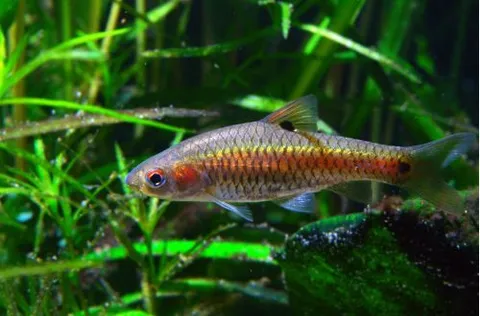
Puntius bimaculatus
Puntius bimaculatus, or the Two-Spot Barb, belongs to the family Cyprinidae. Kept in a school, these fish make a wonderful addition to almost any aquarium. They are undemanding in care, easy to breed, and compatible…
Systomus rubripinnis
The Java Barb, scientifically known as Systomus rubripinnis, is a member of the Cyprinidae family. This rather large fish exhibits remarkable hardiness and relatively low maintenance requirements. It is rarely…