Temperature26 – 30 °C
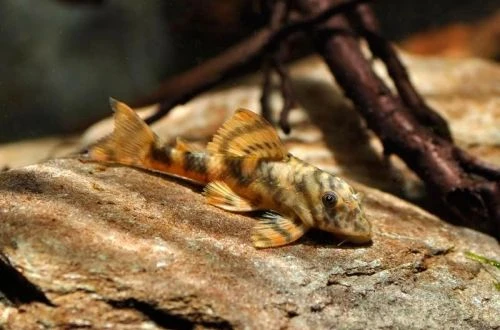
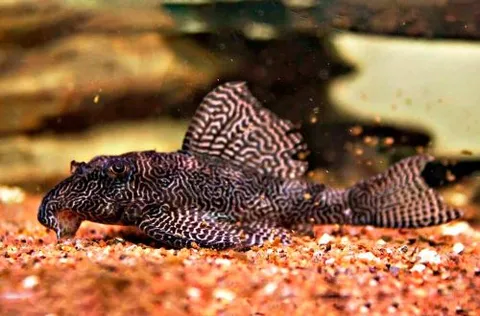
Peckoltia sp. L288, more commonly known as Peckolt's Pleco, belongs to the family Loricariidae, or armored catfish. This fish was named in honor of Gustav Peckolt, a German botanist and pharmacist who, in the late 19th century, published one of the first books dedicated to the flora and fauna of the Amazon. The exact scientific classification of this catfish has not yet been established, which explains the alphanumeric designation in its name. It is quite rare in amateur aquaristics.
Adults reach a length of 9–10 cm. This fish has a triangular head profile, its body is covered with modified scales resembling rough plates, as well as large fins and a forked tail. The first rays of the fins are noticeably thickened and form sharp spines. Its coloration is characterized by a yellow background with black stripes. Sexual dimorphism in Peckoltia sp. L288 is weakly expressed; females appear slightly stockier (wider) when viewed from above during sexual maturity.
The only known habitat of this catfish in South America is the small Curuá Uruará River (Para do Uruara) in the Brazilian state of Pará. This river is a tributary of the Amazon, flowing into its main channel in the lower reaches.
This peaceful and calm catfish, thanks to its 'armor', can coexist even with quite active species. Nevertheless, it is recommended to choose tank mates of comparable size that do not exhibit excessive aggression and prefer to inhabit the water column or surface, to avoid competition for bottom areas.
For keeping one or two fish, aquariums from 80 liters are optimal. The aquascape can be arbitrary, but must include several hiding places, which can be created using snags, dense plant thickets, or decorative elements such as artificial grottoes, crevices, and caves. Successful keeping of Peckoltia plecostomus depends on many factors. In addition to a balanced diet and suitable tank mates, it is crucial to maintain stable water parameters within acceptable temperature and hydrochemical ranges. For this, the aquarium should be equipped with an efficient filtration system and other necessary equipment. Regular procedures are also required: cleaning, partial water changes with fresh water, and removal of organic waste.
In their natural habitat, the diet consists mainly of plant components – algae and soft plant parts. In addition, their diet includes small invertebrates and various zooplankton living in aquatic vegetation. To maintain the fish in a home aquarium, it is important to provide appropriate nutrition. It is recommended to use specialized foods designed for herbivorous catfish, which contain all the necessary nutrients.
Currently, there is insufficient information on the captive breeding of this species, likely due to its low popularity among aquarists. However, it is assumed that the breeding strategy of Peckoltia plecostomus will be largely similar to that of other related species. During the breeding season, the male occupies a specific area, centered around a suitable hiding place or an underwater burrow. After brief courtship, the pair lays a clutch. The male remains near the eggs, protecting the future offspring until the fry emerge.
Most health problems in fish often arise from unsuitable keeping conditions. Maintaining a stable and comfortable habitat is a key factor for successful keeping. If symptoms of illness appear, the first step is to check the water quality. If deviations are found, it is important to take immediate measures to eliminate them. If the symptoms do not disappear or worsen, medicinal treatment may be required.
When selecting individuals, pay attention to the fish's activity at night, as they tend to be secretive during the day. A healthy fish should have clean skin without white spots, ulcers, or damage, and tightly clamped fins without signs of erosion. Avoid purchasing specimens with sunken bellies, which often indicates emaciation or internal parasites. In the store, it is recommended to assess the cleanliness of the water in the aquarium and the absence of dead fish in neighboring tanks, as the species is sensitive to habitat quality. Examine the fish's eyes: they should be clear, without cloudiness, which would indicate a bacterial infection.
The essentials: size, tank volume, water parameters and care
An adult reaches 9–10 cm in length. Plan the tank around the maximum size: the fish quickly outgrows a cramped setup.
The recommended volume is 80 L. A smaller tank speeds up nitrate build-up and raises stress levels.
Temperature 26–30 °C, pH 5–7, hardness 1–10 dGH. Stability matters more than exact values: sudden swings are harder on the fish than a small deviation from the ideal.
Around 8 years when kept properly. Lifespan depends directly on tank volume, water quality and a varied diet.
Temperament: peaceful (regular). Keep this in mind when choosing tank mates.
Recommended setup: both solitary and in group (flexible). Ignoring this is a common cause of stress and disease.
Diet type: sinking (plant-based). Feed small portions that are finished within a couple of minutes — overfeeding does more harm than underfeeding.
The scientific name of the species is Peckoltia sp. L288, family Armored Catfishes (Loricariidae). It also appears in the literature as: Ancistrus vittatus, Chaetostomus vittatus, Peckoltia kuhlmanni.
The water suits 175 of 208 plants in the catalogue — the easiest ones are shown first.
Afzelius's AnubiasAnacharisAnubiasBrazilian PennywortDwarf CloverDwarf CloverDwarf HygrophilaDwarf SagittariaDwarf ValGuppy GrassHornwortJava FernJava MossMoneywortMud SwordNair's LagenandraNarrow Leaf AnacharisNarrow-leaf CloverSüsswassertangTaiwan MossTape GrassTemple PlantUssuri WatermilfoilWater Wisteria
Matched by family, categories and overlapping keeping conditions
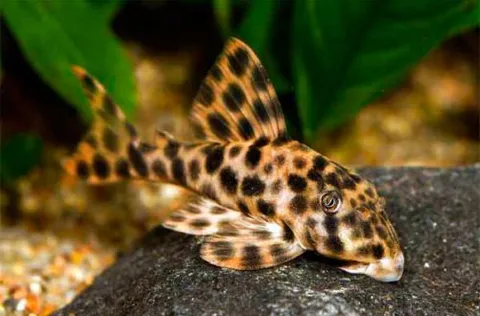
Peckoltia oligospila
This catfish, known scientifically as Peckoltia oligospila, belongs to the extensive family Loricariidae, also called Armored Catfish. The fish owes its name to the botanist and pharmacist Gustavo Peckolt, a German born…
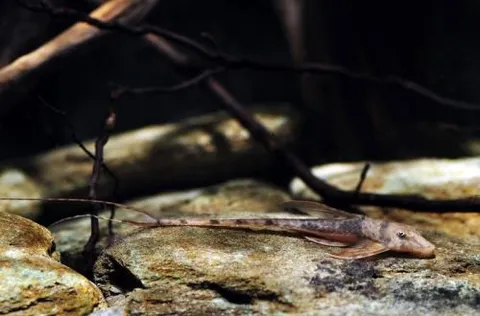
Lamontichthys filamentosus
The Threadfin Catfish, known scientifically as Lamontichthys filamentosus and also called Lamont's Fish, is a member of the Loricariidae family, or Armored Catfish. It was named in honor of Francesca Lamont, a…
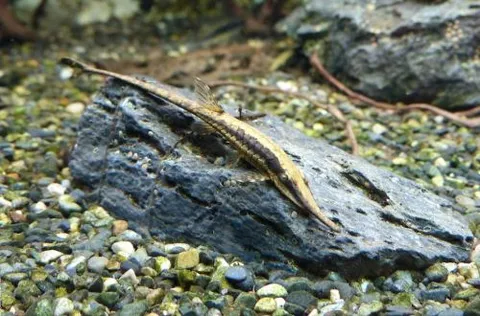
Farlowella vittata
The Twig Catfish, or Stick Catfish, scientifically known as Farlowella vittata, belongs to the family Loricariidae, commonly known as Armored Catfish. It stands out due to its unusual body shape, which is quite atypical…
Hypancistrus sp. L411
Hypancistrus Monte Dourado, known scientifically as Hypancistrus sp. L 411, belongs to the family Loricariidae. This catfish originates from South America. Its primary habitat is the Jari River basin, which is one of…