Temperature24 – 28 °C
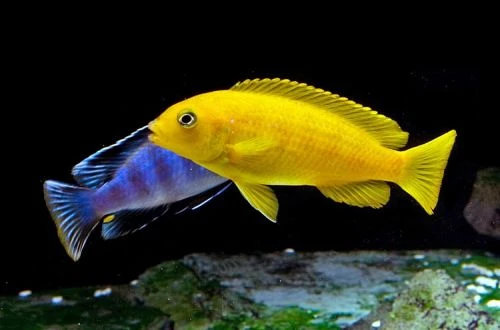
The scientific name for this fish is Chindongo saulosi, although it was formerly known as Pseudotropheus saulosi. It belongs to the Cichlidae family. This species is part of the Mbuna group, which are endemic to Lake Malawi, also known as Lake Nyasa. Despite its ease of care and breeding, the behavioral characteristics of Pseudotropheus saulosi will significantly limit the choice of compatible species for a community tank. For beginners in aquaristics, it is best to keep these fish in a species-specific tank.
Adults grow up to 10 cm in length. Males have a blue coloration with prominent dark vertical stripes, while females have a more modest yellow color with barely discernible stripes. Notably, all fry are born yellow, and only with age do dominant males acquire their characteristic blue hue. Interestingly, subdominant males retain their yellow coloration, outwardly resembling females.
Pseudotropheus saulosi is endemic to Lake Malawi, located on the African continent, on the border between Malawi, Mozambique, and Tanzania. These fish prefer to inhabit depths of 7 to 15 meters, keeping to the rocky shoreline.
Intraspecific relationships in these fish are based on the dominance of an alpha male and his territorial claims. In small aquariums, it is recommended to keep no more than one male with one or more females. In more spacious tanks, it is permissible to keep several males, provided that each has enough space to establish its own territory. Coexistence with other not-too-aggressive Mbuna representatives is also possible. However, avoid neighboring species with similar coloration – both yellow and blue.
The size of the aquarium for Pseudotropheus saulosi is determined by the number of individuals planned. For example, a 100 L tank will be sufficient for a pair, but a group of ten fish will require an aquarium of at least 250 L. The aquarium setup should be simple, consisting of a sandy substrate and piles of rocks or large stones. These elements are used to create grottoes, crevices, and caves, which closely match the natural habitat of these cichlids. Other decorative elements, including live plants, can be placed at the aquarist's discretion. Naturally growing algae will be an excellent additional food source. Natural driftwood placed under bright lighting can serve as a good place for their growth. However, since the fish themselves do not like excessive light, a directed spot lighting source can be used to stimulate algae growth on the driftwood. Success in keeping these fish largely depends on maintaining water purity and its chemical parameters — pH and dGH. In addition to an effective filtration system, regular aquarium maintenance is necessary. This includes weekly water changes of 15–20% of the volume with fresh water, timely removal of organic waste, and cleaning algae from the glass.
In natural conditions, Pseudotropheus saulosi feed on algae that grow on the surface of rocks and stones underwater. Their unique mouth structure allows them to effectively scrape off this food, but it also limits their ability to consume other types of food. In a home aquarium, it is recommended to use foods with a spirulina base. There is also a method of stimulating natural algae growth using spot lighting, which will be discussed further.
When the breeding season arrives, the male Pseudotropheus saulosi begins to construct a peculiar nest, which will serve as a place for future spawning. It usually consists of a simple depression or a small pit in the sandy substrate. The male then actively courts the female. Once the female is ready, she lays 15 to 20 eggs, which she immediately takes into her mouth after fertilization. The entire incubation period and the brooding of the offspring will take place in the female's mouth. Such a unique evolutionary adaptation is characteristic of most cichlids inhabiting Lake Malawi.
Most diseases of Malawian cichlids are often caused by unsuitable keeping conditions or poor-quality food, which frequently leads to the development of "Malawi Bloat. If the first symptoms are detected, it is necessary to check the water parameters for high concentrations of dangerous substances such as ammonia, nitrites, and nitrates. If necessary, all parameters should be normalized, and only then should treatment begin.
When selecting individuals, preference should be given to young fish, as they adapt more easily to new conditions. A healthy fish should be active, have clean fins without signs of erosion, clear eyes, and a robust body without visible damage or ulcers on its scales. Avoid specimens that isolate themselves, breathe heavily, or have a sunken abdomen. Since the coloration of males and females differs, and subdominant males can mimic the yellow color of females, it is recommended to acquire a group of fish to form a harem. It is important to inspect the aquarium in the store for the absence of deceased individuals in the same filtration system, as Mbuna cichlids are sensitive to water quality and infectious diseases.
The essentials: size, tank volume, water parameters and care
An adult reaches 10 cm in length. Plan the tank around the maximum size: the fish quickly outgrows a cramped setup.
The recommended volume is 250 L. A smaller tank speeds up nitrate build-up and raises stress levels.
Temperature 24–28 °C, pH 7.6–8.8, hardness 10–25 dGH. Stability matters more than exact values: sudden swings are harder on the fish than a small deviation from the ideal.
Around 8 years when kept properly. Lifespan depends directly on tank volume, water quality and a varied diet.
Temperament: aggressive / incompatible / unfriendly. Keep this in mind when choosing tank mates.
Recommended setup: harem (1 male and several females). Ignoring this is a common cause of stress and disease.
Diet type: plant-based (algae, vegetables). Feed small portions that are finished within a couple of minutes — overfeeding does more harm than underfeeding.
The scientific name of the species is Chindongo saulosi, family Cichlids (Cichlidae).
The water suits 113 of 208 plants in the catalogue — the easiest ones are shown first.
African Onion PlantAfzelius's AnubiasAmazon FrogbitAmazon SwordAnacharisAnubiasArrowhead CryptDwarf CloverDwarf CloverDwarf HygrophilaDwarf SagittariaDwarf ValGuppy GrassHornwortJava MossMoneywortMud SwordNair's LagenandraNarrow Leaf AnacharisNarrow-leaf CloverStringy MossTaiwan MossTape GrassUssuri Watermilfoil
Matched by family, categories and overlapping keeping conditions
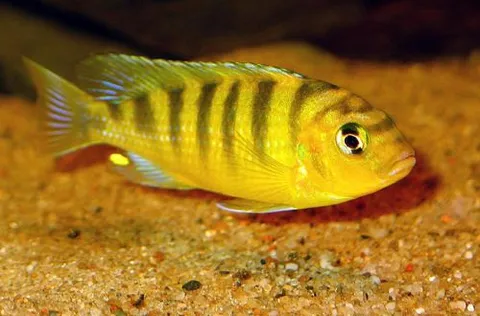
Maylandia lombardoi
Maylandia lombardoi, also known as Lombardo's Cichlid or Pseudotropheus lombardoi, belongs to the family Cichlidae. This bright and attractive fish is characterized by a rather belligerent disposition, which makes it…
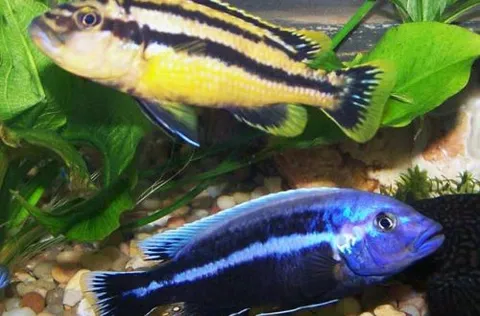
Melanochromis chipokae
Melanochromis chipokae, known scientifically as Melanochromis chipokae, belongs to the family Cichlidae. This species represents the Mbuna group of cichlids, characterized by their aggressive behavior. This particular…
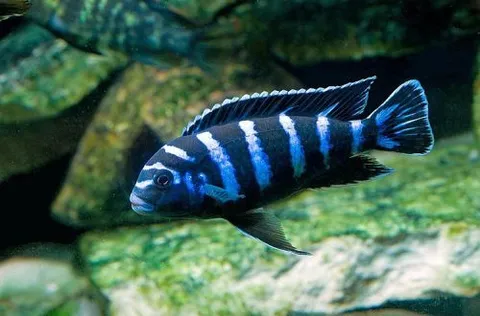
Chindongo demasoni
Pseudotropheus demasoni, known scientifically as Chindongo demasoni, belongs to the family Cichlidae. This species appeared relatively recently in aquaristics, becoming available for purchase only from 1994. Before the…
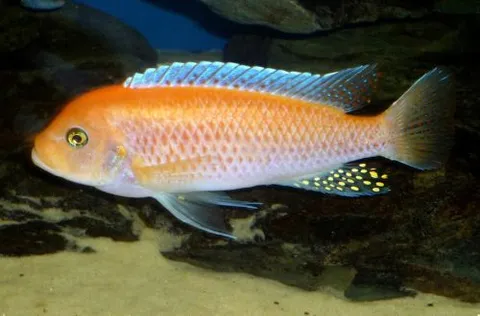
Maylandia estherae
The Red Zebra Cichlid, scientifically known as Maylandia estherae (formerly Pseudotropheus estherae), belongs to the Cichlidae family. This vibrant, beautiful, and active fish exhibits interesting behavior. It can be a…