Temperature23 – 30 °C
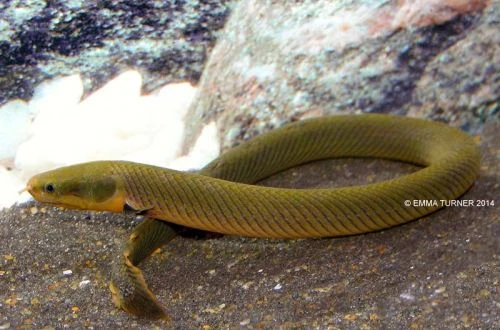
The scientific name Erpetoichthys calabaricus belongs to the family Polypteridae, known as the bichirs, and denotes the species known as the Reedfish or Ropefish. These amazing fish are the closest relatives of the Polypterus. Both species represent the last surviving members of ancient fish whose history spans millions of years, dating back to the dinosaur era in the Triassic period. The oldest fossils found indicate an age of over 200 million years.
In the aquarium adults grow to 35–40 cm; a maximum of 90 cm is reported from the wild, but the fish never reaches that size in captivity. Their appearance is very unusual and resembles a snake, due to their highly elongated body, which allows them to wriggle. The coloration is usually dark gray, with a lighter belly. Despite their seemingly large eyes, Reedfish have poor vision. As a nocturnal predator, they largely rely on their sense of smell. On the fish's head are elongated tubular nostrils, which they use to successfully find food in the dark and in conditions of poor visibility. One of the unique features of this species is the structure of its swim bladder: it is bifurcated, with one part being significantly larger, functioning as an additional respiratory organ. This ability allows the Ropefish to remain out of water for some time, provided there is high humidity. This adaptation is vital for survival in bodies of water with low dissolved oxygen content. It is important to note that breathing atmospheric air is mandatory for them; without regular access to the surface, the Reedfish cannot survive and will die.
The natural habitat of this fish is located in West Africa. It is found in countries such as Angola, Nigeria, Cameroon, Equatorial Guinea, Benin, and also in the Democratic Republic of Congo. Reedfish prefer shallow areas with dense aquatic vegetation, where the current is slow or the water is stagnant. It is a coastal species inhabiting river estuaries from the Ouémé in Benin to the Sanaga in Cameroon; records from the Congo basin rest on a single old collection and still await confirmation.
This species is distinguished by its peaceful and calm disposition. It coexists well with many medium-sized fish. However, any individual capable of fitting into the Reedfish's mouth will likely become its prey. These fish get along perfectly with their own kind. Possible aquarium tank mates include various Synodontis, large Characins, and some cichlid species, such as Severums and Angelfish.
For one adult Reedfish, the optimal aquarium volume should start from 500 liters. In terms of decor, it is recommended to use a soft substrate and a large number of natural snags, which will serve as reliable shelters. Vegetation is also an important element. Dense thickets of plants, including floating species, must be provided. The aquarium must be equipped with a tight lid, as the Ropefish is prone to escaping from the tank. Increased demands are placed on aquarium equipment: submersible devices with large openings into which the fish could climb should not be used. This applies, for example, to the intake or outlet pipes of the filtration system, pumps, and other elements. These fish are very hardy and adapt well to various keeping conditions. They can comfortably exist within a wide range of temperatures and pH and GH values. Nevertheless, they are quite sensitive to sudden changes in water acidity and hardness. In their natural environment, Reedfish are nocturnal, preying on various invertebrates and small fish. In home conditions, their diet consists of live or frozen foods, such as bloodworms, earthworms, and shrimp.
In their natural habitat, these fish are active at night, feeding on various invertebrates and small fish. When kept in a home aquarium, their diet primarily consists of live or frozen foods, such as bloodworms, earthworms, and shrimp. Currently, there is no confirmed data on successful breeding of Reedfish in home aquarium conditions.
Information on the successful breeding of Reedfish in home aquariums has not yet been confirmed. Although cases of spawning and the appearance of fry are recorded, raising them to adulthood in an artificial environment has not yet been successful. Reedfish fry have significant external differences from adults, and it's not just about size. The young have external gills, resembling those of amphibians, which disappear as they mature.
Reedfish have high resistance to typical aquarium parasites and infections, but they are extremely sensitive to water quality and sudden changes in environmental parameters. The main risks are associated with bacterial infections arising from stress during transportation or poor keeping conditions. Symptoms include reddening of the gills, cloudy eyes, the appearance of hemorrhages on the body, or inflammation of internal organs. — avoid using aggressive medications, as the fish tolerate many chemical preparations poorly, including dyes and formalin — ensure stable pH values, as sharp fluctuations of more than 0.5 units can provoke serious health problems — quarantine all new specimens to exclude the introduction of pathogens, often found in wild-caught fish.
When purchasing, it is important to consider that most specimens come from the wild, so they are often emaciated and stressed. A healthy fish should be active at dusk, have clean, tightly fitting scales without visible damage, ulcers, or spots. Pay attention to behavior: the fish should not constantly stay at the water surface or dart chaotically around the aquarium. — check the condition of the fins; they should be intact, without signs of deterioration or redness — prefer specimens that show interest in food and have normal plumpness, rather than sunken sides — ask the seller how long the fish has been there, as wild-caught specimens require an adaptation period and pre-sale holding of at least 3-4 weeks.
The essentials: size, tank volume, water parameters and care
An adult reaches 30–40 cm in length. Plan the tank around the maximum size: the fish quickly outgrows a cramped setup.
The recommended volume is 500 L. A smaller tank speeds up nitrate build-up and raises stress levels.
Temperature 23–30 °C, pH 6–7.5, hardness 5–20 dGH. Stability matters more than exact values: sudden swings are harder on the fish than a small deviation from the ideal.
Around 20 years when kept properly. Lifespan depends directly on tank volume, water quality and a varied diet.
Temperament: predator, but semi-peaceful (gets along with large ones). This is a predatory species — any fish small enough to fit in its mouth will eventually be eaten.
Recommended setup: both solitary and in group (flexible). Ignoring this is a common cause of stress and disease.
Diet type: meat / protein (live, frozen, fresh). Feed small portions that are finished within a couple of minutes — overfeeding does more harm than underfeeding.
The scientific name of the species is Erpetoichthys calabaricus, family Polypteridae (Bichirs). It also appears in the literature as: Calamichthys calabaricus, Calamoichthys calabaricus, Calanichthys calabaricus.
The water suits 197 of 208 plants in the catalogue — the easiest ones are shown first.
Afzelius's AnubiasAnacharisAnubiasBrazilian PennywortDwarf CloverDwarf CloverDwarf HygrophilaDwarf SagittariaDwarf ValGuppy GrassHornwortJava FernJava MossMoneywortMud SwordNair's LagenandraNarrow Leaf AnacharisNarrow-leaf CloverStringy MossSüsswassertangTaiwan MossTape GrassTemple PlantUssuri Watermilfoil
Matched by family, categories and overlapping keeping conditions
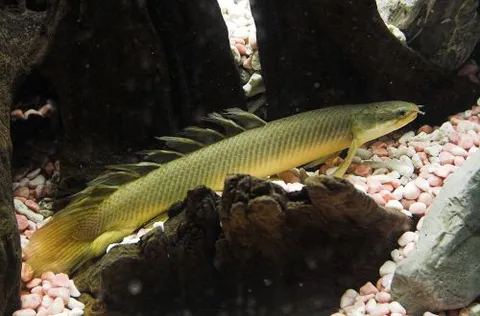
Polypterus senegalus
A representative of an ancient genus of fish that existed more than 200 million years ago, during the Triassic period, is the Polypterus, or Senegal Bichir (scientific name Polypterus senegalus). It belongs to the…
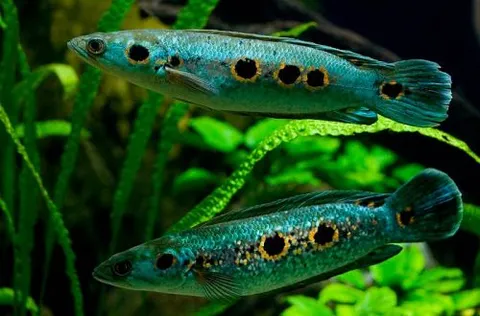
Channa pleurophthalma
The Ornate Snakehead (Channa pleurophthalma) is a species belonging to the family Channidae, or Snakeheads. Its scientific name is Channa pleurophthalma. A distinctive feature of its appearance is the expressive black…
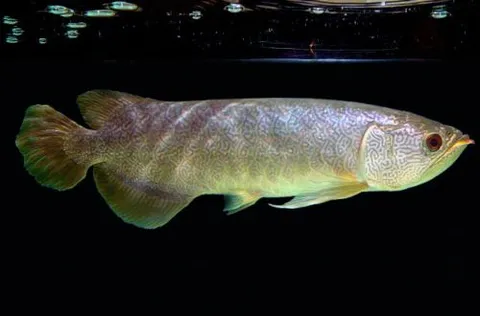
Scleropages inscriptus
The Myanmar arawana, scientific name Scleropages inscriptus, belongs to the family Osteoglossidae. This species is known for its considerable value, with individual specimens fetching tens of thousands of dollars. It is…
Xenentodon cancila
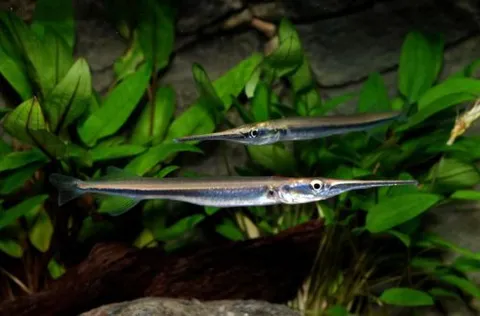
Xenentodon cancila, known as the Freshwater Gar, Freshwater Needlefish, or "Silver Needle," is a member of the Belonidae family. A very similar species, Xenentodon canciloides, is also found under the same name, and…