Temperature24 – 28 °C
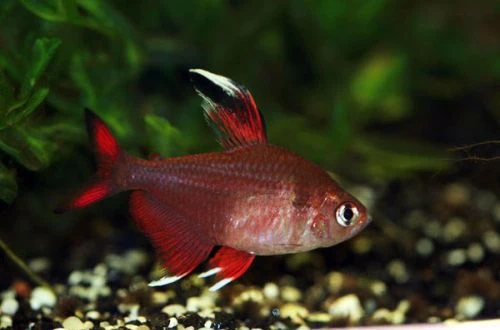
The Rosy Tetra, also known as the Rosaceus Tetra (Megalamphodus rosaceus), belongs to the family Acestrorhamphidae and makes an excellent addition to a community of peaceful aquarium inhabitants. This fish shows significant similarity in body shape and coloration to the Ornate Tetra, which often leads to confusion; in pet stores, these two species are sometimes sold under the same name.
The body of the Rosy Tetra has the classic shape for small representatives of this genus, distinguished by a magnificent pink coloration with contrasting black elements on the fins, the tips of which are marked with white. A similar pattern and shade—from delicate pink to rich coral—are also characteristic of the Ornate Tetra, but its coloration is less intense, giving it a duller appearance.
The species inhabits the rivers of the Guiana Shield in northern South America — the Essequibo, Corantijn and Suriname — in Guyana, Suriname and Brazil. Their natural habitat consists of small, slow-flowing tributaries of large rivers, located under the canopy of the tropical forest. The water in these rivers is usually turbid and contains a lot of silt, and the Tetras' diet primarily consists of small invertebrates.
In a well-maintained aquarium, the Rosy Tetra exhibits activity and reveals the full beauty of its coloration. This is a schooling species, requiring a group of at least 6 individuals. They thrive in the company of closely related species, such as the Black Tetra, White Tetra, Red-Spotted Tetra, or Ornate Tetra. Noisy or aggressive fish are not suitable tank mates; the Rosaceus Tetra should only be kept with peaceful and non-predatory species.
The Tetra is sensitive to water quality, so a productive filter is a key factor for successful keeping. To avoid excessive water movement in the aquarium, the outflow from the filter should be directed towards a side wall. Lighting should be moderate; powerful light sources are not recommended. In addition, essential equipment includes a heater and an aerator. For aquarium decoration, use dense plant thickets, placing them along the side and back walls. River sand is ideal as a substrate. To create a turbid water effect, dried leaves can be used, replaced every two weeks, as well as a bag of alder cones. It is important to purchase peat only from pet stores, where it is specially treated and prepared for aquarium use, and never to collect it from natural bodies of water.
The Rosaceus Tetra is an omnivorous species, but its diet must be balanced and consist of high-quality foods. These fish require a significant amount of vitamins, so healthy food should make up a large part of their diet (60–80% of the total volume). They prefer live foods, such as bloodworms or daphnia, but can also eat soft plant parts.
Breeding the Rosaceus Tetra is a rather complex process that is unlikely to be within the capabilities of a beginner aquarist. Nevertheless, a healthy pair usually has no difficulty reproducing if kept in soft water and at a slightly elevated temperature, around 26°C. The male and female should be isolated, preferably in a separate breeding tank. The female lays eggs on thin leaves or stems of aquarium plants. After spawning, the parent fish should be immediately removed from the aquarium. Fry begin to swim freely after 3–4 days. Daily partial water changes with fresh water are mandatory, and it is important to ensure that the fry are not harmed during this process.
This species is highly resilient and rarely suffers from diseases, provided adequate conditions and regular aquarium maintenance.
When selecting individuals in a store, pay attention to their activity and the integrity of their fins. A healthy fish should exhibit natural schooling behavior, actively swim in the water column, and show no visible damage, sores, or white film on its scales. Avoid purchasing fish that appear apathetic, stay near the surface or bottom away from the group, or show signs of emaciation or an unnaturally bloated belly. — Make sure there are no dead fish in the tank, as this indicates poor maintenance or the presence of infections. — Check the coloration: in healthy tetras, it should be vibrant, without pale or patchy areas. — Keep in mind that this species is often confused with closely related tetras, so carefully examine the fish to ensure it matches the species characteristics.
The essentials: size, tank volume, water parameters and care
An adult reaches 4 cm in length. Plan the tank around the maximum size: the fish quickly outgrows a cramped setup.
The recommended volume is 60 L. A smaller tank speeds up nitrate build-up and raises stress levels.
Temperature 24–28 °C, pH 5.8–7.5, hardness 2–15 dGH. Stability matters more than exact values: sudden swings are harder on the fish than a small deviation from the ideal.
Around 5 years when kept properly. Lifespan depends directly on tank volume, water quality and a varied diet.
Temperament: peaceful (regular). Keep this in mind when choosing tank mates.
Recommended setup: medium group (6–8 individuals). Ignoring this is a common cause of stress and disease.
Diet type: meat with plant additives (omnivores). Feed small portions that are finished within a couple of minutes — overfeeding does more harm than underfeeding.
The scientific name of the species is Megalamphodus rosaceus, family Acestrorhamphidae. It also appears in the literature as: Cheirodon troemneri, Hyphessobrycon bentosi, Hyphessobrycon ornatus.
The water suits 196 of 208 plants in the catalogue — the easiest ones are shown first.
Afzelius's AnubiasAnacharisAnubiasBrazilian PennywortDwarf CloverDwarf CloverDwarf HygrophilaDwarf SagittariaDwarf ValGuppy GrassHornwortJava FernJava MossMoneywortMud SwordNair's LagenandraNarrow Leaf AnacharisNarrow-leaf CloverStringy MossSüsswassertangTaiwan MossTape GrassTemple PlantUssuri Watermilfoil
Matched by family, categories and overlapping keeping conditions
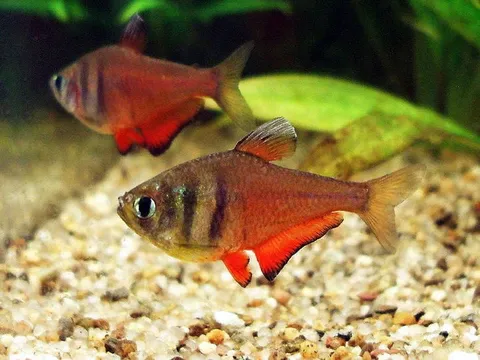
Hyphessobrycon flammeus
Hyphessobrycon flammeus, also known as the Flame Tetra or Red Tetra, belongs to the family Acestrorhamphidae. These fish are distinguished by their beautiful fiery coloration. However, when purchased from pet stores,…
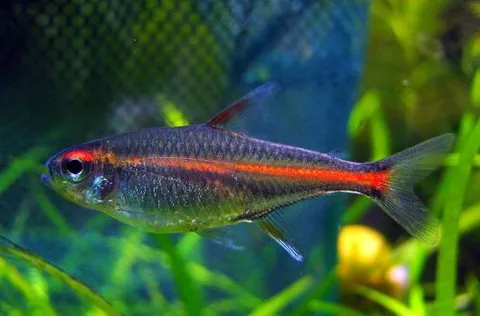
Hemigrammus erythrozonus
The Glowlight Tetra, or Hemigrammus erythrozonus by its scientific name, is a member of the Acestrorhamphidae family. It gets its name from the bright red-orange stripe running from its head to its caudal fin. These…
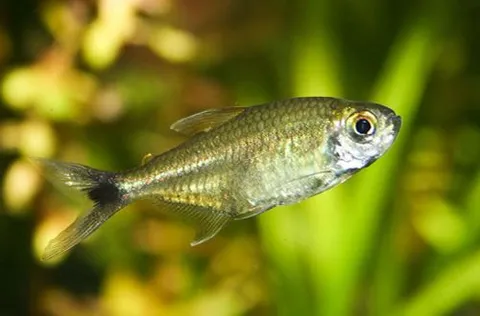
Hemigrammus rodwayi
The Golden Tetra, scientifically known as Hemigrammus rodwayi, belongs to the Acestrorhamphidae family. This fish gets its name from its bright golden scales. In reality, this "gilded" effect is due to the presence of…
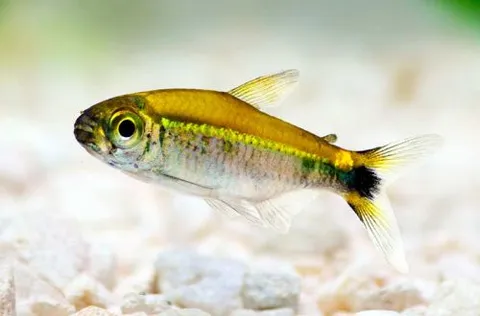
Hemigrammus hyanuary
Hemigrammus hyanuary, known as the Green Neon Tetra or Green Neon, belongs to the family Acestrorhamphidae. Its homeland is South America, where its habitat covers vast areas of the upper and middle Amazon River basin.…