Temperature22 – 26 °C
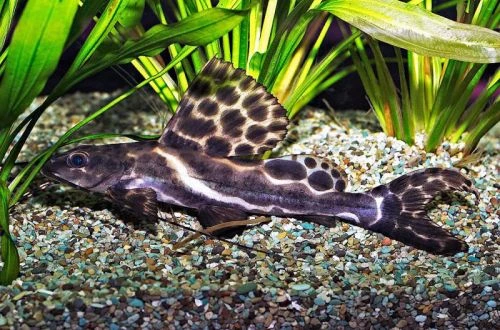
The Sailfin Catfish, also known by its scientific name Leiarius pictus or Marbled Catfish, belongs to the family Pimelodidae. This catfish is distinguished by its beauty and unpretentiousness, but its impressive size limits the circle of aquarists for whom it is a suitable choice. It can hardly be called an ordinary home aquarium fish. Sellers often do not draw buyers' attention to the true dimensions of an adult specimen, which later turns out to be an unpleasant surprise, as not everyone is prepared to keep such large pets.
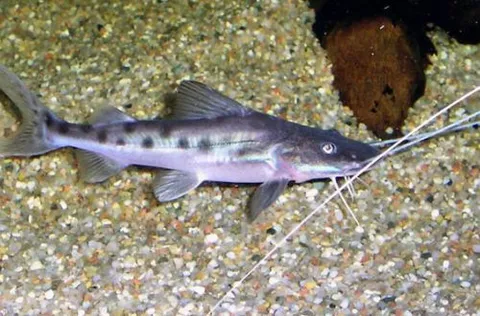
Individual adult specimens reach an impressive 60 cm in length. Their coloration is dark, complemented by irregular white stripes, and a honeycomb-like pattern is visible on the fins — these are angular dark spots with white outlines. Young catfish are considered the most picturesque, while their coloration fades somewhat over time. One of the most striking features of this species is its impressive dorsal fin, which gave it its name — Sailfin Catfish. Sexual dimorphism is weakly expressed, and distinguishing a male from a female without special training is quite a difficult task.
The natural habitat of this species is primarily in the Orinoco River basin, extending through the territories of Colombia and Venezuela in South America. It prefers main channels and large tributaries with slow currents, where there are many natural shelters, such as river backwaters or temporary bodies of water formed when forests are flooded during the rainy season. During the day, catfish usually hide among submerged trees and roots, and at night they actively move in search of food.
Despite its predatory nature, this catfish is considered a rather peaceful species and can be housed in the same aquarium with other non-aggressive fish of similar or slightly smaller size, such as pacu. However, its intraspecific relationships are completely different: being a territorial fish, the Sailfin Catfish will actively guard its territory from its congeners. Therefore, only one specimen should be kept in an aquarium of the recommended volume (from 2600 liters).
The minimum aquarium volume for one Marbled Catfish starts from 2600 liters. The tank setup can be quite simple: preferably subdued lighting, several suitable shelters, and a substrate of large, smooth stones; it is also possible to do without substrate altogether. It should be noted that fine gravel or sand are not suitable as substrate. Fine gravel can get stuck in the gills, and sand is too light — such a large fish will constantly stir up clouds of debris when moving. A large volume aquarium will require appropriate technical equipment capable of effectively handling a large amount of organic waste; as a rule, these are external filtration systems, the selection and installation of which are best entrusted to experts. Other equipment, including heaters and aerators, must be securely placed out of reach of the fish to prevent accidental damage.
Although it is a predator in nature, there is no strict need to use live foods when kept in a home aquarium. The catfish readily consumes various pieces of fish fillet (preferably lean white fish), shrimp, mussels, and large earthworms. It is important to ensure variety in its diet, otherwise the fish may become accustomed to a certain type of food and refuse others. Feeding should be done once a day, avoiding overfeeding, as this can lead to digestive problems and obesity, which will negatively affect health in the long term. It is also not recommended to give meat from terrestrial animals (such as chicken or beef), which is difficult for their digestive system to process.
Breeding Marbled Catfish in home aquarium conditions is practically impossible. For commercial purposes, they are bred on specialized fish farms, and are less common in the wild.
The main cause of most diseases in these fish is unsuitable keeping conditions and poor-quality nutrition. If initial symptoms are observed, it is first necessary to check water parameters and the concentration of dangerous substances such as ammonia, nitrites, and nitrates. If the indicators deviate from the norm, they should be brought back into order, and only then should treatment begin.
When purchasing, it should be noted that Leiarius pictus grows to significant sizes, so it is important to ensure you have the resources to keep a large fish. A healthy specimen should be active, without visible skin damage, ulcers, or signs of fin rot. Avoid specimens with sunken bellies or unnaturally bloated abdomens, as this may indicate internal diseases or digestive problems. In the store, fish of this species often display calm behavior, preferring to stay in the bottom layers of the water or in shelters.
The essentials: size, tank volume, water parameters and care
An adult reaches 60 cm in length. Plan the tank around the maximum size: the fish quickly outgrows a cramped setup.
The recommended volume is 2600 L. A smaller tank speeds up nitrate build-up and raises stress levels.
Temperature 22–26 °C, pH 6.2–7.6, hardness 5–18 dGH. Stability matters more than exact values: sudden swings are harder on the fish than a small deviation from the ideal.
Around 20 years when kept properly. Lifespan depends directly on tank volume, water quality and a varied diet.
Temperament: predator, but semi-peaceful (gets along with large ones). This is a predatory species — any fish small enough to fit in its mouth will eventually be eaten.
Recommended setup: solitary. Ignoring this is a common cause of stress and disease.
Diet type: meat / protein (live, frozen, fresh). Feed small portions that are finished within a couple of minutes — overfeeding does more harm than underfeeding.
The scientific name of the species is Leiarius pictus, family Pimelodidae (Long-whiskered Catfishes). It also appears in the literature as: Bagrus pictus, Sciades pictus.
The water suits 197 of 208 plants in the catalogue — the easiest ones are shown first.
Afzelius's AnubiasAnacharisAnubiasBrazilian PennywortDwarf CloverDwarf CloverDwarf HygrophilaDwarf SagittariaDwarf ValGuppy GrassHornwortJava FernJava MossMoneywortMud SwordNair's LagenandraNarrow Leaf AnacharisNarrow-leaf CloverStringy MossSüsswassertangTaiwan MossTape GrassTemple PlantUssuri Watermilfoil
Matched by family, categories and overlapping keeping conditions
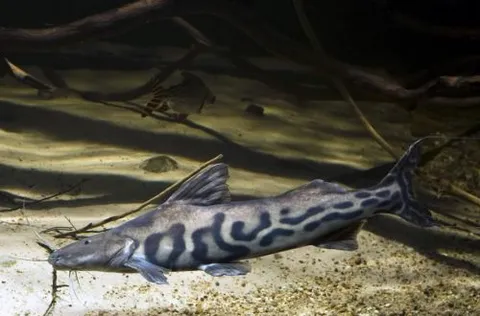
Brachyplatystoma juruense
The Striped Brachyplatystoma, also known as the Golden Zebra Catfish (scientific name Brachyplatystoma juruense), belongs to the family Pimelodidae, which includes flat-headed catfish. This large predatory fish inhabits…
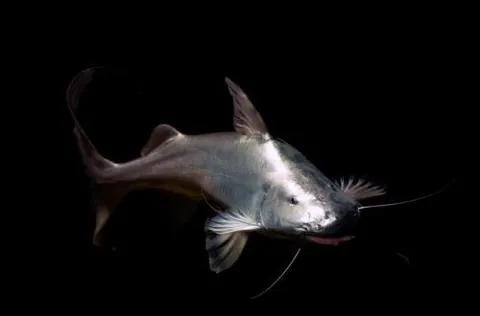
Brachyplatystoma rousseauxii
Dourada, known scientifically as Brachyplatystoma rousseauxii, belongs to the family Pimelodidae, also called pimelodid or flat-headed catfishes. This large predatory fish is highly valued by the local population as an…
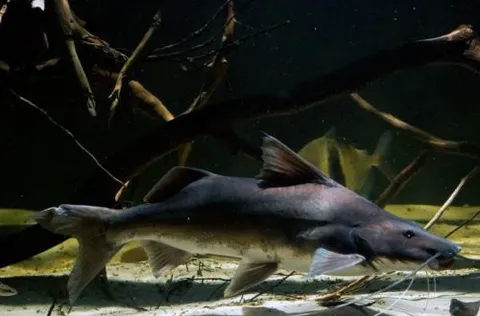
Brachyplatystoma vaillantii
The large predatory fish known as the Lau-Lau Catfish, or Brachyplatystoma vaillantii, belongs to the family Pimelodidae, also known as the Pimelodids or flat-headed catfishes. It is virtually impossible to encounter it…
Brachyplatystoma capapretum
The False Piraíba, scientifically named Brachyplatystoma capapretum, belongs to the family Pimelodidae, also known as long-whiskered or flat-headed catfishes. This large predatory fish is often found in public aquariums…