Temperature22 – 27 °C
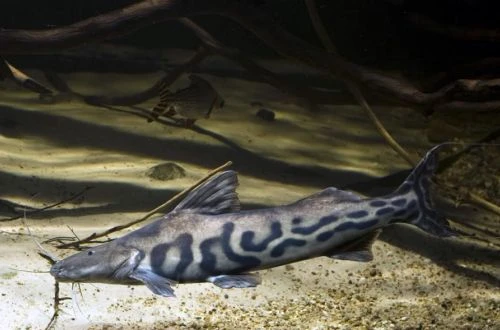
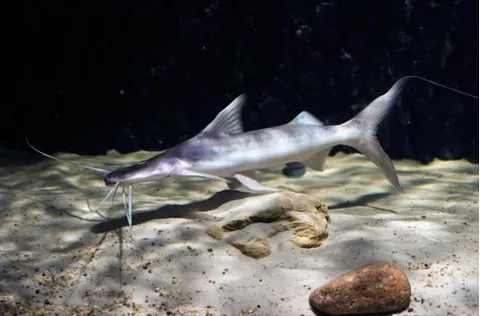
The Striped Brachyplatystoma, also known as the Golden Zebra Catfish (scientific name Brachyplatystoma juruense), belongs to the family Pimelodidae, which includes flat-headed catfish. This large predatory fish inhabits the deep waters of the Amazon and is very rarely found among amateur aquarists.
Adults reach an impressive length, often exceeding 60 cm. Characteristic features include a flattened head and a rather large mouth. The eyes of these catfish are small, and their role in orientation is minimal, which is explained by the low light in murky bottom waters. The main tool for finding food is long, highly sensitive barbels – a key organ of touch. The tail is relatively compact, but its outermost rays have developed into filamentous appendages, which can sometimes be longer than the entire body of the fish. The coloration is usually pale: yellow or gray, and young catfish may show pinkish hues. The body is adorned with a pattern of wide dark stripes, which can be vertical, oblique, or even branched, sometimes breaking into separate spots.
Its natural habitat is South America, where the species is widespread in the basins of the great Amazon and Orinoco rivers, extending through Brazil, Colombia, and Venezuela. It prefers to live in the bottom layer of the main river channel, and feels equally comfortable in swift and slow currents.
This fish is distinguished by its peaceful, calm disposition, but it will not miss an opportunity to swallow any fish that can fit into its mouth. If cohabitation is planned, choose only large, non-aggressive species that prefer to inhabit the upper or middle layers of the water.
The Golden Zebra Catfish is a suitable inhabitant only for truly large private or public aquariums. In home aquaristics, it is extremely rare, as setting up a tank weighing more than one and a half tons (including water, substrate, and decorations) is not accessible to everyone. Despite the fact that this fish is quite unpretentious and able to adapt to various hydrochemical parameters of water, its maintenance cannot be called simple. Maintaining high water quality at the proper level and regular cleaning of such a large aquarium require significant time and financial costs.
This carnivorous species preys on other bottom dwellers in natural conditions. In an aquarium environment, the catfish adapts well to alternative food sources, including shrimp meat, mussels, squid, and pieces of lean fish flesh. For large individuals, one feeding per week is sufficient.
To date, no successful cases of breeding Striped Brachyplatystoma in captivity have been recorded. In nature, its reproductive cycle is closely linked to seasonal migrations.
When kept in favorable conditions, fish rarely experience health deterioration. The occurrence of diseases usually indicates problems in keeping, such as polluted water, poor quality food, or injuries. In most cases, eliminating the root cause leads to recovery. However, sometimes medication may be required.
When choosing a Brachyplatystoma juruense, it is important to assess the overall condition of the fish: it should be active (at night), with clean fins and no visible skin damage. Avoid individuals with sunken bellies or signs of emaciation, as this species is extremely sensitive to food quality and transport conditions. In the store, pay attention to the keeping conditions: the fish requires a high level of oxygen and water purity, so the presence of signs of decay or bacterial infections in the aquarium is a critical risk. Given the large size of an adult specimen, before purchasing, it is important to ensure that you can provide the fish with an aquarium of suitable volume, as any growth delays due to confinement are irreversible and negatively affect health.
The essentials: size, tank volume, water parameters and care
An adult reaches 60 cm in length. Plan the tank around the maximum size: the fish quickly outgrows a cramped setup.
The recommended volume is 1000 L. A smaller tank speeds up nitrate build-up and raises stress levels.
Temperature 22–27 °C, pH 6.5–7.5, hardness 1–12 dGH. Stability matters more than exact values: sudden swings are harder on the fish than a small deviation from the ideal.
Around 15 years when kept properly. Lifespan depends directly on tank volume, water quality and a varied diet.
Temperament: predator, but semi-peaceful (gets along with large ones). This is a predatory species — any fish small enough to fit in its mouth will eventually be eaten.
Recommended setup: both solitary and in group (flexible). Ignoring this is a common cause of stress and disease.
Diet type: sinking (meat / protein). Feed small portions that are finished within a couple of minutes — overfeeding does more harm than underfeeding.
The scientific name of the species is Brachyplatystoma juruense, family Pimelodidae (Long-whiskered Catfishes). It also appears in the literature as: Ginesia cunaguaro, Platystoma juruense.
The water suits 197 of 208 plants in the catalogue — the easiest ones are shown first.
Afzelius's AnubiasAnacharisAnubiasBrazilian PennywortDwarf CloverDwarf CloverDwarf HygrophilaDwarf SagittariaDwarf ValGuppy GrassHornwortJava FernJava MossMoneywortMud SwordNair's LagenandraNarrow Leaf AnacharisNarrow-leaf CloverStringy MossSüsswassertangTaiwan MossTape GrassTemple PlantUssuri Watermilfoil
Matched by family, categories and overlapping keeping conditions
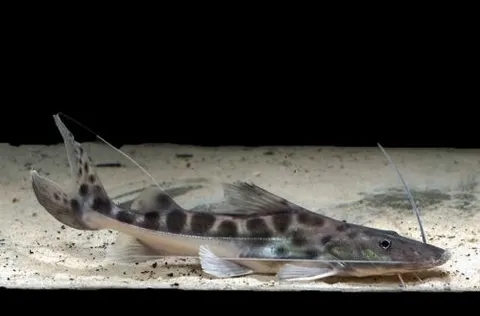
Brachyplatystoma filamentosum
Piraiba, also known by its scientific name Brachyplatystoma filamentosum, belongs to the family Pimelodidae, or long-whiskered catfish (flat-headed catfish). It is one of the largest freshwater fish, rarely encountered…
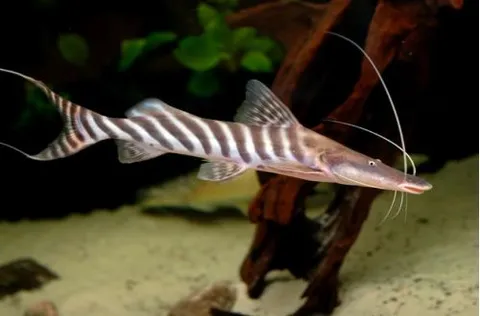
Brachyplatystoma tigrinum
Brachyplatystoma tigrinum, also known as the Tiger Catfish, is a member of the family Pimelodidae (long-whiskered or flat-headed catfish). This large and impressive fish is compatible with other freshwater species,…
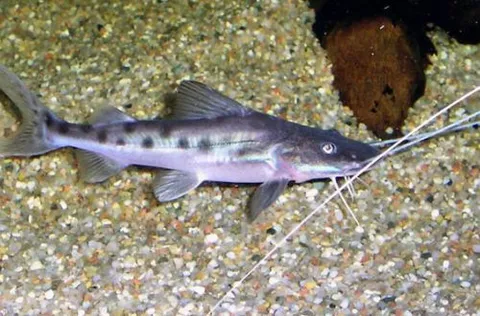
Brachyplatystoma capapretum
The False Piraíba, scientifically named Brachyplatystoma capapretum, belongs to the family Pimelodidae, also known as long-whiskered or flat-headed catfishes. This large predatory fish is often found in public aquariums…
Brachyplatystoma platynema
The scientific name Brachyplatystoma platynema is assigned to the slime catfish, a representative of the family Pimelodidae (long-whiskered or flat-headed catfishes). Fishermen gave it this unusual name because bubbles…