Temperature22 – 28 °C
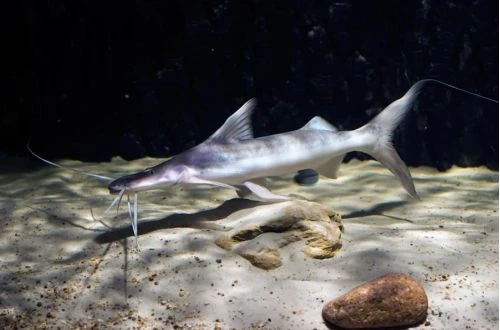
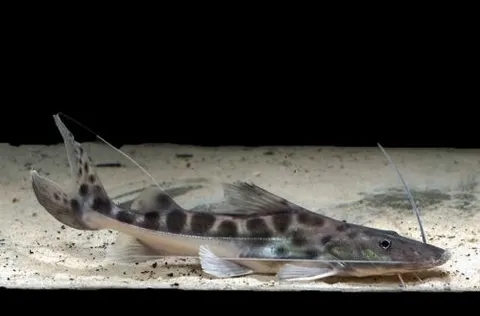
The scientific name Brachyplatystoma platynema is assigned to the slime catfish, a representative of the family Pimelodidae (long-whiskered or flat-headed catfishes). Fishermen gave it this unusual name because bubbles appear around its mouth when a fisherman pulls the catfish out of the water and it tries to breathe air. This is an important commercial species for the local population. Beginner aquarists should not choose this catfish.
Adults grow to an impressive length, reaching approximately 1 meter. Young catfish exhibit a dark coloration with a characteristic spotted pattern, which gradually fades as they mature. Eventually, the upper body takes on light gray or brown hues, while the underside becomes light. The fish's body is elongated and muscular, ending in a flat head with large barbels. The caudal fin is large and forked, with elongated outer rays. Visible differences between male and female are minimal, indicating weak sexual dimorphism.
The natural habitat of this species is in South America, where it is widely distributed throughout most of the Amazon and Orinoco river basins. The catfish inhabits the deep channels of the main rivers, not being tied to a specific biotope. Throughout the year, these fish migrate from the estuary to the headwaters, covering distances of over 5000 km, making their migrations among the longest for freshwater fish.
Despite its predatory diet, this species is characterized by a peaceful disposition and can coexist with other aquarium inhabitants, provided they are large enough not to fit into its mouth. However, it should be understood that any small fish will likely become its prey.
Due to the significant size of adult fish, their keeping will require very large aquariums, holding thousands of liters of water. Such setups, along with decorations and necessary equipment, will weigh several tons, and their maintenance and upkeep entail significant time and financial costs. All of this puts the slime catfish beyond the scope of ordinary amateur aquaristics. The choice of design decoration is not very important, as complex decor is not needed and can be quickly destroyed by the catfish. This catfish will look most organic against a sandy or rocky substrate, among large snags and boulders, provided subdued lighting. Maintaining high water quality is ensured by a strict aquarium maintenance regimen, as well as powerful filtration systems, which sometimes occupy an entire room.
In nature, this carnivorous species feeds exclusively on other fish. However, in aquarium conditions, it can often be accustomed to a diet alternative to live prey. Examples include shrimp, mussels, as well as pieces of squid and fish meat. Feeding frequency is usually once a week.
To date, there have been no recorded successful cases of breeding slime catfish in artificial aquarium environments. Young individuals are usually supplied by direct capture from their natural waters.
Most health problems in fish often arise from unsuitable keeping conditions. Maintaining a stable and comfortable habitat is a key factor for successful keeping. If symptoms of illness appear, the first step is to check the water quality. If deviations are found, it is important to take immediate measures to eliminate them. If the symptoms do not disappear or worsen, medicinal treatment may be required.
The acquisition of this species entails high responsibility due to its impressive size, reaching 1 meter in length. In a pet store, only active individuals without visible skin damage, ulcers, or signs of fungal infections should be selected. It is important to ensure the absence of fin and barbel deformities, as well as clear eyes. Due to specific needs for space and water quality, this species is not recommended for keeping in ordinary home aquariums. The buyer must already have a specialized life support system of thousands of liters, as the transportation and adaptation of adult individuals are extremely difficult.
The essentials: size, tank volume, water parameters and care
An adult reaches 50–117 cm in length. Plan the tank around the maximum size: the fish quickly outgrows a cramped setup.
The recommended volume is 1000 L. A smaller tank speeds up nitrate build-up and raises stress levels.
Temperature 22–28 °C, pH 6–8, hardness 1–21 dGH. Stability matters more than exact values: sudden swings are harder on the fish than a small deviation from the ideal.
Around 15 years when kept properly. Lifespan depends directly on tank volume, water quality and a varied diet.
Temperament: predator, but semi-peaceful (gets along with large ones). This is a predatory species — any fish small enough to fit in its mouth will eventually be eaten.
Recommended setup: both solitary and in group (flexible). Ignoring this is a common cause of stress and disease.
Diet type: meat / protein (live, frozen, fresh). Feed small portions that are finished within a couple of minutes — overfeeding does more harm than underfeeding.
The scientific name of the species is Brachyplatystoma platynema, family Pimelodidae (Long-whiskered Catfishes). It also appears in the literature as: Goslinia platynema, Taenionema steerei.
The water suits 197 of 208 plants in the catalogue — the easiest ones are shown first.
Afzelius's AnubiasAnacharisAnubiasBrazilian PennywortDwarf CloverDwarf CloverDwarf HygrophilaDwarf SagittariaDwarf ValGuppy GrassHornwortJava FernJava MossMoneywortMud SwordNair's LagenandraNarrow Leaf AnacharisNarrow-leaf CloverStringy MossSüsswassertangTaiwan MossTape GrassTemple PlantUssuri Watermilfoil
Matched by family, categories and overlapping keeping conditions
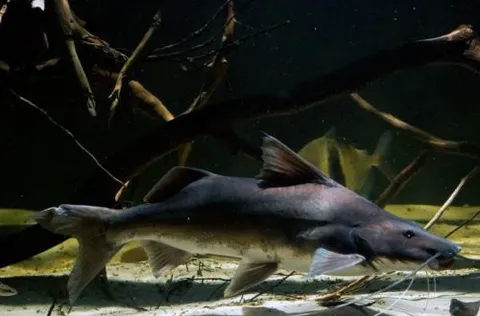
Brachyplatystoma vaillantii
The large predatory fish known as the Lau-Lau Catfish, or Brachyplatystoma vaillantii, belongs to the family Pimelodidae, also known as the Pimelodids or flat-headed catfishes. It is virtually impossible to encounter it…
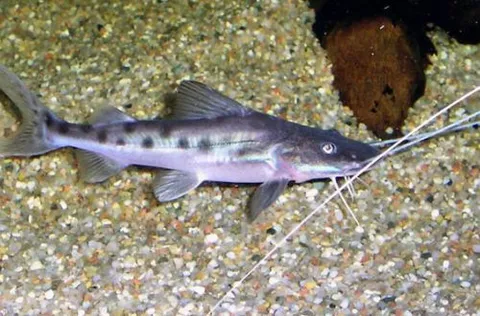
Brachyplatystoma capapretum
The False Piraíba, scientifically named Brachyplatystoma capapretum, belongs to the family Pimelodidae, also known as long-whiskered or flat-headed catfishes. This large predatory fish is often found in public aquariums…
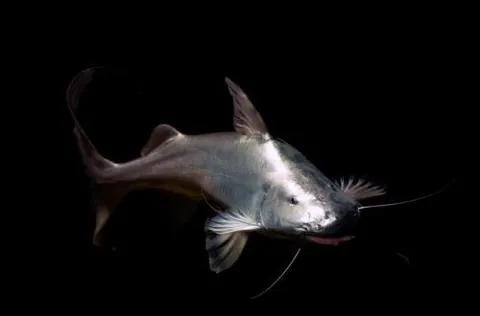
Brachyplatystoma rousseauxii
Dourada, known scientifically as Brachyplatystoma rousseauxii, belongs to the family Pimelodidae, also called pimelodid or flat-headed catfishes. This large predatory fish is highly valued by the local population as an…
Brachyplatystoma filamentosum
Piraiba, also known by its scientific name Brachyplatystoma filamentosum, belongs to the family Pimelodidae, or long-whiskered catfish (flat-headed catfish). It is one of the largest freshwater fish, rarely encountered…