Temperature22 – 28 °C
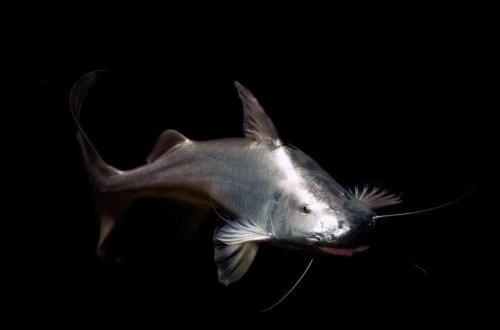
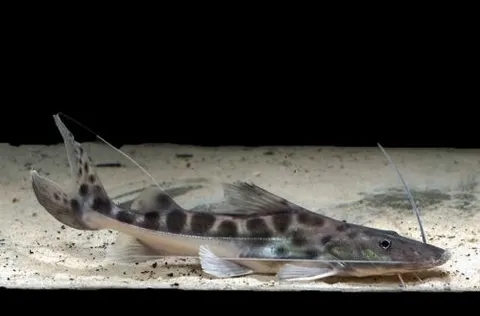
Dourada, known scientifically as Brachyplatystoma rousseauxii, belongs to the family Pimelodidae, also called pimelodid or flat-headed catfishes. This large predatory fish is highly valued by the local population as an important commercial species. It is rarely encountered in aquarium conditions—mostly among dedicated enthusiasts or in large public aquariums.
In natural conditions, adults can reach a length of up to 1.9 meters; however, in confined artificial environments, their growth is somewhat more modest—approximately up to 1.5 meters. This fish has a powerful, elongated body and a rather large, slightly flattened head. A characteristic feature is a massive forked tail, the outer rays of which end in long filamentous appendages. The fish's coloration is monochromatic, presented in a steel silvery-gray color. Sexual dimorphism is poorly expressed, and distinguishing males from females by external signs is not easy.
Its natural range covers South America. This species is widely distributed throughout the vast Amazon and Orinoco river systems. These fish prefer to inhabit deep river channels, from the mouths to the headwaters, which means their natural habitat extends for many thousands of kilometers.
Despite being a predator, this fish has a peaceful disposition and does not show aggression. It coexists well with other fish species of comparable size, as well as with those large enough not to be swallowed by it. However, any small fish will, of course, become its prey.
Successful keeping of Dourada requires exceptionally large aquariums, with a capacity of several thousand liters. To ensure high water quality in such large-scale systems, it is necessary to install productive filtration equipment and lay engineering communications for regular water changes (drainage and supply systems). All of this combined often occupies a space comparable to a small room. The total weight of such an aquarium often exceeds several tons, which, in turn, dictates the need for serious construction work. Given all these requirements, it becomes obvious that Dourada is not a fish for amateur aquaristics.
This species is piscivorous; however, over time, it can be accustomed to alternative food sources such as shrimp, mussels, and pieces of white fish fillet and squid. Feeding is usually done once a week.
Breeding of this species is not carried out in artificial conditions. In nature, spawning occurs in the headwaters of rivers. Parental care for the offspring is absent. Eggs and hatched fry are washed downstream by the current, reaching the delta; this journey takes about a month. Young fish remain in the estuary area for approximately three years, entering the delta for feeding when conditions allow. After this, they migrate to the lower and middle parts of the Amazon, where they spend another year. In their fourth year of life, having reached sexual maturity and readiness to reproduce, the catfishes again ascend to the headwaters of the rivers. Thus, during their migrations, they cover a distance exceeding 5500 kilometers.
Most health problems in fish often arise from unsuitable keeping conditions. Maintaining a stable and comfortable habitat is a key factor for successful keeping. If symptoms of illness appear, the first step is to check the water quality. If deviations are found, it is important to take immediate measures to eliminate them. If the symptoms do not disappear or worsen, medicinal treatment may be required.
The acquisition of this species for private aquariums is not recommended due to its extremely large size and specific migratory needs. Mainly young specimens are found in trade. When choosing, attention should be paid to the absence of skin damage, clean fins, and the absence of visible parasites. A healthy fish should show activity, have clear eyes, and even breathing without signs of a rapid gill rate. Avoid purchasing specimens with sunken bellies or unnatural behavior, as the adaptation of this species to captivity is extremely difficult and requires conditions available only in public oceanariums.
The essentials: size, tank volume, water parameters and care
An adult reaches 150–192 cm in length. Plan the tank around the maximum size: the fish quickly outgrows a cramped setup.
The recommended volume is 1500 L. A smaller tank speeds up nitrate build-up and raises stress levels.
Temperature 22–28 °C, pH 6–8, hardness 1–21 dGH. Stability matters more than exact values: sudden swings are harder on the fish than a small deviation from the ideal.
Around 15 years when kept properly. Lifespan depends directly on tank volume, water quality and a varied diet.
Temperament: predator, but semi-peaceful (gets along with large ones). This is a predatory species — any fish small enough to fit in its mouth will eventually be eaten.
Recommended setup: both solitary and in group (flexible). Ignoring this is a common cause of stress and disease.
Diet type: meat / protein (live, frozen, fresh). Feed small portions that are finished within a couple of minutes — overfeeding does more harm than underfeeding.
The scientific name of the species is Brachyplatystoma rousseauxii, family Pimelodidae (Long-whiskered Catfishes). It also appears in the literature as: Bagrus goliath, Bagrus rousseauxii, Brachyplatystoma paraense.
The water suits 197 of 208 plants in the catalogue — the easiest ones are shown first.
Afzelius's AnubiasAnacharisAnubiasBrazilian PennywortDwarf CloverDwarf CloverDwarf HygrophilaDwarf SagittariaDwarf ValGuppy GrassHornwortJava FernJava MossMoneywortMud SwordNair's LagenandraNarrow Leaf AnacharisNarrow-leaf CloverStringy MossSüsswassertangTaiwan MossTape GrassTemple PlantUssuri Watermilfoil
Matched by family, categories and overlapping keeping conditions
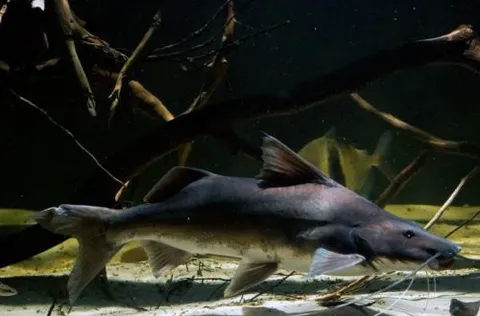
Brachyplatystoma vaillantii
The large predatory fish known as the Lau-Lau Catfish, or Brachyplatystoma vaillantii, belongs to the family Pimelodidae, also known as the Pimelodids or flat-headed catfishes. It is virtually impossible to encounter it…
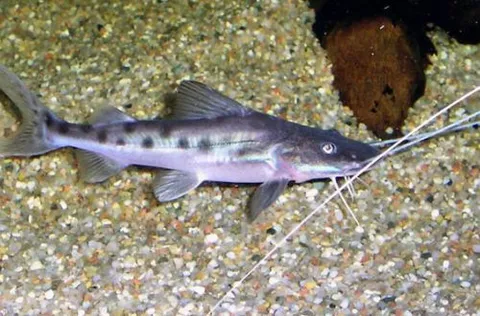
Brachyplatystoma capapretum
The False Piraíba, scientifically named Brachyplatystoma capapretum, belongs to the family Pimelodidae, also known as long-whiskered or flat-headed catfishes. This large predatory fish is often found in public aquariums…
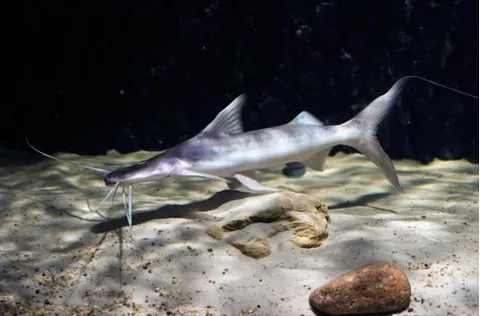
Brachyplatystoma platynema
The scientific name Brachyplatystoma platynema is assigned to the slime catfish, a representative of the family Pimelodidae (long-whiskered or flat-headed catfishes). Fishermen gave it this unusual name because bubbles…
Brachyplatystoma filamentosum
Piraiba, also known by its scientific name Brachyplatystoma filamentosum, belongs to the family Pimelodidae, or long-whiskered catfish (flat-headed catfish). It is one of the largest freshwater fish, rarely encountered…