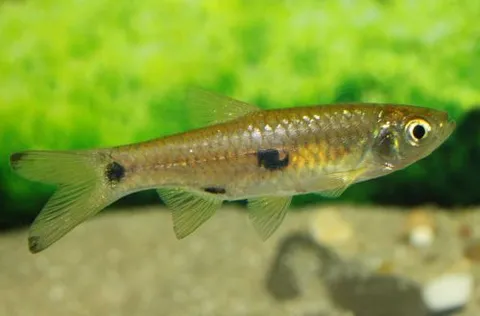
Elegant Rasbora
Rasbora elegans
Rasbora elegans, or the Elegant Rasbora, belongs to the family Cyprinidae. This fish is characterized by an active, peaceful disposition and good hardiness, successfully adapting to various conditions. Despite its…
Rasbora caudimaculata, known as the Scissortail Rasbora, belongs to the family Cyprinidae. It is an active, schooling fish of medium size. Although its coloration is not particularly bright, it compensates for this with its energy, constantly moving and bringing lively dynamics to any freshwater aquarium.
This is a relatively large fish, reaching 15 cm (6 inches) in length. Females are usually slightly larger than males, while males appear more slender. The body coloration is silvery; only the tips of the caudal fin have reddish or orange markings, thanks to which the fish got its name – Scissortail Rasbora. The tail itself has a deep indentation, resembling scissors in shape.
The natural habitat of this species covers Southeast Asia, including peninsular Malaysia, the islands of Borneo and Sumatra. These fish apparently adapt easily to various conditions, as they are found both in small rivers and streams with moderate currents, and in peat swamps with brownish water, rich in tannins and organic decomposition products.
This is a peaceful and friendly, yet very active species. They are incompatible with slow-moving fish; only those that match the Scissortail Rasbora in size and temperament should be chosen as tankmates. It is recommended to keep them in a school of at least 6 individuals. In a group, the fish display their best coloration and natural behavior.
Comfortable conditions for the Scissortail Rasbora can be created in an aquarium of 300 L (80 gallons) or more, providing significant open swimming space. The decor can be anything: from imitating a rocky bottom of a fast river to a section of a peat swamp, strewn with fallen leaves, snags, branches, and tree roots. All decorative elements, including plants, are recommended to be placed along the side walls of the aquarium to maintain a sufficient volume of open water for unimpeded swimming of the Rasboras. Standard equipment includes filtration and lighting systems, an aerator, and a heater. When choosing a “river” setup, devices for creating artificial current can also be used. A lid is essential, as these active fish are prone to jumping out of the water. Water parameters should be characterized by low dGH with slightly acidic or neutral pH. Aquarium care involves weekly water changes of 15–20% of the volume with fresh water, as well as regular cleaning of the substrate from organic waste and glass from film.
Rasbora accepts all types of food: dry, frozen, and live. It is important to provide a varied diet, combining different types of food; for example, flakes or granules can be alternated with bloodworms and mosquito larvae. Feeding should be done 2–3 times a day in an amount that the fish consume within 5 minutes. Leftover food should be removed to avoid excessive water pollution.
Being egg-laying species, females scatter their eggs in the water column, which males then fertilize. Since parental instincts are poorly developed in these fish, after spawning, they may eat both the eggs and the hatched fry. To ensure the survival of the offspring, breeding is recommended in a separate breeding tank. The breeding tank decor should be simple, with an emphasis on the substrate: it should consist of sufficiently large particles, such as pebbles or decorative glass beads, which do not fit tightly together, creating voids. When the eggs sink to the bottom, most of them will fall into these voids, becoming inaccessible to adult fish. A similar effect is achieved by using a fine-mesh net secured to the bottom. Another way to protect the eggs is to use low-growing, fine-leaved plants or mosses, such as Riccia fluitans or Java moss, planted over most of the substrate surface (in this case, the substrate can be any). Dense thickets of plants can provide reliable cover for eggs no worse than a special substrate. A breeding aquarium usually has a volume of 100–120 L (26–32 gallons) and is filled halfway. Equipment used includes an aerator, heater, and a low-power sponge filter to avoid accidentally sucking in eggs and fry. Spawning occurs in dim light, so a light source is not required at the initial stage. The beginning of the breeding period can be determined by rounded females and active attention from males. By this time, a separate tank should be prepared, filled with water from the main aquarium, and then several females and the most colorful males should be transferred there. Spawning can be initiated by adding cool water and lowering the temperature by several degrees. If this is done in the evening, offspring may appear by morning. It is easiest to determine the end of spawning by the females – they will become noticeably slimmer. After spawning, the fish are returned. Fry will hatch in 18–48 hours, and after 1–2 days, they will begin to swim freely. They should be fed specialized microscopic food for aquarium fish fry.
Balanced nutrition and properly selected keeping conditions are the best prevention of diseases in freshwater fish. If the first signs of illness appear, such as changes in coloration or behavior, the first step should be to check the water parameters and quality. If necessary, all values should be brought back to normal, and only then should treatment begin.
When selecting individuals, attention should be paid to clean skin, absence of white spots, ulcers, or signs of fin damage. A healthy fish should be active, stay in a school, and show no signs of emaciation. Avoid purchasing fish that appear sluggish, stay at the water surface, or have an unnaturally bloated abdomen, unless this is related to natural sexual dimorphism. In the store, it is important to assess the general conditions in the aquarium: water clarity and the absence of dead individuals nearby.
There are no pair reviews for this species yet — check tankmates in the matcher.
All tankmatesThe water suits 198 of 208 plants in the catalogue — the easiest ones are shown first.
Afzelius's AnubiasAnacharisAnubiasBrazilian PennywortDwarf CloverDwarf CloverDwarf HygrophilaDwarf SagittariaDwarf ValGuppy GrassHornwortJava FernJava MossMoneywortMud SwordNair's LagenandraNarrow Leaf AnacharisNarrow-leaf CloverStringy MossSüsswassertangTaiwan MossTape GrassTemple PlantUssuri Watermilfoil
Matching water does not mean the plant will stay intact.
The essentials: size, tank volume, water parameters and care
An adult reaches 15 cm in length. Plan the tank around the maximum size: the fish quickly outgrows a cramped setup.
The recommended volume is 300 L. A smaller tank speeds up nitrate build-up and raises stress levels.
Temperature 20–26 °C, pH 5–7.5, hardness 2–10 dGH. Stability matters more than exact values: sudden swings are harder on the fish than a small deviation from the ideal.
Around 8 years when kept properly. Lifespan depends directly on tank volume, water quality and a varied diet.
Temperament: peaceful, active/mobile. Keep this in mind when choosing tank mates.
Recommended setup: medium group (6–8 individuals). Ignoring this is a common cause of stress and disease.
Diet type: any (universal). Feed small portions that are finished within a couple of minutes — overfeeding does more harm than underfeeding.
The scientific name of the species is Rasbora caudimaculata, family Cyprinids (Cyprinidae). It also appears in the literature as: Rasbora dorsimaculata, Rasbora layangi.
Matched by family, categories and overlapping keeping conditions
Rasbora elegans
Rasbora elegans, or the Elegant Rasbora, belongs to the family Cyprinidae. This fish is characterized by an active, peaceful disposition and good hardiness, successfully adapting to various conditions. Despite its…
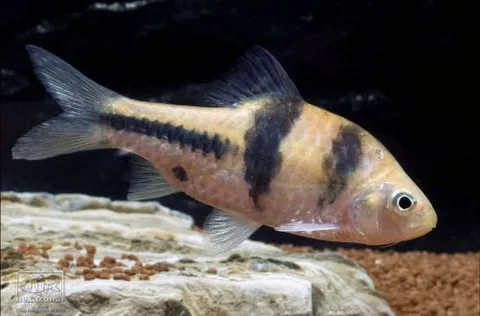
Striuntius lateristriga
The Cross Barb, scientifically known as Striuntius lateristriga, belongs to the carp family (Cyprinidae). This active schooling fish reaches significant size and is constantly in motion. The only significant limitation…
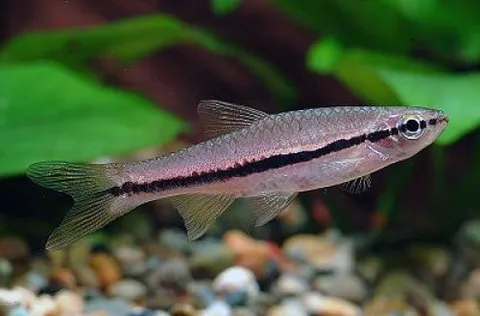
Rasbora einthovenii
Rasbora einthovenii, known as the Brilliant Rasbora, belongs to the family Cyprinidae. This active schooling fish can be successfully kept under specific conditions, but overall it is quite undemanding and easy to breed.
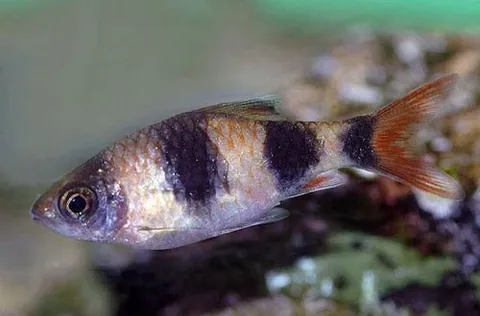
Dawkinsia arulius
The Arulius Barb, scientifically known as Dawkinsia arulius and belonging to the family Cyprinidae, does not impress with its bright coloration or unique body pattern. However, its lively activity and unpretentiousness…