Temperature20 – 26 °C
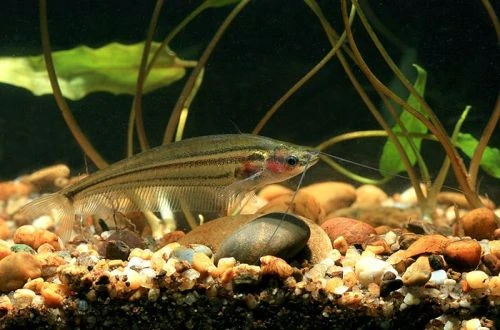
The Spotted Glass Catfish, also known as the False Glass Catfish under its scientific name Kryptopterus macrocephalus, belongs to the family Siluridae. This fish is peaceful but at the same time carnivorous. It is quite easy to keep and will not cause much trouble if the necessary conditions in the aquarium are maintained.
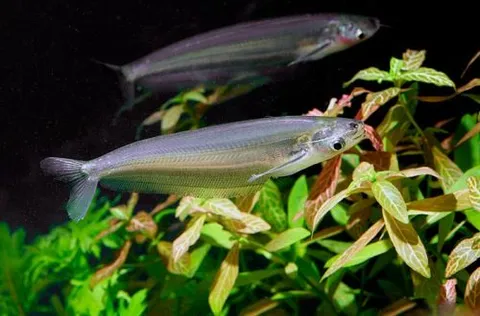
The appearance of this fish is practically indistinguishable from its close relative, the Glass Catfish. Adults can reach a length of 9–10 cm. The catfish's body is elongated, flattened laterally, and tapers towards the caudal part, giving it a blade-like appearance. The head is quite large, adorned with two long barbels. The coloration is predominantly translucent, light brown, with chaotically arranged dark spots.
Its natural habitat covers areas of Southeast Asia, including the southern regions of Thailand, peninsular Malaysia, as well as the Greater Sunda Islands such as Sumatra, Borneo, and Java. This species inhabits peat swamps located in dense tropical forests. Typically, its habitat is characterized by dim lighting, as the dense tree canopies almost completely block sunlight. The coastal zone and water column are rich in shade-loving plants, ferns, and mosses. The bottom of the water bodies is usually soft and silty, strewn with branches and fallen leaves. A large amount of plant organic matter gives the water a rich brown tint.
This catfish exhibits a peaceful and timid character; however, it is important to remember that it is a carnivorous species. Accordingly, it can eat any fish that fits into its mouth. Compatibility is possible with other non-aggressive fish species, but only if they are comparable in size. For comfortable existence, it is recommended to keep a group of 3–4 individuals.
For keeping 2–3 individuals, the optimal aquarium volume should be at least 100 L. When decorating, it is recommended to recreate conditions close to the natural habitat: establish subdued lighting, place many snags and aquatic plants, including floating ones. A layer of fallen leaves from certain trees can be laid on the bottom; their decomposition will contribute to processes similar to those occurring in natural water bodies. As a result, tannins will be released, giving the water the necessary chemical composition and characteristic brown tint. Successful keeping of the Spotted Glass Catfish directly depends on maintaining stable water parameters within the permissible range of temperatures and hydrochemical indicators. The desired level of stability is achieved through regular aquarium maintenance, which includes partial water changes and waste removal, as well as the use of necessary equipment.
This species is characterized as a small predator. In natural conditions, its diet consists of crustaceans, invertebrates, and small fish. Nevertheless, in a home aquarium, it readily accepts dry foods such as flakes and granules. To maintain a complete diet, it is recommended to supplement the diet twice a week with live or frozen foods, for example, Artemia, Daphnia, or bloodworms.
No successful breeding of this species in home aquaria has been recorded. Glass catfishes of the genus Kryptopterus do not spawn on their own in captivity, and no reliable way to induce spawning has been described; nor is there any information on external sexual differences. For the closely related glass catfish there are virtually no records of aquarium spawning either.
When kept in favorable conditions, fish rarely experience health deterioration. The occurrence of diseases usually indicates problems in keeping, such as polluted water, poor quality food, or injuries. In most cases, eliminating the root cause leads to recovery. However, sometimes medication may be required.
When purchasing, choose active fish with transparent bodies without visible spots, ulcers, or fin damage. Avoid individuals that appear emaciated, have a cloudy film on their skin, or stay exclusively at the water surface in the store. Given that this species is schooling and quite timid, it is best to acquire a group of 4 or more specimens simultaneously to reduce stress during adaptation to a new aquarium. Before purchasing, make sure the fish have started to accept food in the store.
The essentials: size, tank volume, water parameters and care
An adult reaches 9–10 cm in length. Plan the tank around the maximum size: the fish quickly outgrows a cramped setup.
The recommended volume is 100 L. A smaller tank speeds up nitrate build-up and raises stress levels.
Temperature 20–26 °C, pH 4–7, hardness 0–8 dGH. Stability matters more than exact values: sudden swings are harder on the fish than a small deviation from the ideal.
Around 7 years when kept properly. Lifespan depends directly on tank volume, water quality and a varied diet.
Temperament: semi-peaceful (dangerous to smaller ones). Not a predatory species, but small fish that fit in its mouth will eventually be eaten.
Recommended setup: small group (3–4 individuals). Ignoring this is a common cause of stress and disease.
Diet type: sinking (any). Feed small portions that are finished within a couple of minutes — overfeeding does more harm than underfeeding.
The scientific name of the species is Kryptopterus macrocephalus, family Sheatfishes (Siluridae). It also appears in the literature as: Cryptopterus macrocephalus, Kryptopterichthys macrocephalus.
The water suits 197 of 208 plants in the catalogue — the easiest ones are shown first.
Afzelius's AnubiasAnacharisAnubiasBrazilian PennywortDwarf CloverDwarf CloverDwarf HygrophilaDwarf SagittariaDwarf ValGuppy GrassHornwortJava FernJava MossMoneywortMud SwordNair's LagenandraNarrow Leaf AnacharisNarrow-leaf CloverStringy MossSüsswassertangTaiwan MossTape GrassTemple PlantUssuri Watermilfoil
Matched by family, categories and overlapping keeping conditions
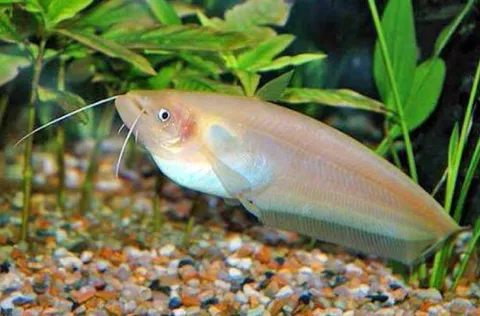
Ompok bimaculatus
Ompok bimaculatus, or the Two-spot Ompok (also known as the Ompok Catfish), belongs to the family Siluridae — the Sheatfishes. This fish is found in its natural habitat in the waters of South and Southeast Asia,…
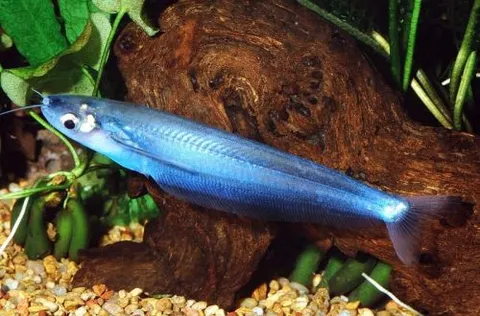
Kryptopterus cryptopterus
The Blue Glass Catfish, also known as the Smoky Glass Catfish (scientific name Kryptopterus cryptopterus), belongs to the family Siluridae. Despite being a miniature predator, it is undemanding to keep and gets along…
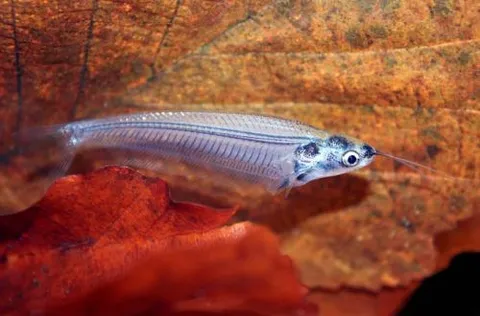
Kryptopterus vitreolus
Kryptopterus vitreolus, known as the glass catfish, belongs to the family Siluridae. It stands out among catfishes for its remarkably transparent body, through which the fish's skeleton can be observed. This unusual…
Kryptopterus geminus
Kryptopterus geminus, known as the Glass Catfish Twin, is a representative of the family Siluridae (Catfishes). Its name "twin" is due to its close relationship with another, quite popular species – the Ghost Glass…