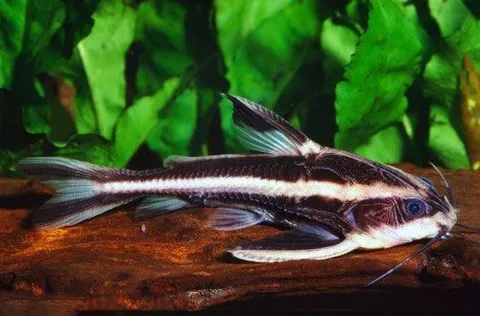
Platydoras
Platydoras armatulus
Platydoras (Platydoras armatulus), a representative of the family Doradidae, exhibits enviable unpretentiousness and high endurance. It can become an excellent helper in the aquarium, picking up food scraps left by…
Agamyxis pectinifrons is the spotted raphael catfish, also known as the starred agamyxis or white-spotted agamyxis. This member of the family Doradidae has the common name "talking catfish" because it produces squeaking sounds when taken out of water. Beyond its attractive appearance, this peaceful fish is useful in the aquarium: it helps clean décor of unwanted algae.
Dangerous to small fish
The spotted raphael catfish has a distinctive look: its body is protected by bony plates, and sharp spines on its fins and body defend it from predators. The dark coloration is marked with contrasting white spots, often just the tips of the spines themselves. A spine wound is painful but not venomous. This "armour" requires special care during transport: do not use ordinary plastic bags. Use only sturdy plastic or glass containers instead. The fish is sluggish and mostly nocturnal, spending much of its time on the bottom among plants, driftwood, or caves. When threatened, it can quickly bury itself in sand.
The spotted raphael catfish lives in the Amazon basin in Bolivia, Brazil, Colombia, and Peru. In nature it inhabits slow, weakly flowing waters with soft silty or sandy bottoms and plenty of driftwood, roots, and leaf litter for shelter. The water temperature there is typically 20–26 °C, pH 5.8–7.5, and hardness varies.
Although this catfish is a carnivore, it can be kept with most fish of similar or slightly smaller size. It prefers to live in groups of its own kind. Its solid protection lets it coexist even with some aggressive fish, such as certain cichlid species.
This species has no special demands on water chemistry and tolerates wide changes in hardness. However, the water must be free of ammonia, which builds up from decaying matter. Weekly partial water changes of about 10% of the tank volume and substrate siphoning will maintain good conditions. Provide many hiding places and dense plants. Use coarse sand or fine, smooth gravel so the fish does not injure itself or clog its gills when burrowing.
The spotted raphael catfish is a carnivore and needs a diet based on protein. Offer bloodworms, earthworms, or tubifex; it also takes frozen meat foods readily. Use dry foods like flakes or pellets only as a supplement. The fish will eat aquarium invertebrates, including snails. Feed daily shortly before the light goes out.
Reliable accounts of breeding this species in captivity are lacking. Published descriptions of spawning are unconfirmed, so successful home breeding is considered unlikely.
The agamyxis catfish is hardy but, lacking scales and with its body structure, it is sensitive to water quality. The main threats are accumulation of ammonia, nitrite, and nitrate from poor filtration or excess organic waste. Poor water conditions and infrequent changes can lead to bacterial skin infections with ulcers or lesions. Prevention means keeping conditions stable, using good filtration, and regularly siphoning the substrate. Avoid sudden swings in temperature or water parameters. When treating illness, remember that some fish are sensitive to certain medications, so dose carefully. Fin and skin damage from rough netting can be a gateway for secondary infections.
When buying, watch for activity at night and check for visible skin damage. Remember that agamyxis catfish have sharp barbed spines on their fins that easily catch on nets, so use plastic containers or glass vessels for transport and moving. A healthy fish has clean skin, solid body shape, and the species' characteristic bright spotted pattern.
There are no pair reviews for this species yet — check tankmates in the matcher.
All tankmatesThe water suits 197 of 208 plants in the catalogue — the easiest ones are shown first.
Afzelius's AnubiasAnacharisAnubiasBrazilian PennywortDwarf CloverDwarf CloverDwarf HygrophilaDwarf SagittariaDwarf ValGuppy GrassHornwortJava FernJava MossMoneywortMud SwordNair's LagenandraNarrow Leaf AnacharisNarrow-leaf CloverStringy MossSüsswassertangTaiwan MossTape GrassTemple PlantUssuri Watermilfoil
Matching water does not mean the plant will stay intact.
The essentials: size, tank volume, water parameters and care
An adult reaches 15 cm in length. Plan the tank around the maximum size: the fish quickly outgrows a cramped setup.
The recommended volume is 130 L. A smaller tank speeds up nitrate build-up and raises stress levels.
Temperature 20–26 °C, pH 5.8–7.5, hardness 2–20 dGH. Stability matters more than exact values: sudden swings are harder on the fish than a small deviation from the ideal.
Around 15 years when kept properly. Lifespan depends directly on tank volume, water quality and a varied diet.
Temperament: semi-peaceful (dangerous to smaller ones). Not a predatory species, but small fish that fit in its mouth will eventually be eaten.
Recommended setup: small group (5–6 individuals). Ignoring this is a common cause of stress and disease.
Diet type: meat / protein (live, frozen, fresh). Feed small portions that are finished within a couple of minutes — overfeeding does more harm than underfeeding.
The scientific name of the species is Agamyxis pectinifrons, family Doradidae (Thorny Catfishes). It also appears in the literature as: Doras flavopictus, Doras pectinifrons.
Matched by family, categories and overlapping keeping conditions
Platydoras armatulus
Platydoras (Platydoras armatulus), a representative of the family Doradidae, exhibits enviable unpretentiousness and high endurance. It can become an excellent helper in the aquarium, picking up food scraps left by…
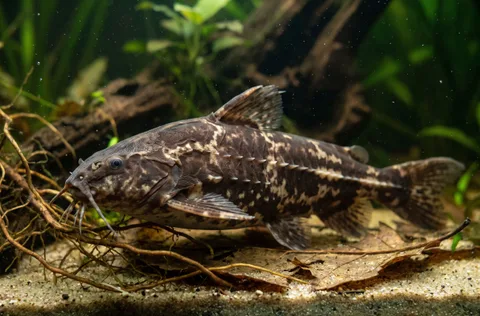
Acanthodoras spinosissimus
The Spiny Catfish, scientifically known as Acanthodoras spinosissimus, belongs to the family Doradidae, or Thorny Catfishes. They are also called "Talking Catfishes" due to the sounds they produce using special bony…
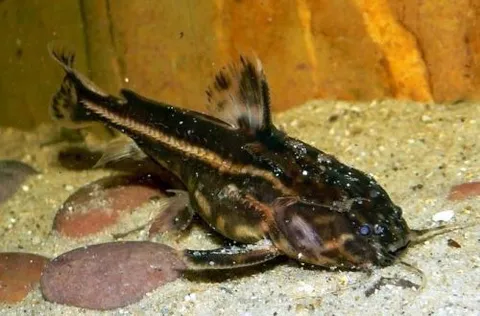
Acanthodoras cataphractus
Acanthodoras cataphractus, commonly known as the Chocolate Talking Catfish or Chocolate Doradid, belongs to the family Doradidae (Thorny Catfishes). It is also called the Spiny Catfish. This fish is not frequently found…
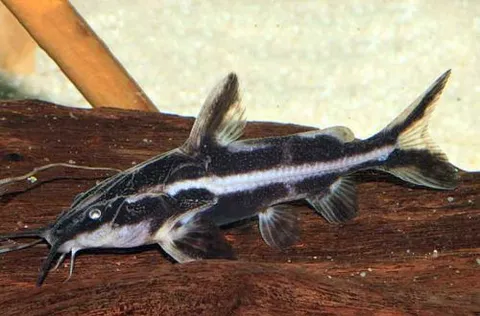
Orinocodoras eigenmanni
Orinocodoras eigenmanni, also known as the Striped Raphael Catfish or Orinoco Raphael Catfish, belongs to the family Doradidae (thorny catfishes). This catfish originates from South America, specifically the Orinoco…