Temperature22 – 25 °C
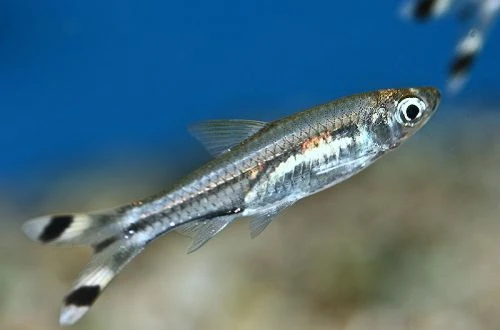
Rasbora trilineata, known as the Three-lined Rasbora, belongs to the family Cyprinidae. This fish is an excellent choice for a beginner aquarist, as it demonstrates high endurance, easily adapts to changing living conditions, and is undemanding in terms of diet. Despite its rather modest coloration, it can hardly be called dull.
This is an elegant fish with a distinctly streamlined body shape. Adults grow to 13 cm in length — they are usually sold at a much smaller size; females are typically slightly larger than males. Its coloration is silvery, and one of its striking features is two dark, symmetrically placed stripes on the caudal fin, as well as a stripe starting from the base of the caudal fin and extending to the belly. It is thanks to these three characteristic stripes that the Rasbora got its name.
This species is widespread in Southeast Asia, found in modern-day Laos, Thailand, Cambodia, the Malay Peninsula, and on the islands of Borneo and Sumatra. Its natural habitat varies from swift rivers and streams flowing through humid tropical forests to ancient peat swamps. Individual populations can also be found in lakes, reservoirs, and even in coastal areas temporarily flooded during the rainy season.
This is a peaceful and very active fish. It is recommended to keep them in a school of at least 6 individuals, as it is in a group that they display their brightest coloration and natural behavioral characteristics. The Three-lined Rasbora coexists well with many other species of similar temperament and size. The best results are achieved when choosing fish from the same region of origin as tankmates, for example, the Spanner Barb, Harlequin Rasbora, or Five-banded Barb.
A comfortable existence for these fish can be provided in an aquarium of 250 L or more, with sufficient open space for their active swimming. The choice of aquarium design is not critical at all and depends entirely on your preferences: it is permissible to imitate either a rocky bottom of a fast river or the environment of a peat swamp with a large number of snags, branches, and fallen leaves. It is important to place all decorative elements, including vegetation, along the side walls of the aquarium. This will allow for the maximum possible volume of open water where the Three-lined Rasbora can move freely. A standard set of equipment is sufficient: this includes lighting and filtration systems, an aerator, and a heater. If you choose a “river” design, you can supplement it with devices to create artificial current. A reliable lid is a mandatory condition, as these fish are very active and have a tendency to jump out of the water. Water parameters such as dGH and pH allow for a wide range of values, which greatly simplifies water preparation. Aquarium care includes weekly water changes of 15–20% of the volume with fresh water, as well as regular cleaning of the substrate from organic residues and the glass from algae.
The diet of these fish can include all types of dry, frozen, and live foods suitable for their size. To maintain good overall fish health, it is recommended to offer a varied menu. Feeding should be done 2–3 times a day, in portions that the fish can consume within 5 minutes.
Being egg-laying species, females scatter their eggs in the water column, which males then fertilize. Since parental instincts are poorly developed in these fish, after spawning, they may eat both the eggs and the hatched fry. To ensure the survival of the offspring, breeding is recommended in a separate breeding tank. The breeding tank decor should be simple, with an emphasis on the substrate: it should consist of sufficiently large particles, such as pebbles or decorative glass beads, which do not fit tightly together, creating voids. When the eggs sink to the bottom, most of them will fall into these voids, becoming inaccessible to adult fish. A similar effect is achieved by using a fine-mesh net secured to the bottom. Another way to protect the eggs is to use low-growing, fine-leaved plants or mosses, such as Riccia fluitans or Java moss, planted over most of the substrate surface (in this case, the substrate can be any). Dense thickets of plants can provide reliable cover for eggs no worse than a special substrate. A breeding aquarium usually has a volume of 100–120 L (26–32 gallons) and is filled halfway. Equipment used includes an aerator, heater, and a low-power sponge filter to avoid accidentally sucking in eggs and fry. Spawning occurs in dim light, so a light source is not required at the initial stage. The beginning of the breeding period can be determined by rounded females and active attention from males. By this time, a separate tank should be prepared, filled with water from the main aquarium, and then several females and the most colorful males should be transferred there. Spawning can be initiated by adding cool water and lowering the temperature by several degrees. If this is done in the evening, offspring may appear by morning. It is easiest to determine the end of spawning by the females – they will become noticeably slimmer. After spawning, the fish are returned. Fry will hatch in 18–48 hours, and after 1–2 days, they will begin to swim freely. They should be fed specialized microscopic food for aquarium fish fry.
Balanced nutrition and properly selected keeping conditions are the best prevention of diseases in freshwater fish. If the first signs of illness appear, such as changes in coloration or behavior, the first step should be to check the water parameters and quality. If necessary, all values should be brought back to normal, and only then should treatment begin.
When choosing Three-lined Rasboras, pay attention to the overall activity of the school in the aquarium. Healthy individuals should be active, without visible damage, ulcers, or white film on their scales. Avoid purchasing fish with signs of emaciation, sunken bellies, or unnaturally bloated abdomens, as well as specimens that keep to themselves or constantly hover near the water surface. — Choose individuals with clean, transparent fins without signs of damage. — Assess the condition of their eyes: they should be clear, without cloudiness. — Make sure the fish show interest in food if feeding occurs in your presence. — Remember that stress in the store can temporarily dull their natural coloration, but it should become brighter after adaptation at home.
The essentials: size, tank volume, water parameters and care
An adult reaches 8–13 cm in length. Plan the tank around the maximum size: the fish quickly outgrows a cramped setup.
The recommended volume is 250 L. A smaller tank speeds up nitrate build-up and raises stress levels.
Temperature 22–25 °C, pH 6–8, hardness 5–12 dGH. Stability matters more than exact values: sudden swings are harder on the fish than a small deviation from the ideal.
Around 6 years when kept properly. Lifespan depends directly on tank volume, water quality and a varied diet.
Temperament: peaceful, active/mobile. Keep this in mind when choosing tank mates.
Recommended setup: medium group (6–8 individuals). Ignoring this is a common cause of stress and disease.
Diet type: any (universal). Feed small portions that are finished within a couple of minutes — overfeeding does more harm than underfeeding.
The scientific name of the species is Rasbora trilineata, family Cyprinids (Cyprinidae). It also appears in the literature as: Rasbora stigmatura.
The water suits 196 of 208 plants in the catalogue — the easiest ones are shown first.
Afzelius's AnubiasAnacharisAnubiasBrazilian PennywortDwarf CloverDwarf CloverDwarf HygrophilaDwarf SagittariaDwarf ValGuppy GrassHornwortJava FernJava MossMoneywortMud SwordNarrow Leaf AnacharisNarrow-leaf CloverStringy MossSüsswassertangTaiwan MossTape GrassTemple PlantUssuri WatermilfoilWater Wisteria
Matched by family, categories and overlapping keeping conditions
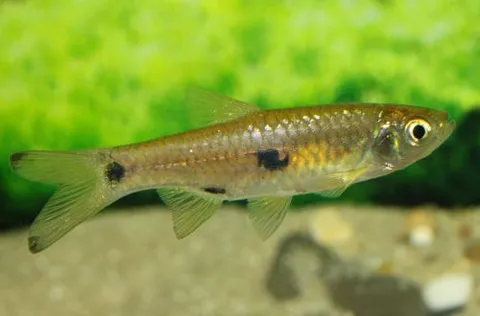
Rasbora elegans
Rasbora elegans, or the Elegant Rasbora, belongs to the family Cyprinidae. This fish is characterized by an active, peaceful disposition and good hardiness, successfully adapting to various conditions. Despite its…
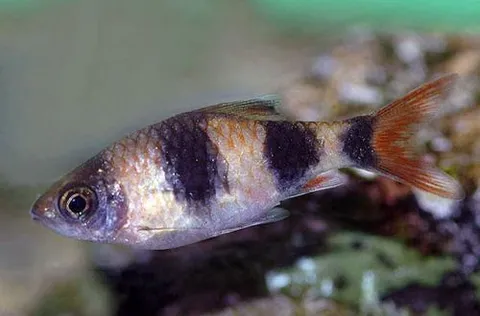
Dawkinsia arulius
The Arulius Barb, scientifically known as Dawkinsia arulius and belonging to the family Cyprinidae, does not impress with its bright coloration or unique body pattern. However, its lively activity and unpretentiousness…
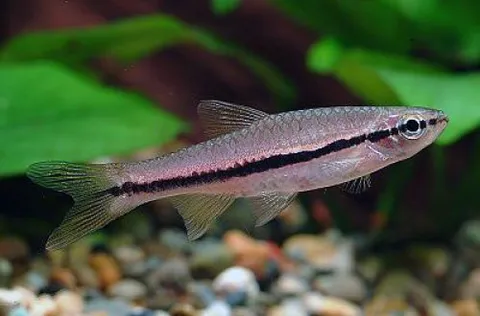
Rasbora einthovenii
Rasbora einthovenii, known as the Brilliant Rasbora, belongs to the family Cyprinidae. This active schooling fish can be successfully kept under specific conditions, but overall it is quite undemanding and easy to breed.
Rasbora borapetensis
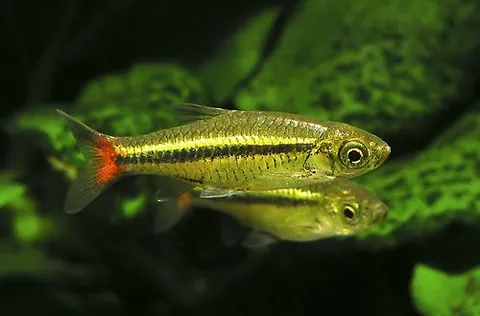
Rasbora borapetensis, also known as the Red-tailed or Black-striped Rasbora, belongs to the family Cyprinidae. This attractive aquarium fish is valued for its unpretentiousness in care, compatibility with many other…