Temperature21 – 26 °C
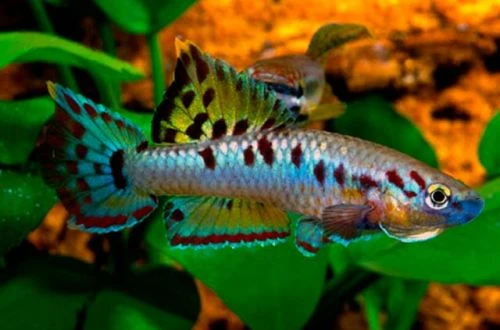
Aphyosemion bivittatum, known as the Two-striped Aphyosemion, belongs to the family Nothobranchiidae. Its natural habitat is in Africa, where the fish inhabits small river systems and streams. These bodies of water are typically located in dense equatorial forests in southeastern Nigeria and southwestern Cameroon.
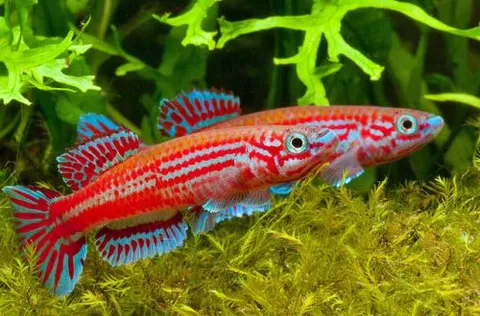
Adults of this fish reach a length of about 5 cm. A distinctive feature is their bright coloration. Notably, several natural color variations exist: predominantly turquoise, reddish, or yellow hues. Two dark stripes are often present on the body. Sometimes, instead of solid stripes, dotted lines consisting of small dark specks can be seen, or the lines may be absent altogether. Dark red spots are often chaotically distributed over the fish's body. In males, the fins and caudal fin are larger, pointed at the ends, and their coloration is more varied, forming patterns of lines and spots.
The Twostripe Lyretail inhabits small streams and swampy waters in the coastal rainforests of Togo, Benin and Nigeria as far east as the Cross River delta, plus some inland localities along the lower Niger. These fish prefer to stay in the bottom layers of the water or directly above the substrate. In their natural habitat, the water is typically soft, acidic, and high in humic substances.
These fish are distinguished by their peaceful and calm disposition. In small aquariums, it is recommended to keep them in pairs – one male and one female. If the aquarium is spacious enough, a group of individuals can be kept. In such a case, males will compete for the attention of females, but this occurs without pronounced aggression. Twostripe Lyretails coexist well with other species of comparable size, such as Nannostomus, Kuhli Loach, Corydoras catfish, Dwarf Gourami, as well as other inhabitants that prefer soft water.
For keeping a pair of fish and several compatible species, an aquarium of 40 liters or more is considered optimal. When decorating, it is recommended to create dense thickets of aquatic plants, including floating species, which will provide the necessary shading. Natural snags, bark, and tree leaves will also be beneficial. The substrate should preferably be soft, dark, and peat-based. The presence of natural wood elements contributes to the release of tannins – astringent substances that will give the water a characteristic tint, close to the conditions of the fish's natural habitat. According to aquarists' observations, brighter fish coloration is manifested in dark water with subdued lighting (due to dissolved tannins). Under high light levels, the fish's coloration, on the contrary, becomes pale. Important water parameters are low general hardness (GH) and acidic reaction (pH). A comfortable water temperature ranges from 22 to 24°C. The fish do not tolerate strong currents in the aquarium, which are often created by filters. Therefore, it is recommended to choose a filter model that will not cause excessive water movement. For example, a simple air-lift filter is well suited for small aquariums. The diet should preferably include protein-rich foods, such as dry or live bloodworms, daphnia, artemia, and similar products.
Their diet should be rich in protein, so foods such as dry or frozen bloodworms, daphnia, artemia, and other similar products are preferred.
Breeding is carried out in separate spawning tanks using a separator net, as adult fish tend to eat their eggs. Fine-leaved plants or synthetic fibers are used as a spawning substrate. Stimulation is provided by maintaining a water temperature of about 26°C with soft water parameters (GH up to 4, pH around 6.5). The incubation period for the eggs lasts 18–20 days. Infusoria, live dust, and artemia nauplii are used as initial food for the fry.
The species is sensitive to abrupt changes in water hydrochemical parameters and the accumulation of organic waste, which can provoke bacterial infections or fungal lesions of the fins. Prevention includes regular water changes, maintaining stable conditions, and using high-quality live food. If sanitary norms are not observed, the fish are susceptible to oodinium disease and other parasitic diseases characteristic of killifish.
When purchasing, choose active fish with clean, undamaged fins and no white film or spots on the body. It is important to ensure that the fish show interest in the offered food and do not appear emaciated. It is recommended to avoid individuals with sluggish behavior or clamped fins, as this may indicate stress or hidden diseases. It is advisable to purchase fish from reputable breeders to guarantee proper keeping conditions from an early age.
The essentials: size, tank volume, water parameters and care
An adult reaches 5 cm in length. Plan the tank around the maximum size: the fish quickly outgrows a cramped setup.
The recommended volume is 40 L. A smaller tank speeds up nitrate build-up and raises stress levels.
Temperature 21–26 °C, pH 5–6.5, hardness 5–7 dGH. Stability matters more than exact values: sudden swings are harder on the fish than a small deviation from the ideal.
Around 3 years when kept properly. Lifespan depends directly on tank volume, water quality and a varied diet.
Temperament: peaceful (regular). Keep this in mind when choosing tank mates.
Recommended setup: mixed (solitary / pair / group). Ignoring this is a common cause of stress and disease.
Diet type: high protein (predominantly meat). Feed small portions that are finished within a couple of minutes — overfeeding does more harm than underfeeding.
The scientific name of the species is Aphyosemion bivittatum, family Nothobranchiidae. It also appears in the literature as: Aphyosemion hollyi, Fundulopanchax bivittatus, Fundulus bivittatus.
The water suits 197 of 208 plants in the catalogue — the easiest ones are shown first.
Afzelius's AnubiasAnacharisAnubiasBrazilian PennywortDwarf CloverDwarf CloverDwarf HygrophilaDwarf SagittariaDwarf ValGuppy GrassHornwortJava FernJava MossMoneywortMud SwordNair's LagenandraNarrow Leaf AnacharisNarrow-leaf CloverStringy MossSüsswassertangTaiwan MossTape GrassTemple PlantUssuri Watermilfoil
Matched by family, categories and overlapping keeping conditions
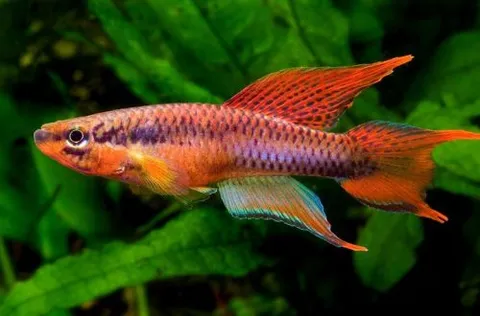
Aphyosemion bitaeniatum
The Two-striped Aphyosemion, scientifically known as Aphyosemion bitaeniatum, belongs to the family Nothobranchiidae, or nothobranchs. These vibrant fish are not particularly demanding to keep and adapt easily to…
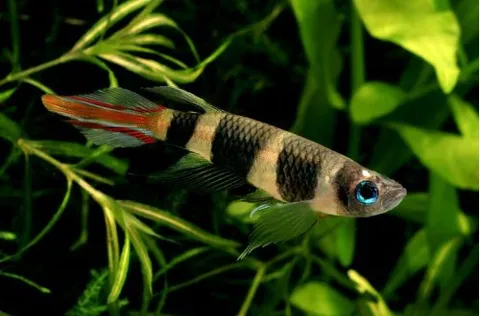
Epiplatys annulatus
The Torch Epiplatys, or Clown Killifish (scientific name Epiplatys annulatus), belongs to the family Nothobranchiidae. This fish attracts with its vibrant coloration, activity, and unique appearance. It is considered…
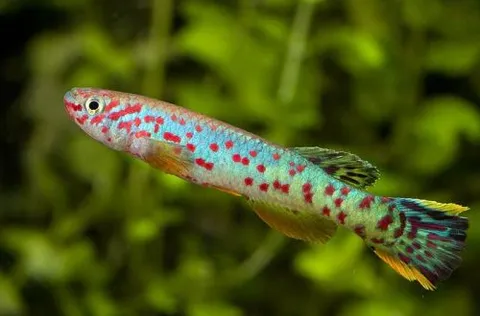
Fundulopanchax scheeli
Fundulopanchax scheeli, known as Aphyosemion scheeli, belongs to the family Nothobranchiidae. This fish was named in honor of the Danish ichthyologist Jorgen Jacob Scheel (1916–1989). Interestingly, until 2002, the…
Aphyosemion ogoense
Aphyosemion ogoense, also known by its scientific name Aphyosemion ogoense, belongs to the family Nothobranchiidae. A distinctive feature of this fish is its bright and original appearance. Despite its relative ease of…