Temperature21 – 25 °C
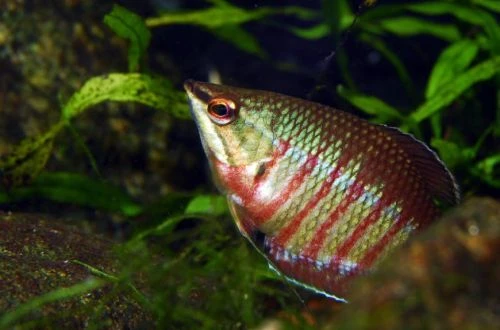
Sphaerichthys vaillanti, known as Vaillant's Gourami, belongs to the family Osphronemidae. This fish is relatively easy to keep and breed, and it coexists well with many other species. It is believed that the majority of this population today lives in aquariums rather than in the wild, where the species is endangered.
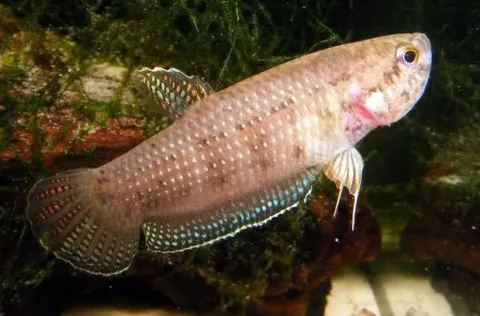
Adult Vaillant's Gourami reach a length of about 5 cm. A distinctive feature of these fish is their high, flattened body and pointed head shape. The dorsal and anal fins extend from the middle of the body to the caudal region. When kept in favorable conditions, sexual dimorphism is quite pronounced. Females have a straight head profile, and their coloration is a combination of green and red hues, which become more intense during spawning. Males, on the other hand, have a somewhat elongated lower jaw, forming a kind of pouch, and their bodies are colored in gray or brownish tones.
The natural habitat of this species is in Southeast Asia, on the Indonesian part of Borneo Island. It includes the upper Kapuas River basin, located in the West Kalimantan province. Common places where these fish are found are peat swamps, as well as the streams and small rivers flowing into and out of them, which run through dense tropical forests. The water in these swamps acquires a rich brown color due to the high concentration of dissolved tannins and humic acids, formed by the decomposition of plant organic matter. The bottom is usually covered with a thick layer of fallen leaves, branches, and various snags. Regarding aquatic vegetation, shade-tolerant plant species, numerous aquatic mosses, and ferns predominate here. Nowadays, the natural habitat of these fish has been severely affected by active human activity: pollution, illegal gold mining, deforestation, and large-scale capture of tropical fish for export. As a result, it is assumed that this species is practically no longer found in the wild.
This is a peaceful and calm fish. Although Vaillant's Gourami are not schooling species, they still prefer to be in the company of their own kind. It is recommended to acquire a group of at least 6 individuals. The choice of tank mates should be approached with caution. Overly active or large fish can easily intimidate the harmless Vaillant's Gourami and push them to the periphery of the aquarium.
For a small group of these fish, the optimal aquarium size starts from 60 liters. Vaillant's Gourami will create the most harmonious picture under moderate or diffused lighting, placed among driftwood and dense thickets of aquatic plants against a dark substrate. It is recommended to provide several shelters or include decorative elements that can be used as such. They will be very useful during the breeding period. If aesthetic design is not a priority, simple ceramic pots lying on their side or sections of hollow PVC pipes will also work. Adding dried leaves from certain trees will not only make the aquarium look more natural but also enrich the water with tannins, which will help recreate the hydrochemical composition of natural bodies of water. The successful keeping of these fish directly depends on the quality and hydrochemical composition of the water. Unlike their relatives from flowing waters, Vaillant's Gourami are less sensitive to water purity and can tolerate certain concentrations of organic waste. Of course, this is acceptable if such concentrations do not disrupt the normal course of the nitrogen cycle. As for pH and dGH values, they should correspond to the acidic and soft values characteristic of swamp water. The stability of the biological system is maintained by regular maintenance (regular partial water changes, waste removal) and uninterrupted operation of equipment. This primarily concerns the filtration system. In some cases, a simple air-driven sponge filter can be an excellent solution.
This species is carnivorous, and in natural conditions, its diet consists of small aquatic crustaceans, worms, insect larvae, and other zooplankton. However, fish adapted to aquarium conditions readily accept alternative foods. For example, daily feeding can well be composed of dry foods such as flakes and pellets, supplemented with live or frozen products: bloodworms, brine shrimp, mosquito larvae, Drosophila flies, daphnia, and the like.
The breeding process is quite simple. This species is known for mouthbrooding, with males taking on this role, which explains the presence of a pouch on their lower jaw. The female, or alpha female if the fish are kept in a group, often initiates courtship. Spawning lasts several hours and occurs near a shelter, inside which 10 to 40 eggs are laid. After fertilization, the male collects the eggs in his mouth and finds a quiet place to seclude himself away from other fish. The incubation period lasts from 7 to 20 days, after which fully formed fry emerge. At this point, the male's parental instincts weaken, but the fry can still remain near the parents without fear of being eaten. Nevertheless, such behavior should not be expected from other fish species, so to ensure the safety of the fry, it is better to keep them in a separate tank.
Most health problems in fish often arise from unsuitable keeping conditions. Maintaining a stable and comfortable habitat is a key factor for successful keeping. If symptoms of illness appear, the first step is to check the water quality. If deviations are found, it is important to take immediate measures to eliminate them. If the symptoms do not disappear or worsen, medicinal treatment may be required.
When selecting individuals, attention should be paid to their activity and scale condition. Healthy fish should show curiosity, have no visible injuries, ulcers, white film, or signs of emaciation. Since the species is sensitive to transport and adaptation conditions, it is recommended to purchase only fish that have already undergone a quarantine period in the store and are confidently accepting food. Avoid buying individuals that appear apathetic, stay at the water surface, or have clamped fins, as this may indicate hidden diseases or severe stress.
The essentials: size, tank volume, water parameters and care
An adult reaches 4–6 cm in length. Plan the tank around the maximum size: the fish quickly outgrows a cramped setup.
The recommended volume is 60 L. A smaller tank speeds up nitrate build-up and raises stress levels.
Temperature 21–25 °C, pH 3.5–6.5, hardness 1–3 dGH. Stability matters more than exact values: sudden swings are harder on the fish than a small deviation from the ideal.
Around 4 years when kept properly. Lifespan depends directly on tank volume, water quality and a varied diet.
Temperament: peaceful (regular). Keep this in mind when choosing tank mates.
Recommended setup: both solitary and in group (flexible). Ignoring this is a common cause of stress and disease.
Diet type: any (universal). Feed small portions that are finished within a couple of minutes — overfeeding does more harm than underfeeding.
The scientific name of the species is Sphaerichthys vaillanti, family Osphronemidae.
The water suits 195 of 208 plants in the catalogue — the easiest ones are shown first.
Afzelius's AnubiasAnacharisAnubiasBrazilian PennywortDwarf CloverDwarf CloverDwarf HygrophilaDwarf SagittariaDwarf ValGuppy GrassHornwortJava FernJava MossMoneywortMud SwordNarrow Leaf AnacharisNarrow-leaf CloverStringy MossSüsswassertangTaiwan MossTape GrassTemple PlantUssuri WatermilfoilWater Wisteria
Matched by family, categories and overlapping keeping conditions
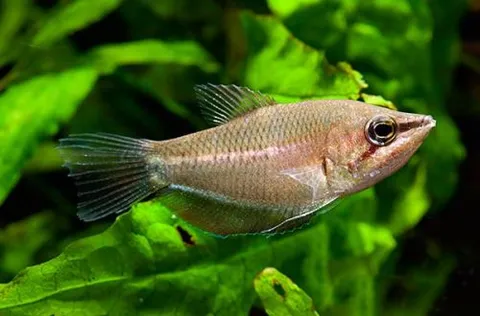
Sphaerichthys acrostoma
The scientific name Sphaerichthys acrostoma is assigned to the giant chocolate gourami, which belongs to the family Osphronemidae. The lack of bright colors in its coloration and the need to maintain extremely low pH…
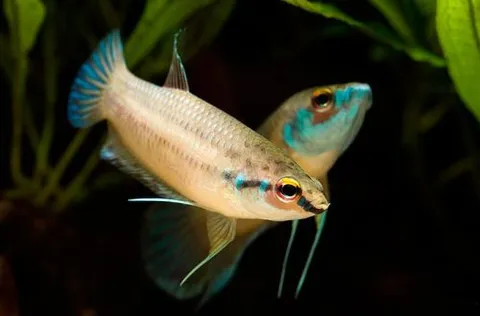
Betta kuehnei
The scientific name Betta kuehnei, or Kuehne's Betta, belongs to the family Osphronemidae. This fish was named in honor of collector Jens Kuehne, whose efforts brought it widespread recognition among aquarists. It is…
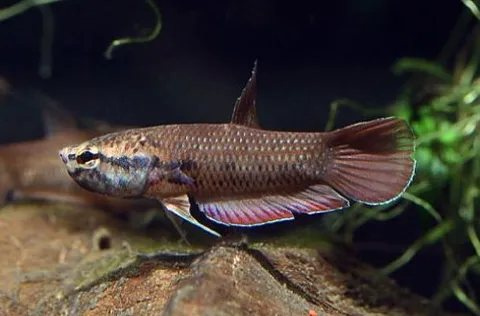
Betta falx
Betta falx, or Falx Betta, belongs to the family Osphronemidae. This fish, known by the scientific name Betta falx, is a representative of the fighting fish group, yet its calm disposition distinguishes it from its more…
Betta edithae
The scientific name Betta edithae, or Betta Edith, or Edith's Fighting Fish, indicates its belonging to the Osphronemidae family. This fish was named in honor of the researcher Edith Korthaus, a naturalist who…