Temperature22 – 30 °C
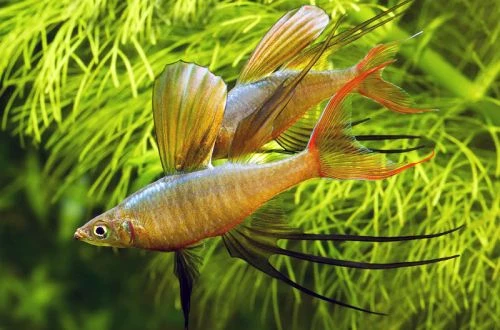
Iriatherina werneri, also known as Werner's Rainbowfish, belongs to the family Melanotaeniidae. This astonishingly beautiful fish has a unique appearance that makes it unmistakable. Its care and breeding are relatively simple, but it's important to remember that a species-specific aquarium is best for these fish. If a community tank is planned, tankmates should be chosen with particular care to ensure they do not pose a threat to the impressive fins of Iriatherina werneri.
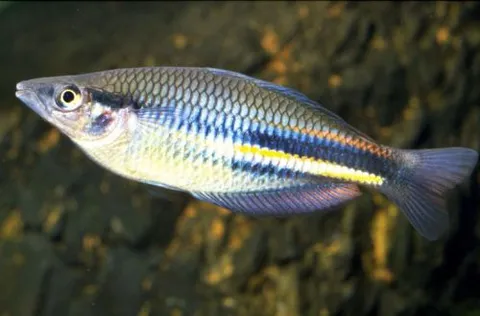
Adult Iriatherina werneri reach a length of about 3–4 cm. This species is easily recognizable due to the unique shape of its fins, especially pronounced in males, whose fins are significantly longer than those of females. The body coloration is yellow-green, and the lower part and caudal fin usually have a reddish tint.
The origins of this fish lie in the Indonesian islands, New Guinea, and the humid regions of Australia. Such a vast range, encompassing many separate islands, is explained by the fact that in the past New Guinea and Australia formed a single landmass. Geologically speaking, relatively recently, after the end of the last ice age, the low-lying land between them became submerged. Werner's Rainbowfish inhabits shallow, slow-flowing rivers, freshwater swamps, and lagoons, preferring areas with abundant aquatic vegetation. Currently, wild-caught specimens are minimal, and most of these fish are bred on commercial farms.
Iriatherina werneri is a peaceful and friendly species that coexists successfully with many fish of similar size and temperament. However, selecting tankmates requires attention: the elongated fins of males can become an object of interest for some species, such as barbs. Within their own species, the fish form a hierarchy, with one alpha male dominating a designated territory. If two or more males are kept together, they will compete for the attention of females, but this rarely leads to serious injuries. A recommended group size is at least 10 individuals, with a ratio of 1 male to every 3–4 females.
For a group of 8–10 of these fish, an aquarium of at least 100 liters will be needed. The setup should include dense thickets of rooted and floating plants, as well as several snags imitating tree branches and roots. It is important to consider that Werner's Rainbowfish tolerates strong water movement poorly. Therefore, equipment, especially filters, should be positioned to minimize internal current. Otherwise, the fish are quite undemanding and easily adapt to a wide range of temperatures and hydrochemical parameters like pH and dGH.
The diet of these fish should be balanced and include both animal and plant components. For example, live or frozen brine shrimp, daphnia, and spirulina flakes can be used. Alternatively, dry foods with a high protein content, offered by reputable manufacturers, are suitable.
Raising the water temperature to the upper permissible limit stimulates the onset of the breeding period. Spawning continues for several days, during which the female lays eggs in portions, and different males can fertilize them. The eggs are scattered among dense vegetation, which serves as their only protection. Parental instincts are absent in these fish, and adult individuals may readily feast on their own eggs and fry. To preserve offspring, eggs can be timely transferred to a separate tank with similar water conditions, equipped with a simple sponge filter. Such a tank should also feature fine-leaved plants, mosses, or their artificial counterparts. If conditions in the main aquarium are favorable, fry can grow to adulthood there, provided there is abundant floating vegetation where the offspring spend their early life stages near the surface.
Health problems usually arise only as a result of injuries or keeping in unsuitable conditions, which leads to a weakening of the immune system and, as a rule, provokes the development of various diseases. At the first signs of illness, the primary task is to check the water parameters for excesses or dangerous concentrations of toxic substances (nitrates, nitrites, ammonia, etc.). After bringing all indicators back to normal, treatment can begin.
When selecting individuals, attention should be paid to the integrity of the fins, which in healthy fish should be spread out and show no signs of damage or cloudiness. Avoid purchasing fish that exhibit signs of emaciation, sunken bellies, or apathetic behavior, as Iriatherina are sensitive to stress during transport and changes in living conditions. In the store, the fish should be actively schooling, have bright coloration, and clean skin without white spots or film. Given the delicate nature of the species, it is recommended to acquire individuals from the same batch to minimize the risk of introducing infections and facilitate adaptation to the new aquarium.
The essentials: size, tank volume, water parameters and care
An adult reaches 4 cm in length. Plan the tank around the maximum size: the fish quickly outgrows a cramped setup.
The recommended volume is 100 L. A smaller tank speeds up nitrate build-up and raises stress levels.
Temperature 22–30 °C, pH 5–8, hardness 1–12 dGH. Stability matters more than exact values: sudden swings are harder on the fish than a small deviation from the ideal.
Around 4 years when kept properly. Lifespan depends directly on tank volume, water quality and a varied diet.
Temperament: peaceful (regular). Keep this in mind when choosing tank mates.
Recommended setup: large group (10+ individuals). Ignoring this is a common cause of stress and disease.
Diet type: floating (protein). Feed small portions that are finished within a couple of minutes — overfeeding does more harm than underfeeding.
The scientific name of the species is Iriatherina werneri, family Rainbowfishes (Melanotaeniidae).
The water suits 198 of 208 plants in the catalogue — the easiest ones are shown first.
Afzelius's AnubiasAnacharisAnubiasBrazilian PennywortDwarf CloverDwarf CloverDwarf HygrophilaDwarf SagittariaDwarf ValGuppy GrassHornwortJava FernJava MossMoneywortMud SwordNair's LagenandraNarrow Leaf AnacharisNarrow-leaf CloverStringy MossSüsswassertangTaiwan MossTape GrassTemple PlantUssuri Watermilfoil
Matched by family, categories and overlapping keeping conditions
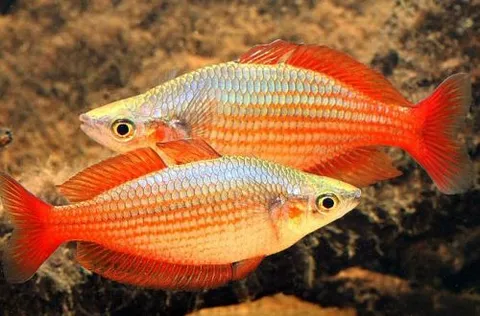
Melanotaenia splendida splendida
The Eastern Rainbowfish (scientific name – Melanotaenia splendida splendida) belongs to the family Melanotaeniidae. These fish are known for their beauty, peaceful nature, and hardiness. Thanks to their excellent…
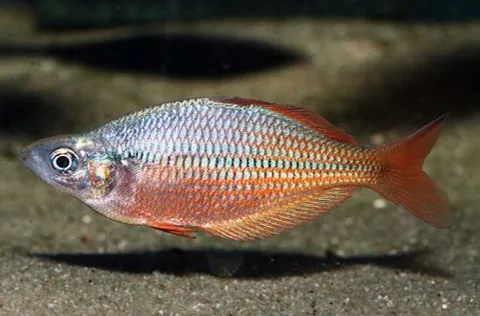
Melanotaenia splendida rubrostriata
The Red-striped Rainbowfish (scientific name Melanotaenia splendida rubrostriata), also known as the Red-banded Rainbowfish, belongs to the family Melanotaeniidae. This species can be an excellent choice even for…
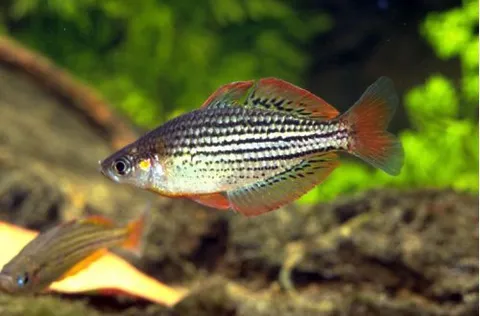
Melanotaenia maccullochi
McCulloch's Rainbowfish, or Dwarf Rainbowfish (scientific name Melanotaenia maccullochi), belongs to the family Melanotaeniidae. This Rainbowfish, characterized by its relatively small size among its relatives, is a…
Melanotaenia affinis
The Northern Melanotaenia, widely known as the New Guinea Rainbowfish, belongs to the family Melanotaeniidae and has the scientific name Melanotaenia affinis. These beautiful fish are peaceful and undemanding, allowing…