Temperature20 – 30 °C
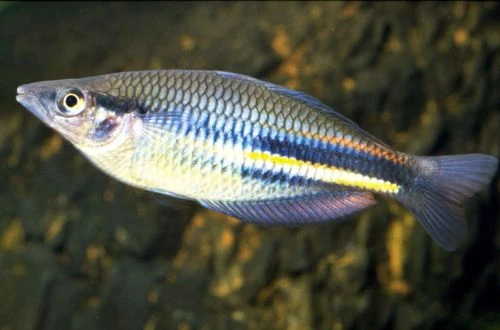
The Northern Melanotaenia, widely known as the New Guinea Rainbowfish, belongs to the family Melanotaeniidae and has the scientific name Melanotaenia affinis. These beautiful fish are peaceful and undemanding, allowing them to successfully adapt to various keeping conditions, making them an excellent choice for a home aquarium.
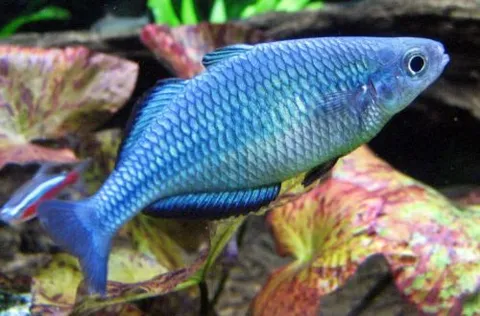
Under one commercial name, aquarists are usually offered three very similar varieties belonging to the same species. These fish grow up to 12 cm in length, reaching their adult size. Their coloration is a rainbow combination, predominantly yellow and bluish hues, with a green sheen whose variability depends on the specific region of origin. A horizontal stripe, consisting of dark, yellow, and orange sections, runs along the entire body. The coloration of the caudal fin and other fins is quite complex and includes almost the entire spectrum of rainbow colors. Differences between the sexes are not pronounced: males are only slightly larger and have more intense coloration compared to females, but in a large school, this difference is practically imperceptible.
Its origin is linked to the territory of Papua New Guinea, where it inhabits diverse biotopes, ranging from swampy tropical zones to coastal waters. This fish shows a preference for areas with dense aquatic vegetation, as well as places where submerged shrubs and fallen trees are found. It is important to note that the conditions of its natural habitat are subject to seasonal changes affecting water hydrochemistry and temperature indicators.
Rainbowfish are active, peaceful fish that get along well with other species of similar size and temperament. However, they can cause discomfort for slower aquarium inhabitants. They must be kept in a school, preferably at least 6–8 individuals of both sexes. Intraspecific conflicts do not occur among them.
For a school of 6–8 adult New Guinea Rainbowfish, the optimal aquarium volume starts from 110 liters. The aquascape should include many floating and rooted plants, placed in separate areas to leave enough open space for swimming. Other decorative elements are not as critically important and are chosen according to the aquarist's taste. It is extremely important to constantly maintain high water quality. Acceptable keeping conditions are possible due to a productive filtration system and regular partial water changes. It should be noted that this species does not tolerate strong currents well, and the filter is the main source of such movement in the aquarium. Therefore, the choice of filter model and its installation should be approached with particular care.
This species is not demanding regarding diet and nutrition. The fish readily accept most common foods, whether dry, frozen, or live. To maintain vibrant coloration, it is advisable to combine various products, for example, flakes and granules can be combined with bloodworms.
Rainbowfish can be successfully bred both in the main aquarium and in a specially prepared spawning tank. To stimulate the breeding period and initiate spawning, optimal water temperatures will be in the range of 24 to 26 °C, medium hardness, and pH values close to neutral. The interior of the spawning aquarium must include dense thickets of fine-leaved plants or their artificial counterparts; it is among these that the females will lay their eggs. Furthermore, as mentioned, internal current in the aquarium must be minimized. Spawning continues for about two weeks, during which the female lays several dozen eggs daily, and the male fertilizes them. Parental instincts are absent in these fish, so after spawning, they show no interest in their future offspring. If breeding was carried out in a community tank, it is advisable to transfer the eggs to a separate tank, ensuring identical conditions there, otherwise, there is a high risk of them being eaten by other inhabitants. The incubation period lasts approximately 7 to 12 days. In the first days of their lives, fry can only consume microscopic organisms, such as infusoria. Approximately a week later, Artemia nauplii or special powdered foods intended for juveniles can be introduced into their diet.
Health problems usually arise only as a result of injuries or keeping in unsuitable conditions, which leads to a weakening of the immune system and, as a rule, provokes the development of various diseases. At the first signs of illness, the primary task is to check the water parameters for excesses or dangerous concentrations of toxic substances (nitrates, nitrites, ammonia, etc.). After bringing all indicators back to normal, treatment can begin.
When choosing New Guinea Rainbowfish at a store, pay attention to the fish's activity and appearance. Healthy individuals should be active, curious, and stay together with the school, as this is a social species. Avoid buying fish with signs of emaciation, fin damage, whitish spots on scales, or an unnaturally bloated belly. In the display tank, the fish should look vibrant, and their coloration should match the species standards. Given the species' timidity, a brief freeze when a person approaches is acceptable, but constant apathy or attempts to hide in a corner may indicate stress or hidden diseases.
The essentials: size, tank volume, water parameters and care
An adult reaches 12 cm in length. Plan the tank around the maximum size: the fish quickly outgrows a cramped setup.
The recommended volume is 110 L. A smaller tank speeds up nitrate build-up and raises stress levels.
Temperature 20–30 °C, pH 6.5–8, hardness 10–20 dGH. Stability matters more than exact values: sudden swings are harder on the fish than a small deviation from the ideal.
Around 5 years when kept properly. Lifespan depends directly on tank volume, water quality and a varied diet.
Temperament: peaceful (regular). Keep this in mind when choosing tank mates.
Recommended setup: medium group (6–8 individuals). Ignoring this is a common cause of stress and disease.
Diet type: any (universal). Feed small portions that are finished within a couple of minutes — overfeeding does more harm than underfeeding.
The scientific name of the species is Melanotaenia affinis, family Rainbowfishes (Melanotaeniidae). It also appears in the literature as: Rhombatractus affinis.
The water suits 197 of 208 plants in the catalogue — the easiest ones are shown first.
Afzelius's AnubiasAnacharisAnubiasBrazilian PennywortDwarf CloverDwarf CloverDwarf HygrophilaDwarf SagittariaDwarf ValGuppy GrassHornwortJava FernJava MossMoneywortMud SwordNair's LagenandraNarrow Leaf AnacharisNarrow-leaf CloverStringy MossSüsswassertangTaiwan MossTape GrassTemple PlantUssuri Watermilfoil
Matched by family, categories and overlapping keeping conditions
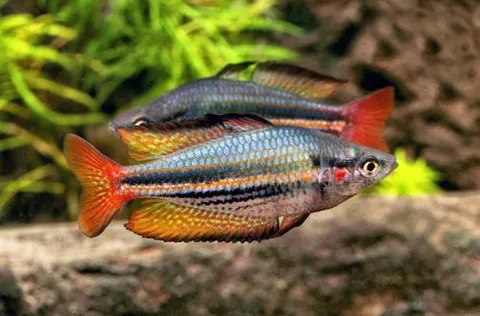
Melanotaenia australis
Melanotaenia australis, also known as the Western Rainbowfish, belongs to the family Melanotaeniidae. This fish is an excellent choice for beginner aquarists due to its unpretentiousness, ease of care and breeding, and…
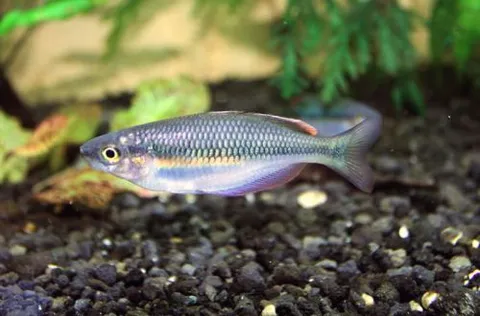
Melanotaenia irianjaya
Melanotaenia irianjaya, also known as the Irian Jaya Rainbowfish, belongs to the family Melanotaeniidae. This fish is an excellent choice for beginner aquarists due to its unpretentiousness, ease of breeding and…
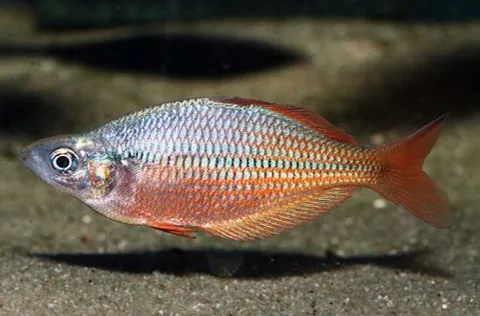
Melanotaenia splendida rubrostriata
The Red-striped Rainbowfish (scientific name Melanotaenia splendida rubrostriata), also known as the Red-banded Rainbowfish, belongs to the family Melanotaeniidae. This species can be an excellent choice even for…
Melanotaenia lacustris
The Lake Melanotaenia, also known as the Blue Melanotaenia or Turquoise Rainbowfish, bears the scientific name Melanotaenia lacustris and belongs to the family Melanotaeniidae. It is a peaceful and active fish that is…