Temperature22 – 27 °C
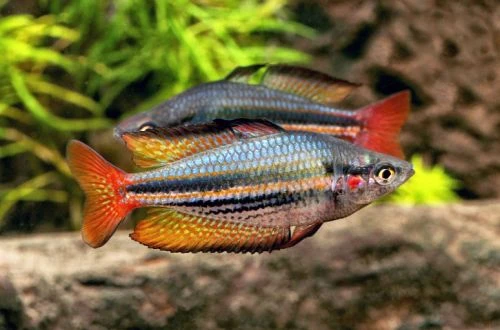
Melanotaenia australis, also known as the Western Rainbowfish, belongs to the family Melanotaeniidae. This fish is an excellent choice for beginner aquarists due to its unpretentiousness, ease of care and breeding, and beautiful body coloration, which makes it compatible with many other species.
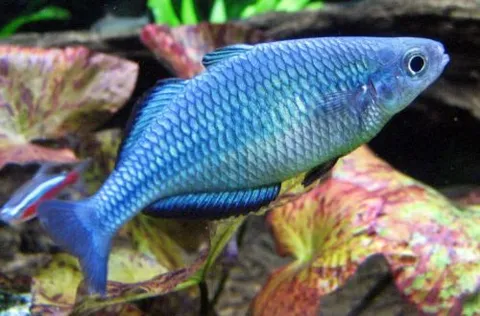
Adults of this fish can reach a length of about 12 cm. Their coloration is quite varied: the body is adorned with several horizontal stripes of various colors, such as black, blue, and orange, while the back often has a bluish tint. The fins and tail are usually redder. It is worth noting that the coloration can vary depending on the region of origin. Sexual dimorphism is weakly expressed: males are generally slightly larger and brighter than females.
The native range of this species is north-western Australia: the Pilbara and Kimberley regions of Western Australia, extending eastwards into the Northern Territory. Melanotaenia australis inhabits diverse biotopes, including swamps, lagoons, lakes, and rivers. It prefers slow currents and areas with abundant aquatic vegetation, often staying near the shore among submerged snags.
This active and peaceful fish coexists well with other non-aggressive species of similar size. However, the excessive activity of the Southern Rainbowfish may be undesirable for slower tank mates, so it's best to exclude them from a community tank. It is recommended to keep them in a school consisting of at least 6–8 individuals of both sexes.
For a small group of these fish, an aquarium of at least 110 liters will be required. When setting up the tank, provide areas with dense vegetation, both rooted and floating, and also leave enough open space for their swimming. The presence of shelters, for example, in the form of driftwood, will be a definite plus. Any substrate can be chosen; its selection depends on the needs of the plants and the aquarist's personal preferences. The Southern Rainbowfish feels best in subdued lighting and weak or moderate water movement. The selection and installation of equipment should correspond to these conditions. Water quality plays a key role; therefore, installing an efficient filtration system and weekly water changes of 15–20% of the tank volume with fresh water will help maintain an acceptable environment and minimize the accumulation of organic waste for these tropical fish.
These fish are undemanding when it comes to feeding. They readily accept most common types of food, whether dry, live, or frozen. To ensure the best color display, it is desirable to combine different products. For example, flakes and granules can be alternated with bloodworms or Artemia.
Both community tanks and special breeding tanks are suitable for breeding rainbowfish. Optimal parameters for stimulating the breeding period include a temperature range of 24–27°C, slightly alkaline water (up to pH 7.0), and medium hardness. The aquarium interior should be supplemented with dense thickets of fine-leaved plants or their artificial counterparts, which serve as a spawning substrate. It is among these that the females will lay their eggs. Spawning continues for approximately 2 weeks, during which the female lays several dozen eggs daily, and the male fertilizes them. These fish lack parental instincts, so upon completion of spawning, the adults show no interest in their future offspring. If breeding occurred in a community tank, it is recommended to carefully transfer the eggs to a separate tank with similar water conditions to avoid the risk of them being eaten by other fish. If a separate breeding tank is unavailable, dense clusters of floating plants can be used, which will provide a reliable refuge for the fry, who initially stay near the water surface. The incubation period for the eggs lasts from 7 to 12 days. In the first days of life, the fry feed only on microscopic food, such as infusoria. After a week, Artemia nauplii or specialized powdered foods designed for juvenile aquarium fish can be introduced into their diet. It is important to note that feeding rainbowfish fry in a community tank presents certain difficulties, unlike targeted feeding in a breeding tank.
Health problems usually arise only as a result of injuries or keeping in unsuitable conditions, which leads to a weakening of the immune system and, as a rule, provokes the development of various diseases. At the first signs of illness, the primary task is to check the water parameters for excesses or dangerous concentrations of toxic substances (nitrates, nitrites, ammonia, etc.). After bringing all indicators back to normal, treatment can begin.
When choosing Southern Rainbowfish, pay attention to the overall activity of the fish in the aquarium: healthy individuals should be active and show interest in their surroundings. Avoid specimens with signs of emaciation, sunken bellies, damaged fins, or the presence of white film on the body, which may indicate bacterial infections. It is recommended to choose fish from the same group, as they are schooling fish and adapt better when moved together. Clarify the keeping conditions with the seller, as prolonged exposure to unsuitable water parameters can lead to irreversible health consequences for the fish.
The essentials: size, tank volume, water parameters and care
An adult reaches 12 cm in length. Plan the tank around the maximum size: the fish quickly outgrows a cramped setup.
The recommended volume is 100 L. A smaller tank speeds up nitrate build-up and raises stress levels.
Temperature 22–27 °C, pH 6.5–8, hardness 5–20 dGH. Stability matters more than exact values: sudden swings are harder on the fish than a small deviation from the ideal.
Around 6 years when kept properly. Lifespan depends directly on tank volume, water quality and a varied diet.
Temperament: peaceful (regular). Keep this in mind when choosing tank mates.
Recommended setup: medium group (6–8 individuals). Ignoring this is a common cause of stress and disease.
Diet type: any (universal). Feed small portions that are finished within a couple of minutes — overfeeding does more harm than underfeeding.
The scientific name of the species is Melanotaenia australis, family Rainbowfishes (Melanotaeniidae). It also appears in the literature as: Melanotaenia splendida, Neoatherina australis.
The water suits 197 of 208 plants in the catalogue — the easiest ones are shown first.
Afzelius's AnubiasAnacharisAnubiasBrazilian PennywortDwarf CloverDwarf CloverDwarf HygrophilaDwarf SagittariaDwarf ValGuppy GrassHornwortJava FernJava MossMoneywortMud SwordNair's LagenandraNarrow Leaf AnacharisNarrow-leaf CloverStringy MossSüsswassertangTaiwan MossTape GrassTemple PlantUssuri Watermilfoil
Matched by family, categories and overlapping keeping conditions
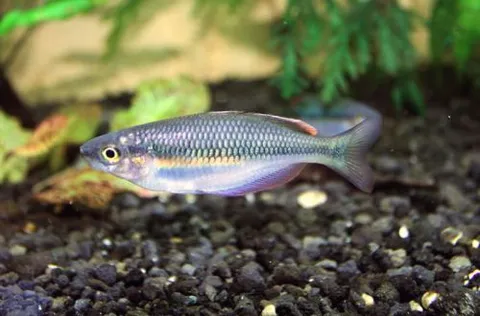
Melanotaenia irianjaya
Melanotaenia irianjaya, also known as the Irian Jaya Rainbowfish, belongs to the family Melanotaeniidae. This fish is an excellent choice for beginner aquarists due to its unpretentiousness, ease of breeding and…
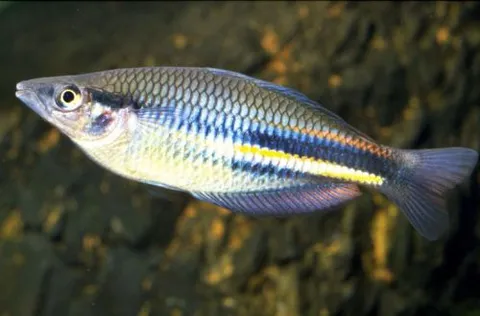
Melanotaenia affinis
The Northern Melanotaenia, widely known as the New Guinea Rainbowfish, belongs to the family Melanotaeniidae and has the scientific name Melanotaenia affinis. These beautiful fish are peaceful and undemanding, allowing…
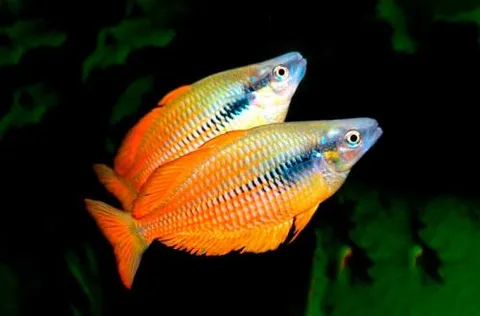
Melanotaenia angfa
Melanotaenia angfa, or Angfa Rainbowfish, is a member of the family Melanotaeniidae. The natural habitat of this species is limited to two tributaries of the Yakati River, located on the isthmus of the Cenderawasih…
Melanotaenia lacustris
The Lake Melanotaenia, also known as the Blue Melanotaenia or Turquoise Rainbowfish, bears the scientific name Melanotaenia lacustris and belongs to the family Melanotaeniidae. It is a peaceful and active fish that is…