Temperature20 – 25 °C
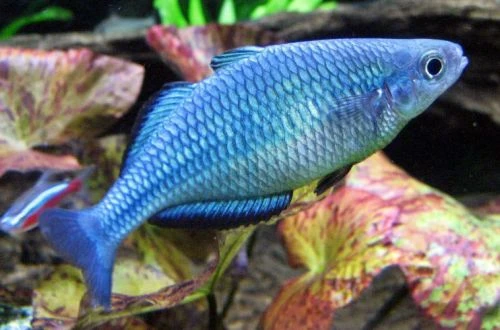
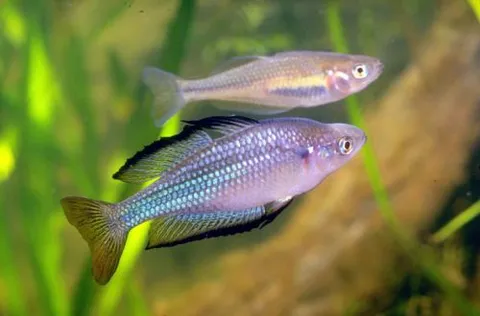
The Lake Melanotaenia, also known as the Blue Melanotaenia or Turquoise Rainbowfish, bears the scientific name Melanotaenia lacustris and belongs to the family Melanotaeniidae. It is a peaceful and active fish that is relatively easy to keep and breed successfully. However, the specific water conditions it requires place restrictions on the choice of tank mates. The quality of food significantly influences the intensity of its coloration, so the appearance of adult specimens can vary noticeably depending on the supplier. Nevertheless, if provided with a balanced diet after purchase, they will undoubtedly delight you with rich and vibrant colors.
Adult specimens of this fish reach a length of about 12 cm. Their coloration consists of bluish tones with a yellowish iridescence on their scales. The intensity of the blue color depends on factors such as keeping conditions and diet. During the breeding season, the upper part of the fish's body acquires orange hues. Males are usually somewhat larger than females and have more saturated coloration.
This species originates from Papua New Guinea, specifically from the southern Highlands province. It is endemic to the small mountain Lake Kutubu, as well as the Soro River, which flows into this lake. In their natural habitat, the fish prefer to stay near aquatic vegetation, as well as snags and submerged trees. In the wild, this species is endangered due to water pollution from active industrial development.
The Turquoise Rainbowfish is a peaceful and active fish that coexists well with other species of similar size and temperament. However, it can cause discomfort to excessively slow-moving species. Due to specific requirements for keeping conditions, such as the need for hard, alkaline water, the choice of potential tank mates will be limited. It is not recommended to keep it with other Rainbowfish species to avoid hybrid offspring. Keeping them in a group of at least 6–8 individuals of both sexes is optimal. It has been observed that in the presence of competitors, males tend to display brighter coloration, which is one way to attract females.
For a group of 6–8 fish, an aquarium of at least 110 liters will be required. The decor can be creative, but it is important to provide both areas with dense vegetation and open swimming zones. Other decorative elements are chosen at the discretion of the aquarist. Maintaining stable water conditions, characterized by high pH and dGH values, as well as a narrow range of acceptable temperatures, is crucial. Water movement in the aquarium should be minimal, so when choosing a filtration system, attention should be paid to models that do not create a strong internal current.
Like many other members of the family, the Lake Melanotaenia does not have special food requirements. It readily accepts all common types of food, including dry, frozen, and live. Nevertheless, when choosing food, it is recommended to give preference to products from proven and well-known manufacturers, as a varied and high-quality diet directly influences the brightness and saturation of the fish's coloration.
While keeping these fish in a home aquarium will not cause much trouble, the task of raising their offspring will require attention. For a successful start to the breeding period, specific conditions are necessary: the water should be alkaline (pH 8.0) and of medium hardness, the temperature should be maintained in the range of 22 to 24°C, and feeding should be regular and high-quality. The spawning tank setup involves dense thickets of low-growing, fine-leaved plants or moss clusters where the female can lay her eggs. The spawning process takes approximately two weeks; during this time, the male is capable of fertilizing clutches from several females. Adult fish generally do not exhibit parental instincts, but they usually do not threaten either the eggs or the fry, unlike potential tank mates. To protect the future offspring, it is recommended to move them to a separate tank. This tank should be equipped with an air-lift filter with a sponge, a light, and a heater, and the water parameters in it should be identical to the conditions of the main aquarium. The presence of both live and artificial plants is welcome, while a substrate is not mandatory. The incubation period for the eggs lasts from seven to twelve days. In the first days of their lives, the fry will feed on their yolk sac, but later they will require micro-food, such as infusoria. As the young fish grow, their diet can be expanded to include Artemia nauplii and other appropriately sized foods. It is important to note that these fish spend most of their time near the water surface, so sinking foods are undesirable. Such foods will not be eaten and will only cause contamination of the aquarium water.
Health problems usually arise only as a result of injuries or keeping in unsuitable conditions, which leads to a weakening of the immune system and, as a rule, provokes the development of various diseases. At the first signs of illness, the primary task is to check the water parameters for excesses or dangerous concentrations of toxic substances (nitrates, nitrites, ammonia, etc.). After bringing all indicators back to normal, treatment can begin.
When purchasing, it is important to consider that stores most often sell young specimens that have an inconspicuous gray or pale turquoise coloration. Bright colors appear in fish only upon reaching sexual maturity, which can take up to 12 months. Do not look for adult brightly colored fish for sale, as they are rare and significantly more expensive. When selecting specimens, pay attention to their behavior and health. Healthy fish should be active, show interest in their surroundings, and have no visible damage, sores, or signs of emaciation. Avoid buying fish with sluggish behavior, clamped fins, or an unnaturally bloated abdomen, as this may indicate the presence of diseases or stress from improper keeping conditions in the store.
The essentials: size, tank volume, water parameters and care
An adult reaches 12 cm in length. Plan the tank around the maximum size: the fish quickly outgrows a cramped setup.
The recommended volume is 110 L. A smaller tank speeds up nitrate build-up and raises stress levels.
Temperature 20–25 °C, pH 7–9, hardness 10–20 dGH. Stability matters more than exact values: sudden swings are harder on the fish than a small deviation from the ideal.
Around 8 years when kept properly. Lifespan depends directly on tank volume, water quality and a varied diet.
Temperament: peaceful (regular). Keep this in mind when choosing tank mates.
Recommended setup: medium group (6–8 individuals). Ignoring this is a common cause of stress and disease.
Diet type: any (universal). Feed small portions that are finished within a couple of minutes — overfeeding does more harm than underfeeding.
The scientific name of the species is Melanotaenia lacustris, family Rainbowfishes (Melanotaeniidae).
The water suits 113 of 208 plants in the catalogue — the easiest ones are shown first.
African Onion PlantAfzelius's AnubiasAmazon FrogbitAmazon SwordAnacharisAnubiasArrowhead CryptAsian WatermossDwarf CloverDwarf CloverDwarf HygrophilaDwarf SagittariaDwarf ValGuppy GrassHornwortJava MossMoneywortMud SwordNarrow Leaf AnacharisNarrow-leaf CloverStringy MossTaiwan MossTape GrassUssuri Watermilfoil
Matched by family, categories and overlapping keeping conditions
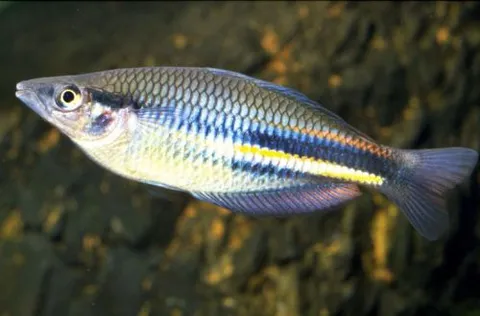
Melanotaenia affinis
The Northern Melanotaenia, widely known as the New Guinea Rainbowfish, belongs to the family Melanotaeniidae and has the scientific name Melanotaenia affinis. These beautiful fish are peaceful and undemanding, allowing…
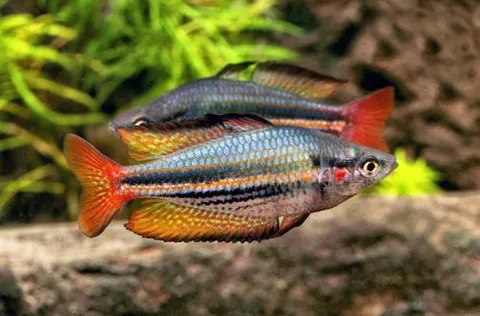
Melanotaenia australis
Melanotaenia australis, also known as the Western Rainbowfish, belongs to the family Melanotaeniidae. This fish is an excellent choice for beginner aquarists due to its unpretentiousness, ease of care and breeding, and…
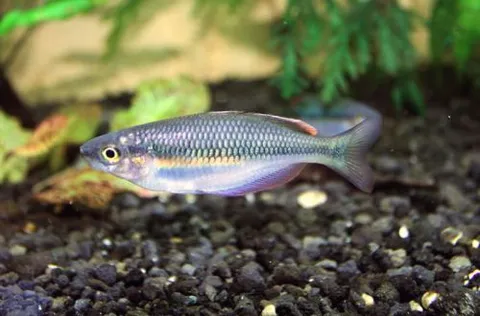
Melanotaenia irianjaya
Melanotaenia irianjaya, also known as the Irian Jaya Rainbowfish, belongs to the family Melanotaeniidae. This fish is an excellent choice for beginner aquarists due to its unpretentiousness, ease of breeding and…
Melanotaenia fluviatilis
The Murray River Rainbowfish, also known as the River Rainbowfish, bears the scientific name Melanotaenia fluviatilis and belongs to the family Melanotaeniidae. This fish is characterized by its unpretentiousness, ease…