Rainbowfishes (Melanotaeniidae)

Irian Jaya Rainbowfish

Melanotaenia irianjaya

Melanotaenia irianjaya, also known as the Irian Jaya Rainbowfish, belongs to the family Melanotaeniidae. This fish is an excellent choice for beginner aquarists due to its unpretentiousness, ease of breeding and keeping, compatibility with many other species, and attractive body coloration.

Tank
from 85 L (22 gal), 100 L (26 gal) recommended
Temperature
23 – 26 °C (73 – 79 °F)
Size in aquarium
12 cm (4.7 in)
Acidity
pH 6.5–8
Natural rangeRange on the map
  • Western New Guinea area
  • Irian Jaya area
  • Indonesia

Tank conditions

Plan the tank stocking
Temperature
23 – 26 °C (73 – 79 °F)
Water pH
Neutral (6.5) – Slightly alkaline (8)
Water dH
Medium hardness (10) – Hard (15)
Water salinity
no salt (freshwater)
Size in aquarium
12 cm (4.7 in)
Lifespan
7 years
Temperament
Peaceful (regular)
Toward small fish
not a predator
Required aquarium volume
from 85 L (22 gal), 100 L (26 gal) recommended
Lighting
dimmed
Substrate
any (no restrictions)
Water flow
weak or moderate
Feeding
Any (universal)
Keeping
Medium group 6–8 individuals
  • Lifespan. A lifespan to expect under good care, not a measured value: it depends heavily on tank volume, water quality and diet — and for selectively bred forms, on their origin as well.
  • Toward small fish. Based on the Predators category in the catalog or the temperament in the species parameters. “A risk to small fish” means the species is not a predator by habit, yet will swallow any fish that fits in its mouth.
  • Required aquarium volume. This is a husbandry recommendation, not a measured value: the volume depends on the keeping mode (medium group (6–8 individuals)), footprint, decor and tank mates.

Care and keeping

Description

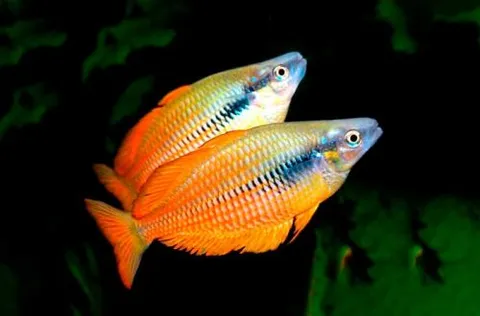
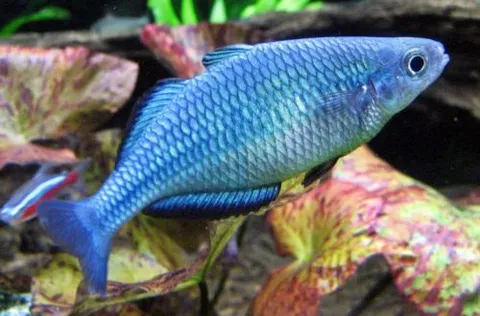
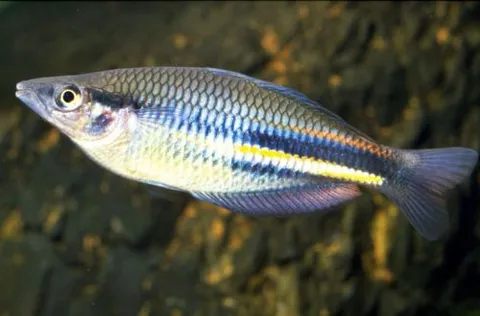
Adults of this fish reach a length of about 12 cm. Their coloration consists of bluish-gray tones with a white belly, complemented by a yellow horizontal stripe. The fins are edged in red. Sexual dimorphism is weakly expressed: males are slightly brighter in color and somewhat larger than females.

Habitat

Its origin is linked to the island of New Guinea, where it is endemic to a small western region historically called Irian Jaya or West Irian. These fish inhabit river systems that flow into the Seram Sea. They prefer to live in regions with moderate or slow currents, staying in shallow waters near the banks, among submerged trees and various snags.

Behavior and Compatibility

This active and peaceful fish coexists well with other non-aggressive species of similar size. However, the excessive activity of the Southern Rainbowfish may be undesirable for slower tank mates, so it's best to exclude them from a community tank. It is recommended to keep them in a school consisting of at least 6–8 individuals of both sexes.

Care and Maintenance

For keeping a small group of these fish, a tank volume of at least 100 liters will be optimal. The aquarium's decor is not critically important. The Irian Jaya Rainbowfish will feel comfortable both in an almost empty aquarium with a sandy substrate and a few snags, and among dense thickets of aquatic vegetation. Although in nature the fish inhabits regions with moderate currents, recreating such conditions in the aquarium is not necessary. The main condition for successful keeping is maintaining high water quality. Acquiring an effective filtration system and regular weekly water changes of 15–20% of the volume will minimize the accumulation of organic waste and ensure acceptable conditions for these tropical fish.

Diet

These fish are undemanding when it comes to feeding. They readily accept most common types of food, whether dry, live, or frozen. To ensure the best color display, it is desirable to combine different products. For example, flakes and granules can be alternated with bloodworms or Artemia.

Breeding and Reproduction

Rainbowfish can be bred both in a community tank and in a specially equipped breeding tank. To stimulate courtship and spawning, an optimal temperature would be 26 to 28°C, as well as slightly alkaline water of medium hardness, where the pH level does not exceed 7.5. An important element of the decor is thickets of fine-leaved plants or their imitation, which will serve as an ideal spawning substrate for females to lay their eggs. The spawning process lasts about two weeks, during which the female lays several dozen eggs daily, which are then fertilized by the male. Rainbowfish lack parental instincts, so after spawning, the fish show no interest in their offspring. If breeding in a community tank, it is recommended to transfer the eggs to a separate tank with similar water parameters to prevent them from being eaten by other inhabitants. If there is no specialized breeding tank, dense floating plants can be used. They will provide reliable cover for the fry, which prefer to stay near the surface in the initial stages of life. The incubation period is approximately 7 to 12 days. In the first days after hatching, the fry need microscopic food, such as infusoria. After a week, Artemia nauplii or special powdered foods for young aquarium fish can be included in their diet. It is important to note that the process of feeding Rainbowfish fry in a community tank can cause significant difficulties, unlike keeping them in a separate tank specifically designed for spawning.
Diseases

Health problems usually arise only as a result of injuries or keeping in unsuitable conditions, which leads to a weakening of the immune system and, as a rule, provokes the development of various diseases. At the first signs of illness, the primary task is to check the water parameters for excesses or dangerous concentrations of toxic substances (nitrates, nitrites, ammonia, etc.). After bringing all indicators back to normal, treatment can begin.

How to choose

When selecting individuals, preference should be given to active fish with clean fins and no visible damage or ulcers on the body. Avoid purchasing fish that appear emaciated, have sunken bellies, or show signs of apathy, hiding in the corners of the aquarium. Healthy rainbowfish should display vibrant coloration and show interest in their surroundings. Since the species is timid, fish in the store may appear pale due to stress, but their coloration should recover in calm conditions. It is recommended to purchase a group of 6–8 individuals, as keeping them in a school reduces stress levels and promotes better well-being for the fish.

Compatibility

There are no pair reviews for this species yet — check tankmates in the matcher.

All tankmates

Plants and this fish

Matching water does not mean the plant will stay intact.

Frequently asked questions

The essentials: size, tank volume, water parameters and care

How big does Irian Jaya Rainbowfish get?

An adult reaches 12 cm in length. Plan the tank around the maximum size: the fish quickly outgrows a cramped setup.

What size aquarium does Irian Jaya Rainbowfish need?

The recommended volume is 100 L. A smaller tank speeds up nitrate build-up and raises stress levels.

What water parameters does Irian Jaya Rainbowfish need?

Temperature 23–26 °C, pH 6.5–8, hardness 10–15 dGH. Stability matters more than exact values: sudden swings are harder on the fish than a small deviation from the ideal.

How long does Irian Jaya Rainbowfish live?

Around 7 years when kept properly. Lifespan depends directly on tank volume, water quality and a varied diet.

Is Irian Jaya Rainbowfish aggressive?

Temperament: peaceful (regular). Keep this in mind when choosing tank mates.

How many Irian Jaya Rainbowfish should be kept together?

Recommended setup: medium group (6–8 individuals). Ignoring this is a common cause of stress and disease.

What does Irian Jaya Rainbowfish eat?

Diet type: any (universal). Feed small portions that are finished within a couple of minutes — overfeeding does more harm than underfeeding.

What is the scientific name of Irian Jaya Rainbowfish?

The scientific name of the species is Melanotaenia irianjaya, family Rainbowfishes (Melanotaeniidae).

Similar fishes

Matched by family, categories and overlapping keeping conditions

Melanotaenia australis

Melanotaenia australis

Melanotaenia australis

Rainbowfishes (Melanotaeniidae)

Melanotaenia australis, also known as the Western Rainbowfish, belongs to the family Melanotaeniidae. This fish is an excellent choice for beginner aquarists due to its unpretentiousness, ease of care and breeding, and…

New Guinea Rainbowfish

New Guinea Rainbowfish

Melanotaenia affinis

Rainbowfishes (Melanotaeniidae)

The Northern Melanotaenia, widely known as the New Guinea Rainbowfish, belongs to the family Melanotaeniidae and has the scientific name Melanotaenia affinis. These beautiful fish are peaceful and undemanding, allowing…

Angfa Rainbowfish

Angfa Rainbowfish

Melanotaenia angfa

Rainbowfishes (Melanotaeniidae)

Melanotaenia angfa, or Angfa Rainbowfish, is a member of the family Melanotaeniidae. The natural habitat of this species is limited to two tributaries of the Yakati River, located on the isthmus of the Cenderawasih…

Turquoise Rainbowfish

Turquoise Rainbowfish

Melanotaenia lacustris

Rainbowfishes (Melanotaeniidae)

The Lake Melanotaenia, also known as the Blue Melanotaenia or Turquoise Rainbowfish, bears the scientific name Melanotaenia lacustris and belongs to the family Melanotaeniidae. It is a peaceful and active fish that is…

Other scientific names and conservation status

Categories
Rainbowfish
Conservation status
VulnerableVU