Temperature23 – 27 °C
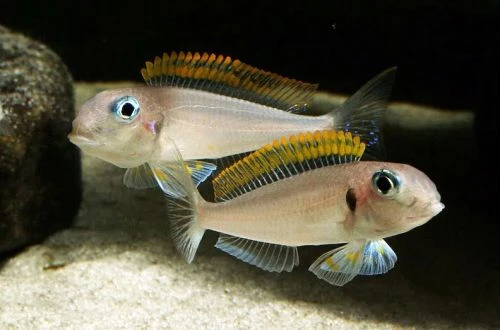
Xenotilapia flavipinnis, also known as the "Yellow Sand" cichlid, belongs to the family Cichlidae. This small fish is endemic to Lake Tanganyika in East Africa, where it inhabits areas with sandy bottoms. It exhibits a peaceful and calm disposition, which makes it easy to keep, provided a suitable environment is created; furthermore, the breeding behavior of these fish is of particular interest.
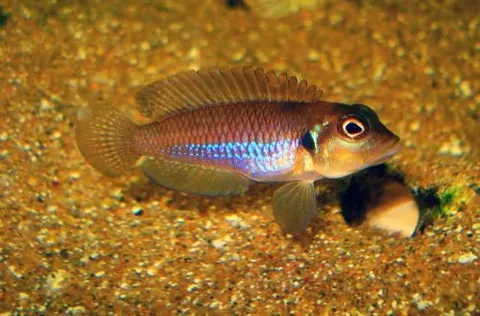
Adults reach approximately 9 cm in length. Their body is elongated, tapering towards the tail, with a rather large head and big eyes. The coloration is usually light gray or silvery. A characteristic feature of the species is the ribbed dorsal fin of bright yellow color. Sexual dimorphism is weakly expressed, making sex determination difficult.
The species is endemic to Lake Tanganyika in East Africa. The fish inhabit coastal areas with sandy bottoms and transitional zones between sandy shallows and rocky areas. In nature, they prefer shallow waters, where they constantly stay near the substrate, sifting sand in search of small invertebrates and plankton.
These fish behave calmly and peacefully if kept in a group of 6–10 individuals. With fewer numbers, intraspecific conflicts are possible. During the spawning period, a pair may show some aggression, which is explained by the instinctive desire to protect their territory and future clutch. They get along well with other non-aggressive species that require similar living conditions.
For keeping a small school of these fish, an aquarium of at least 100 L is required. The aquascape can be quite simple and typically includes two main elements: a sandy substrate and rocks or rock formations that create caves and grottoes. Alternatively, decorative shelters or ordinary ceramic pots placed on their side can be used. Important attention should be paid to the quality and chemical composition of the water; it should be very clean, with high pH and dGH values. In addition to weekly water changes of 15–20% of the volume, a mandatory condition is the presence of a high-performance filtration system, preferably using filter media that help maintain the necessary hydrochemical balance.
In its natural habitat, this fish sifts sand with its mouth at the bottom of the reservoir, searching for small invertebrates. In a home aquarium, it is recommended to offer live or frozen meaty foods, such as bloodworms. However, the best solution will be specially formulated foods from recognized manufacturers.
When the breeding period begins, a male/female pair separates from the group. They choose a small area of the aquarium bottom, about 30 cm in diameter, which they then actively guard from other inhabitants. The female lays several eggs on the substrate, and after fertilization, she takes them into her mouth. This process can be repeated several times. The female incubates the eggs in her mouth for approximately 9–12 days, while the male guards the territory. Then the roles change: the male takes the eggs, and the female swims away to provide protection from a distance. After about ten days, the hatched fry begin to swim freely. Nevertheless, for the first few weeks, they continue to stay near their parents and, if danger arises, hide in the mouth of the female or male.
The main cause of most diseases in Lake Tanganyika cichlids is unsuitable keeping conditions and poor-quality food, which often leads, for example, to African Bloat. At the first symptoms, it is necessary first to check the water parameters and ensure there are no high concentrations of dangerous substances such as ammonia, nitrites, and nitrates. If the readings deviate from the norm, they should be brought into order, and only then should treatment begin.
When selecting individuals, attention should be paid to the activity of the fish and the cleanliness of their skin. Healthy fish should show interest in food and have no fin damage or signs of emaciation. Since the species is extremely sensitive to transport conditions and sudden changes in water parameters, it is recommended to purchase fish from trusted suppliers and prepare an aquarium with an established biological balance in advance. Avoid buying individuals that appear lethargic or show signs of damage incurred during capture or keeping in overcrowded store tanks.
The essentials: size, tank volume, water parameters and care
An adult reaches 8–9 cm in length. Plan the tank around the maximum size: the fish quickly outgrows a cramped setup.
The recommended volume is 100 L. A smaller tank speeds up nitrate build-up and raises stress levels.
Temperature 23–27 °C, pH 7.6–9, hardness 10–25 dGH. Stability matters more than exact values: sudden swings are harder on the fish than a small deviation from the ideal.
Around 9 years when kept properly. Lifespan depends directly on tank volume, water quality and a varied diet.
Temperament: semi-peaceful (including aggression during spawning / intraspecific conflicts). Keep this in mind when choosing tank mates.
Recommended setup: group (8–10 individuals). Ignoring this is a common cause of stress and disease.
Diet type: meat / protein (live, frozen, fresh). Feed small portions that are finished within a couple of minutes — overfeeding does more harm than underfeeding.
The scientific name of the species is Xenotilapia flavipinnis, family Cichlids (Cichlidae). It also appears in the literature as: Xenotilapia flavipinnus.
The water suits 114 of 208 plants in the catalogue — the easiest ones are shown first.
African Onion PlantAfzelius's AnubiasAmazon FrogbitAmazon SwordAnacharisAnubiasArrowhead CryptDwarf CloverDwarf CloverDwarf HygrophilaDwarf SagittariaDwarf ValGuppy GrassHornwortJava MossMoneywortMud SwordNair's LagenandraNarrow Leaf AnacharisNarrow-leaf CloverStringy MossTaiwan MossTape GrassUssuri Watermilfoil
Matched by family, categories and overlapping keeping conditions
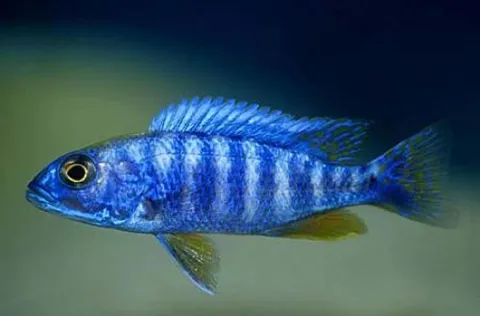
Sciaenochromis fryeri
The Electric Blue Hap, known scientifically as Sciaenochromis fryeri, belongs to the Cichlidae family. This is an energetic and brightly colored fish, however, its temperament can be quite complex. For this reason, it…
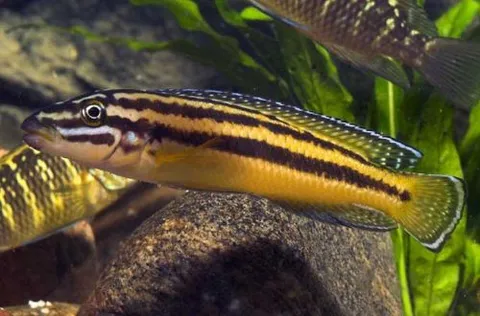
Julidochromis regani
Julidochromis regani, with the scientific name Julidochromis regani, belongs to the family Cichlidae. This cichlid is quite popular among aquarists. Like many members of its family, it can show aggression towards…
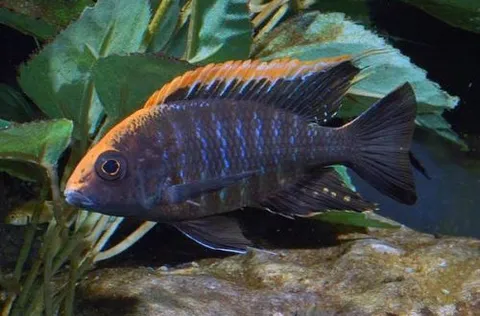
Aulonocara maylandi
Aulonocara maylandi, known as Mayland's Aulonocara, is a representative of the Cichlidae family, typical of Malawian cichlids. This species is relatively easy to keep and breed, demonstrating good compatibility with…
Lamprologus ocellatus
Lamprologus ocellatus, known as the Lamprologus ocellatus, belongs to the Cichlidae family. This fish is a miniature and vibrant creature, distinguished by its ease of care and successful breeding. With sufficient…