Temperature22 – 27 °C
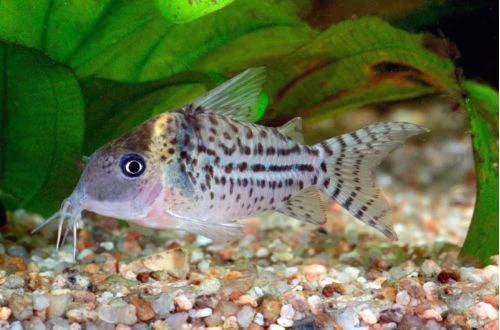
Agassiz's Corydoras, also known as the Spotted Cory (scientific name Corydoras agassizii), belongs to the family Callichthyidae. This catfish was named in honor of the distinguished researcher and naturalist Jean Louis Rodolphe Agassiz. The natural habitat of this species extends throughout the Solimões River basin, covering the upper regions of the Amazon in modern-day Brazil and Peru. More detailed information regarding the exact distribution range of this species is currently unavailable. It prefers to inhabit small tributaries of the large river, as well as streams, backwaters, and small lakes that form during the flooding of forest areas.
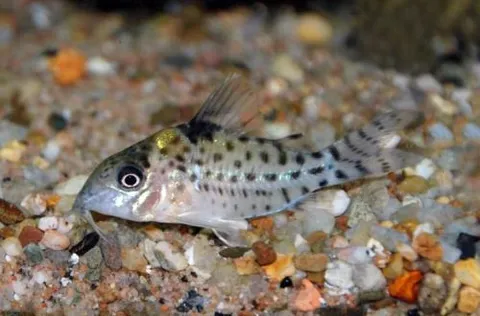
Adult fish of this species typically reach a length of about 7 cm. Their body coloration is grayish-pink, with numerous dark spots scattered across the body, as well as on the fins and tail. Additionally, distinct dark stripe-like markings can be observed on the dorsal fin, at its base on the body, and on the head. Sexual dimorphism in these catfishes is quite subtle: males are practically indistinguishable from females. The latter can be identified closer to the spawning period when females become larger.
Agassiz's Corydoras inhabits the Amazon River basin, primarily in the border regions of Brazil and Peru. In nature, this species occupies areas with slow currents, rich in organic matter, where the water often has a brownish tint due to high tannin content. The fish prefer places with soft sandy or silty substrate, abundant aquatic vegetation, and fallen leaves, which serve as cover.
This is a peaceful schooling fish, most active in the bottom layers of the water. For their comfort and well-being, it is recommended to keep a group of 5 or more individuals, which promotes natural social behavior. Agassiz's Corydoras coexists well with other non-aggressive fish species that occupy the middle and upper layers of the aquarium, such as small characins or rasboras.
For keeping a school, an aquarium of at least 80 L is required. An important condition is the use of a soft substrate, such as fine sand, to avoid damaging the fish's delicate barbels. The decor should include live plants and various shelters that create shaded areas. Water parameters: temperature 22–27 °C, pH 6.0–8.0, hardness 2–12 dGH. Regular water changes and effective filtration with moderate current are necessary.
The species is omnivorous. In the aquarium, fish readily accept high-quality dry foods in the form of sinking tablets or granules. The diet should be supplemented with frozen or live foods, such as artemia, bloodworms, or daphnia. It is important to ensure that the food reaches the bottom, as the fish feed exclusively in the bottom layer.
Breeding is possible in aquarium conditions. Spawning is stimulated by imitating the rainy season, achieved through frequent cool water changes. The female lays eggs, holding them between her pelvic fins, where the male fertilizes them. Then the female transfers the eggs to a chosen substrate, such as broad plant leaves or the aquarium glass. This process is repeated until about 100 eggs are laid.
Agassiz's Corydoras, like other members of the genus, is highly sensitive to water quality and substrate condition. The main cause of diseases is non-compliance with environmental parameters, which leads to damage or erosion of the barbels, through which secondary infections can enter the body. For prevention, it is necessary to use a soft, fine-grained substrate without sharp edges and maintain cleanliness in the bottom layer. Fish are susceptible to typical aquarium fish diseases when keeping conditions are violated, including skin and gill lesions from parasites or fungal infections. High-quality filtration and regular water changes are the main methods of disease prevention. If signs of illness appear, such as apathy, discoloration, or fin damage, the ammonia and nitrite levels should be checked, and the chemical composition of the water should be stabilized.
When selecting individuals in a store, attention should be paid to the activity of the fish and the cleanliness of their skin. Healthy corydoras should be active, without visible damage, ulcers, or white film on the body. Special attention should be paid to the condition of the barbels: they should be intact, without signs of erosion or shortening, which often indicates poor water quality in the aquarium.
The essentials: size, tank volume, water parameters and care
An adult reaches 6–7 cm in length. Plan the tank around the maximum size: the fish quickly outgrows a cramped setup.
The recommended volume is 80 L. A smaller tank speeds up nitrate build-up and raises stress levels.
Temperature 22–27 °C, pH 6–8, hardness 2–12 dGH. Stability matters more than exact values: sudden swings are harder on the fish than a small deviation from the ideal.
Around 8 years when kept properly. Lifespan depends directly on tank volume, water quality and a varied diet.
Temperament: peaceful (regular). Keep this in mind when choosing tank mates.
Recommended setup: small group (5–6 individuals). Ignoring this is a common cause of stress and disease.
Diet type: sinking (any). Feed small portions that are finished within a couple of minutes — overfeeding does more harm than underfeeding.
The scientific name of the species is Corydoras agassizii, family Armored Catfish (Callichthyidae).
The water suits 197 of 208 plants in the catalogue — the easiest ones are shown first.
Afzelius's AnubiasAnacharisAnubiasBrazilian PennywortDwarf CloverDwarf CloverDwarf HygrophilaDwarf SagittariaDwarf ValGuppy GrassHornwortJava FernJava MossMoneywortMud SwordNair's LagenandraNarrow Leaf AnacharisNarrow-leaf CloverStringy MossSüsswassertangTaiwan MossTape GrassTemple PlantUssuri Watermilfoil
Matched by family, categories and overlapping keeping conditions
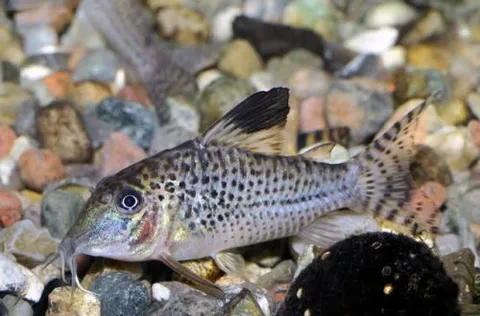
Corydoras acutus
Corydoras acutus, also known as the Black-spotted Corydoras, belongs to the family Callichthyidae (Armored Catfishes) and bears the scientific name Corydoras acutus. Both of its names accurately reflect its…
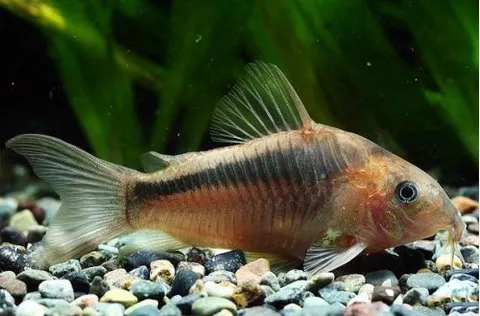
Corydoras zygatus
Corydoras zygatus, also known as the zygatus cory catfish (scientific name Corydoras zygatus), belongs to the armored catfish family Callichthyidae. The species name is derived from the Greek word ζυγόν (zugón), meaning…
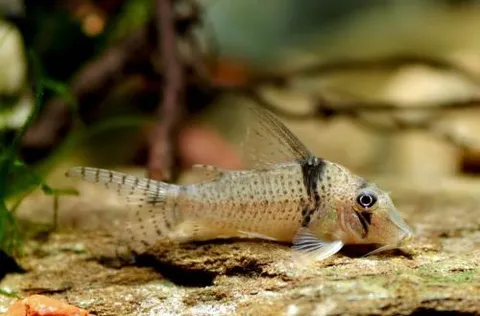
Corydoras pastazensis
The Pastaza Corydoras, also known as the Pastaza Cory catfish, bears the scientific name Corydoras pastazensis and belongs to the family Callichthyidae (Armored or Callichthid catfishes). This fish was named after the…
Corydoras ambiacus
The scientific name Corydoras ambiacus is applied to the Corydoras ambiacus catfish, or Cory Ambiacus catfish, which belongs to the family Callichthyidae (Armored or Callichthyid Catfish). Its homeland is South America,…