Temperature21 – 27 °C
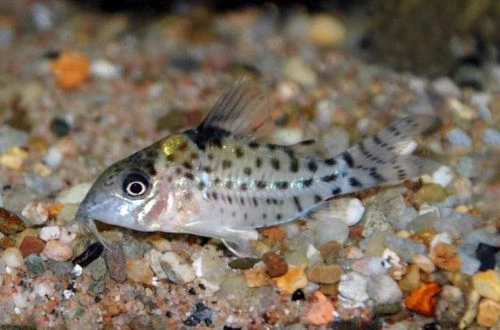
The scientific name Corydoras ambiacus is applied to the Corydoras ambiacus catfish, or Cory Ambiacus catfish, which belongs to the family Callichthyidae (Armored or Callichthyid Catfish). Its homeland is South America, specifically the northeastern regions of Peru, where its extensive natural habitat is located. This species was named in honor of the area of its first discovery — the Ampiyacu River basin. In the local dialect, this sounds like Ambiaca. The Ampiyacu River is one of the many tributaries feeding the upper Amazon River.
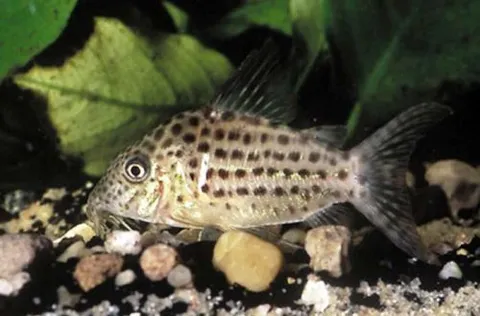
The body pattern of these fish consists of numerous dark speckles on a silvery background, with adults reaching a length of about 6 cm. The base of the dorsal fin is marked with a large black spot, preceded by a golden stripe. Most fins are also adorned with a spotted pattern, with the exception of the ventral and pelvic fins, which are uniformly bluish-white. Interestingly, due to its characteristic spotted pattern, this species is often confused with other similar Corydoras catfish, such as the Black-and-white Corydoras, Agassiz's Corydoras, or the Spotted Corydoras.
The species inhabits the upper Amazon basin, including the tributaries of the Ampiyacu, Yavari, Napo, Nanay rivers, and the lower Ucayali River. It is found in Brazil, Peru, Colombia, and Ecuador. It inhabits freshwater bodies with soft to moderately hard water, preferring areas with slow currents and silty or sandy bottoms.
A peaceful schooling fish, active mainly at dusk and night. In an aquarium, it is recommended to keep a group of 4–6 individuals or more, which helps reduce stress and promotes natural behavior. It is compatible with most non-aggressive fish species, but due to its bottom-dwelling lifestyle, it may compete for space with other bottom dwellers.
The catfish is unpretentious and easily adapts to various conditions, making it an excellent choice for beginner aquarists. Keeping Corydoras ambiacus does not require recreating any specific environment; it can be introduced into almost any freshwater aquarium, the main thing is to ensure proper acclimatization. This species is distinguished by its peaceful nature, so it gets along well with many non-aggressive fish of comparable size. The keeping rules are quite simple and common for most aquarium species. It is important to prevent the accumulation of organic waste, such as food remnants or excrement, as they can disrupt the stability of the nitrogen cycle. It is necessary to maintain the temperature, as well as pH and dGH values, within the permissible range. Regular aquarium maintenance includes equipment prophylaxis, partial water changes with fresh water, and cleaning the substrate and decor elements from plaque and debris. As for feeding, these catfish readily accept almost all commercially available foods. The only condition is that the food must be sinking, as Corydoras ambiacus is a bottom dweller.
An omnivorous species, in nature it feeds on small invertebrates, insect larvae, crustaceans, and organic detritus. In the aquarium, it accepts all types of sinking foods: high-quality dry granules, catfish tablets, as well as frozen or live foods such as bloodworms or brine shrimp. One should not rely solely on leftover food from other fish, as this does not provide a complete diet.
Breeding is typical for representatives of the genus. Spawning is paired or communal, stimulated by water changes with softer and cooler water, which mimics the rainy season. Eggs are laid on the substrate, plant leaves, or aquarium glass. Parents do not show parental care and may eat the eggs, so it is recommended to remove the adults after spawning.
The species is sensitive to water quality and substrate cleanliness. When kept on a coarse or sharp substrate, damage to the delicate barbels is possible, leading to the development of bacterial infections. Like other scaleless fish, it is extremely sensitive to salt content in the water and certain medications containing copper or malachite green in high concentrations.
When purchasing, active fish with clean integuments without visible spots, ulcers, or signs of emaciation should be chosen. It is important to ensure the integrity of the barbels — their absence or damage indicates poor keeping conditions. Healthy individuals should show interest in foraging for food at the bottom and not have sunken bellies.
The essentials: size, tank volume, water parameters and care
An adult reaches 6 cm in length. Plan the tank around the maximum size: the fish quickly outgrows a cramped setup.
The recommended volume is 80 L. A smaller tank speeds up nitrate build-up and raises stress levels.
Temperature 21–27 °C, pH 6–8, hardness 2–12 dGH. Stability matters more than exact values: sudden swings are harder on the fish than a small deviation from the ideal.
Around 5 years when kept properly. Lifespan depends directly on tank volume, water quality and a varied diet.
Temperament: peaceful (regular). Keep this in mind when choosing tank mates.
Recommended setup: small group (5–6 individuals). Ignoring this is a common cause of stress and disease.
Diet type: sinking (any). Feed small portions that are finished within a couple of minutes — overfeeding does more harm than underfeeding.
The scientific name of the species is Corydoras ambiacus, family Armored Catfish (Callichthyidae). It also appears in the literature as: Corydoras grafi, Corydoras longirostris, Corydoras melanistius.
The water suits 197 of 208 plants in the catalogue — the easiest ones are shown first.
Afzelius's AnubiasAnacharisAnubiasBrazilian PennywortDwarf CloverDwarf CloverDwarf HygrophilaDwarf SagittariaDwarf ValGuppy GrassHornwortJava FernJava MossMoneywortMud SwordNair's LagenandraNarrow Leaf AnacharisNarrow-leaf CloverStringy MossSüsswassertangTaiwan MossTape GrassTemple PlantUssuri Watermilfoil
Matched by family, categories and overlapping keeping conditions
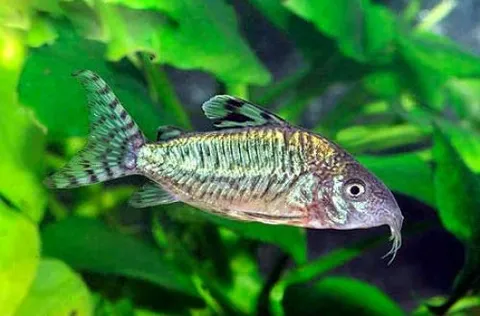
Corydoras geryi
The Bolivian Corydoras, scientifically known as Corydoras geryi, belongs to the family Callichthyidae (Armored Catfishes). This fish originates from South America, with its natural habitat concentrated in the Mamoré…
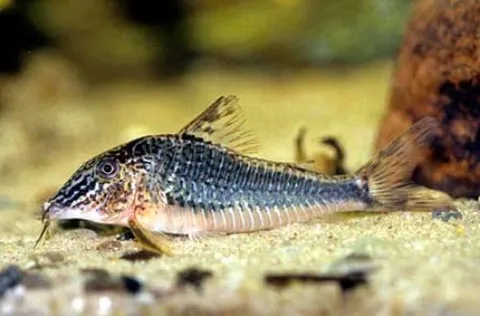
Corydoras semiaquilus
Corydoras semiaquilus, also known as the Black Peruvian Cory, bears the scientific name Corydoras semiaquilus and is a member of the Callichthyidae family, which unites armored catfish. These catfish originate from…
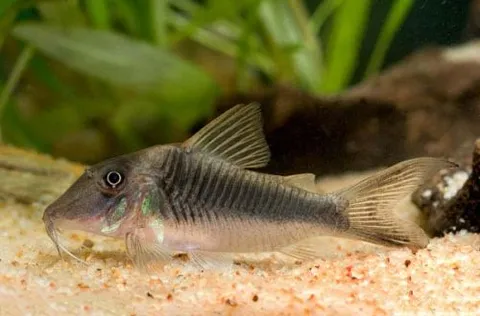
Corydoras treitlii
Corydoras treitlii, scientifically known as Corydoras treitlii, is a representative of the Callichthyidae family, also known as Armored Catfishes. This fish comes from the coastal drainages of north-eastern Brazil, in…
Corydoras maculifer
The scientific name of this catfish is Corydoras maculifer, also known as Maculifer Corydoras or Dotted Corydoras, and it belongs to the family Callichthyidae (Armored Catfish). This species was discovered relatively…